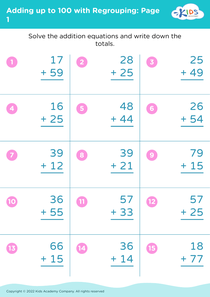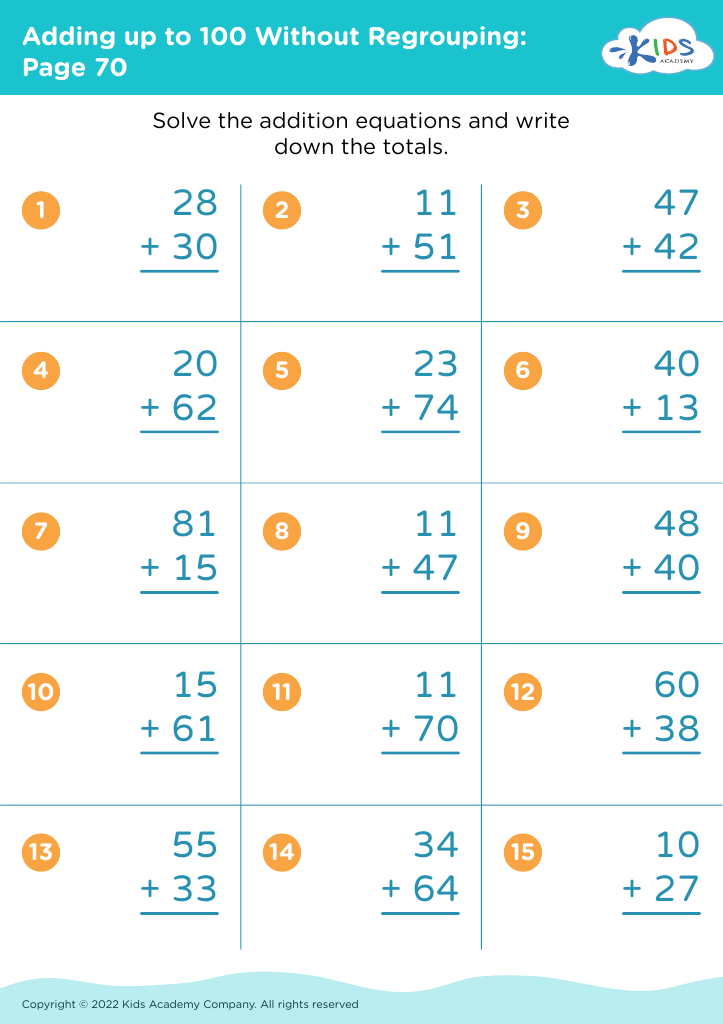





Parents and teachers should prioritize helping young learners understand Addition up to 100 Without Regrouping because it lays a critical foundation for their mathematical skills. At ages 4-7, children are developing their cognitive abilities and learning how to manipulate numbers. Mastering simple addition enhances their number sense, boosts confidence, and reduces anxiety related to math.
This skill aids in connecting basic arithmetic to real-life situations, fostering problem-solving and critical thinking. When children grasp how to add numbers without regrouping, they develop a mental framework for more complex mathematical operations they'll encounter later, such as subtraction and multiplication.
Additionally, fluency in addition strengthens their ability to work with larger numbers and different mathematical concepts in future grades. Engaging learners in fun activities or games that revolve around adding to 100 builds enthusiasm and positive attitudes toward math, encouraging lifelong learning and curiosity.
Investing time and resources into teaching this skill not only accelerates academic growth but also prepares children for future educational challenges. By creating a supportive and enriching learning environment, parents and teachers can instill a love for mathematics and unlock the potential for success in various areas of their children's lives.