
Sequencing numbers Numbers Worksheets for Ages 4-8
3 filtered results
Difficulty Level
Grade
Age
-
From - To
Subject
Activity
Standards
Looking to enhance your child's number sequencing skills? Our Sequencing Numbers Worksheets for Ages 4-8 offer engaging and educational activities designed to help young learners grasp number order concepts easily. With colorful exercises and fun puzzles, children practice arranging numbers in the correct sequence, improving their counting abilities and numerical understanding. Perfect for both classroom and home use, these worksheets cater to different learning styles and keep kids motivated. Start building a strong mathematical foundation today with our Sequencing Numbers Worksheets, and watch your child's confidence and skills soar! Suitable for ages 4-8.
Favorites
With answer key
Interactive
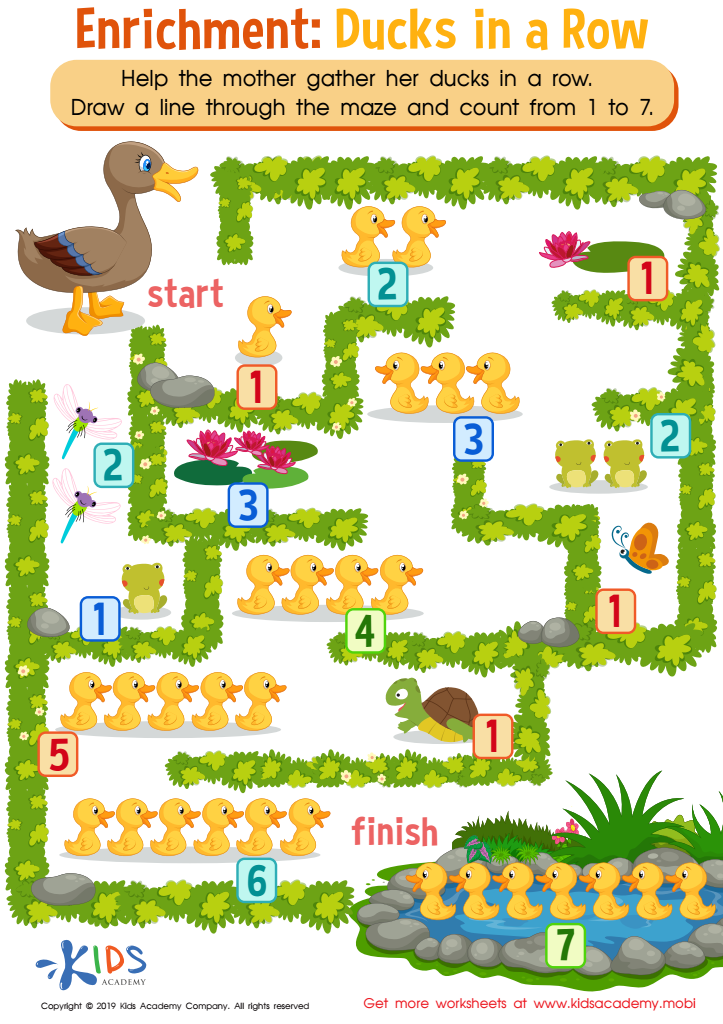
Ducks in a Row Worksheet
Are you looking for a fun and free math enrichment activity for your young one? Get Sweet Mama Duck and her ducks to the pond by helping your child navigate through this colorful maze! They'll use their fine motor skills and hone their number sense as they count ducks, turtles and frogs. Plus, they'll learn one-to-one representation. A great educational way to have fun!
 Assign to My Students
Ducks in a Row Worksheet
Worksheet
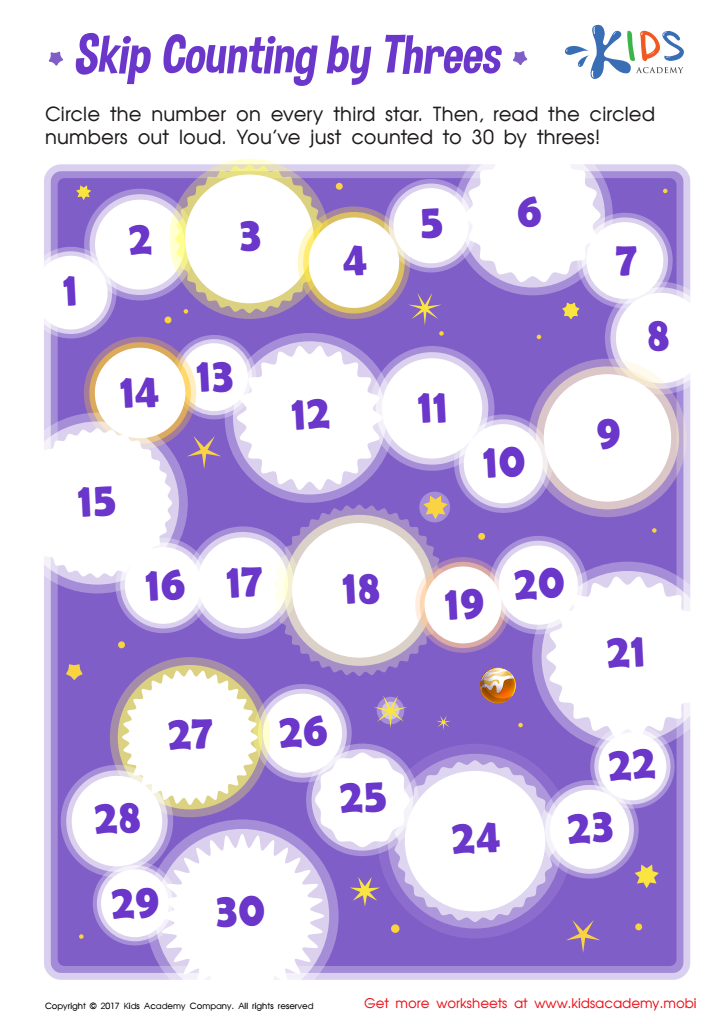
Skip Counting By Three Printable
Inspire your child with this star-themed skip counting worksheet! It offers a fun way to learn while providing a foundation for more advanced math skills, like adding, subtracting, and multiplication. It will help your child gain a sense of numeracy, practice problem solving, and stay ahead in math.
Skip Counting By Three Printable
Worksheet
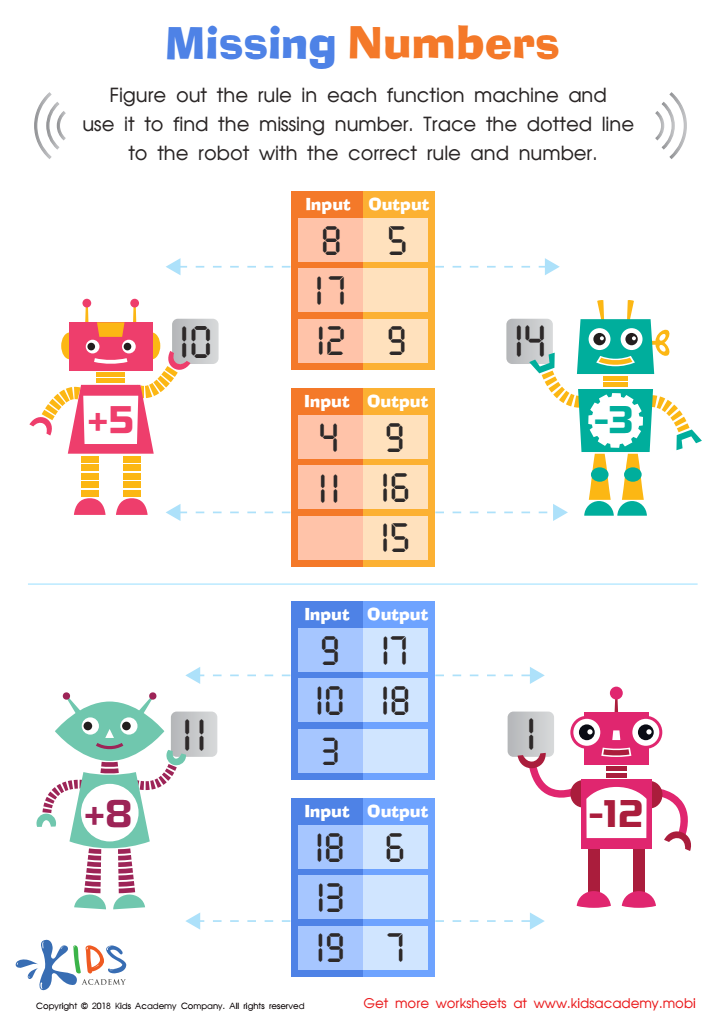
Missing Numbers Worksheet
Elementary students can learn the important pre-algebra skill of solving for missing numbers! Our robots guide them along with number-filled bellies and missing answers in their hands. Kids can examine the other numbers in each graph, use the rule to solve the missing number, and check their work with the missing number to ensure correctness.
Missing Numbers Worksheet
Worksheet
Join Kids Academy for Free
Who is primarily going to use this learning content?








Sequencing numbers is a fundamental skill for children aged 4-8 because it lays the groundwork for essential mathematical concepts and cognitive development. Understanding sequential order helps children grasp the relationship between numbers, which is crucial for basic arithmetic operations like addition, subtraction, and beyond. It also aids in recognizing patterns, an important aspect of problem-solving and logical thinking.
For parents and teachers, sequencing is not just about memorizing numbers; it’s about fostering a deeper comprehension that will support future learning. For instance, being able to put numbers in order helps children understand the flow of time (days of the week, months of the year) and follow instructions more effectively. It enhances their ability to predict outcomes and understand patterns in everyday life.
Additionally, sequencing is linked to literacy skills. Just as letters form words in a specific order, numbers follow a logical sequence. This parallel strengthens a child's overall ability to organize information systematically.
Neglecting this developmental milestone can lead to future struggles in mathematics and other sequential activities. Supporting children in number sequencing through engaging activities and consistent practice can lead to academic success and instill confidence in their cognitive abilities, making it a crucial aspect of early childhood education.








