
Map reading skills Our Planet and Environment Worksheets for Ages 4-8
1 filtered results
Difficulty Level
Grade
Age
-
From - To
Subject
Activity
Standards
Explore the fascinating world of map reading with our engaging "Our Planet and Environment Worksheets" designed for ages 4-8. These colorful and interactive worksheets help young learners develop essential map reading skills, such as understanding symbols, finding directions, and identifying landmarks. Created by Kids Academy, these educational resources make geography fun and accessible, encouraging curiosity about the world. Perfect for budding explorers, the worksheets promote critical thinking, spatial awareness, and environmental awareness. Empower your child to navigate their way through learning and discovery with our expertly crafted map reading activities. Let's nurture the next generation of skilled map readers!
Favorites
With answer key
Interactive
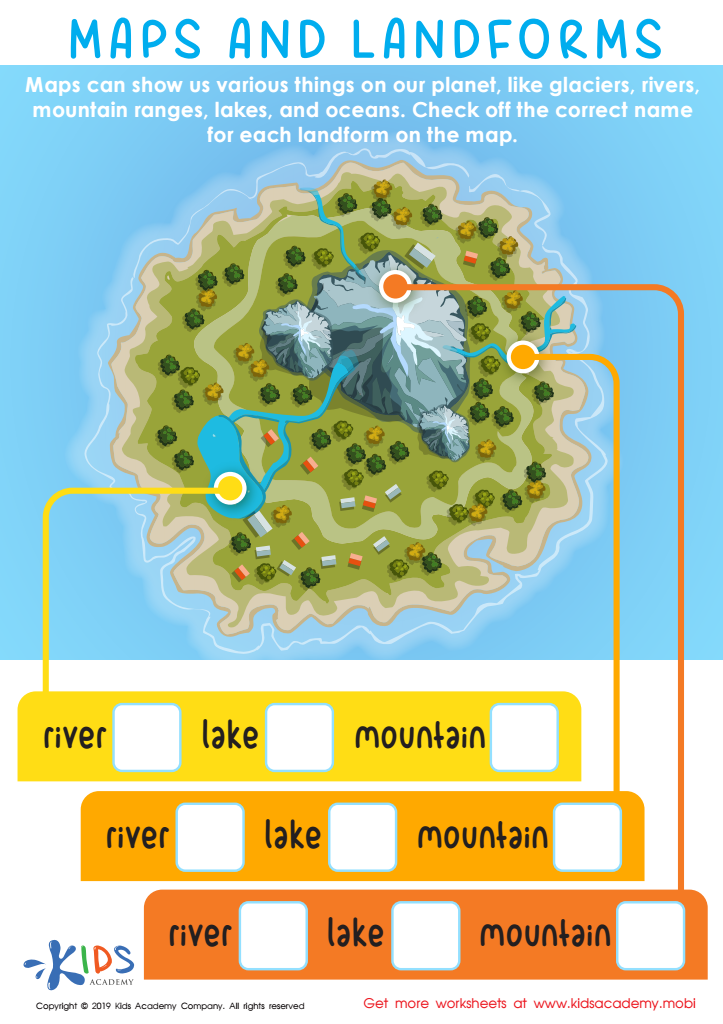
Maps and Landforms Worksheet
We can educate our kids on the world and its landforms by showing them a map. Point out mountains, rivers, and oceans, and help them identify each correctly. With this knowledge, they will better understand our planet.
 Assign to My Students
Maps and Landforms Worksheet
Worksheet
Join Kids Academy for Free
Who is primarily going to use this learning content?





Map reading skills are essential for children ages 4-8 as they lay the foundation for a deeper understanding of our planet and environment. At this tender age, children are naturally curious and absorb information rapidly. Introducing them to maps helps them develop spatial awareness and critical thinking skills. They begin to understand concepts such as direction, distance, and scale, which are fundamental for navigating their surroundings and for later learning in areas such as geography, science, and even mathematics.
Understanding maps also enhances a child’s global awareness. It instills an early appreciation for diverse places, people, and cultures, fostering empathy and respect for others. By learning to read maps that depict various terrains, climates, and ecosystems, children become more aware of the environment and the importance of conservation. This awareness can inspire responsible behavior toward natural resources and heighten their understanding of issues such as climate change and pollution.
Teachers and parents play a crucial role in guiding children through this learning process. By incorporating map reading into fun and engaging activities, they can help children realize how their local actions impact the global environment. Ultimately, map reading is a key component of education that empowers children to navigate their world intelligently, thoughtfully, and sustainably.







