
Comparing shapes Math Worksheets for Ages 4-9
6 filtered results
Difficulty Level
Grade
Age
-
From - To
Subject
Activity
Standards
Kickstart your child's geometry journey with our "Comparing Shapes Math Worksheets for Ages 4-9". These engaging printable activities are designed to help young learners identify, compare, and contrast different shapes while developing critical thinking skills. Our expertly crafted worksheets feature colorful illustrations, interactive tasks, and age-appropriate challenges to make learning both fun and rewarding. Whether your child is just starting with basic shapes or advancing to more complex comparisons, these worksheets will provide the perfect foundation. Empower your child with essential math skills and build their confidence in geometry with Kids Academy's top-quality resources.
Favorites
With answer key
Interactive
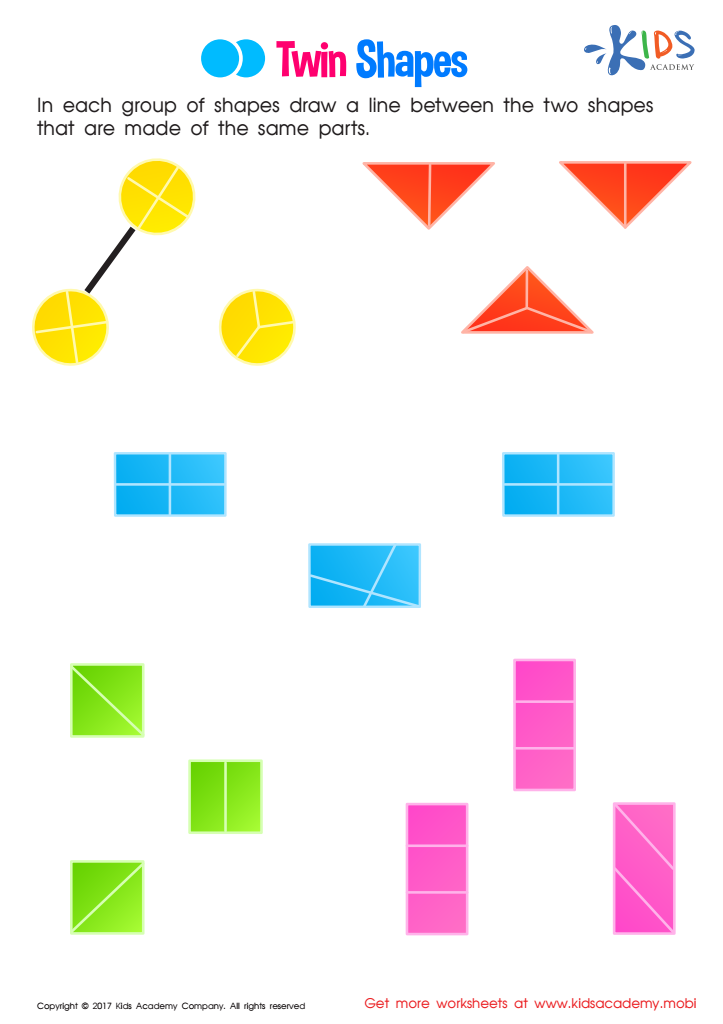
Twin Shapes Worksheet
Your students' goal in this worksheet is to find the twin shapes: drawing a line between two shapes made of the same parts. Likely, the first shapes encountered were circles, triangles, rectangles and squares - examples of which are seen frequently in everyday life. Encourage them to apply what they know and work out which is the twin shape!
 Assign to My Students
Twin Shapes Worksheet
Worksheet
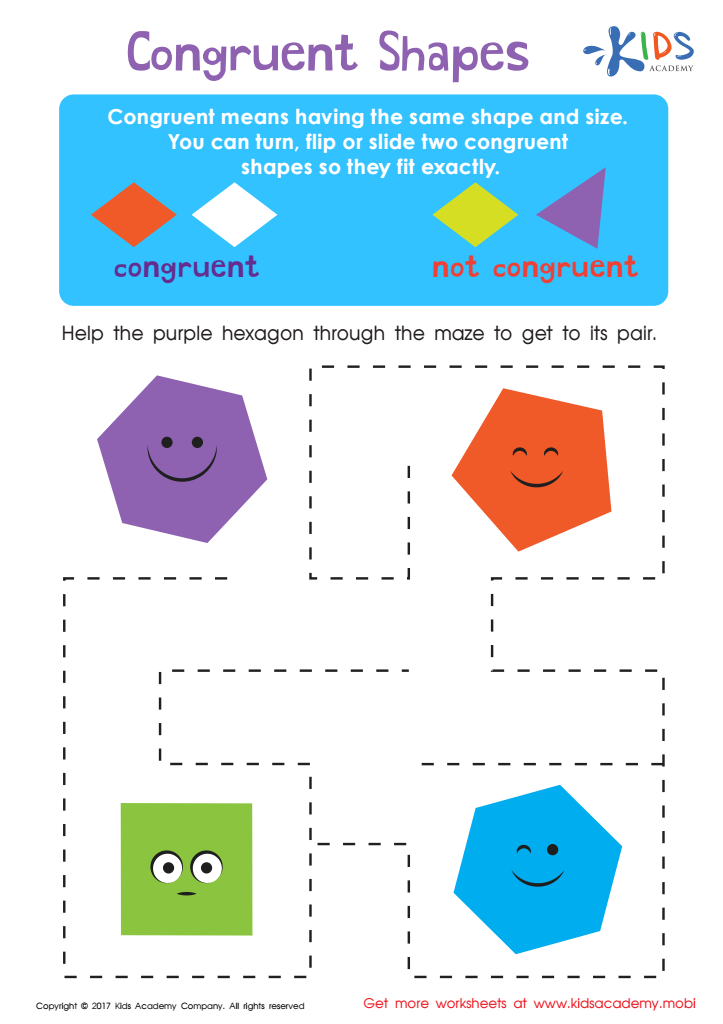
Congruent Shapes Worksheet
Help your child find the twin of the purple hexagon! This congruent shapes worksheet is great for increasing vocabulary while challenging mental rotation skills.
Congruent Shapes Worksheet
Worksheet
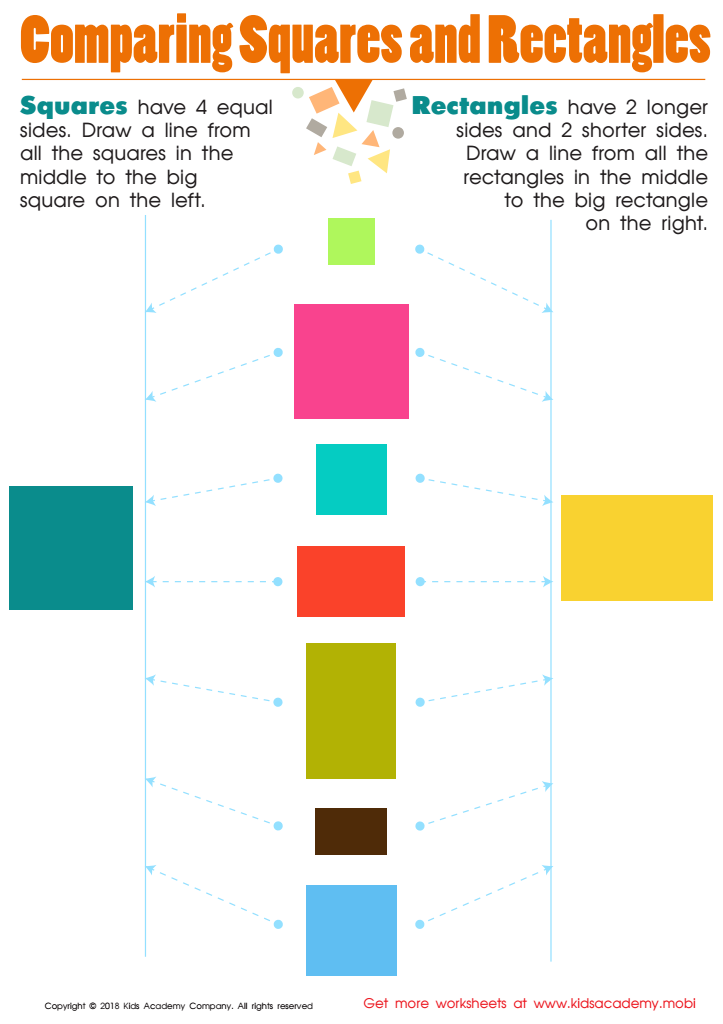
Comparing Squares Rectangles Worksheet
Help your little learner distinguish rectangles from squares with this fun geometry worksheet from Kids Academy! Read the definitions at the top, use the shapes on either side as a guide, then trace over the dotted line to match the rectangles and squares!
Comparing Squares Rectangles Worksheet
Worksheet
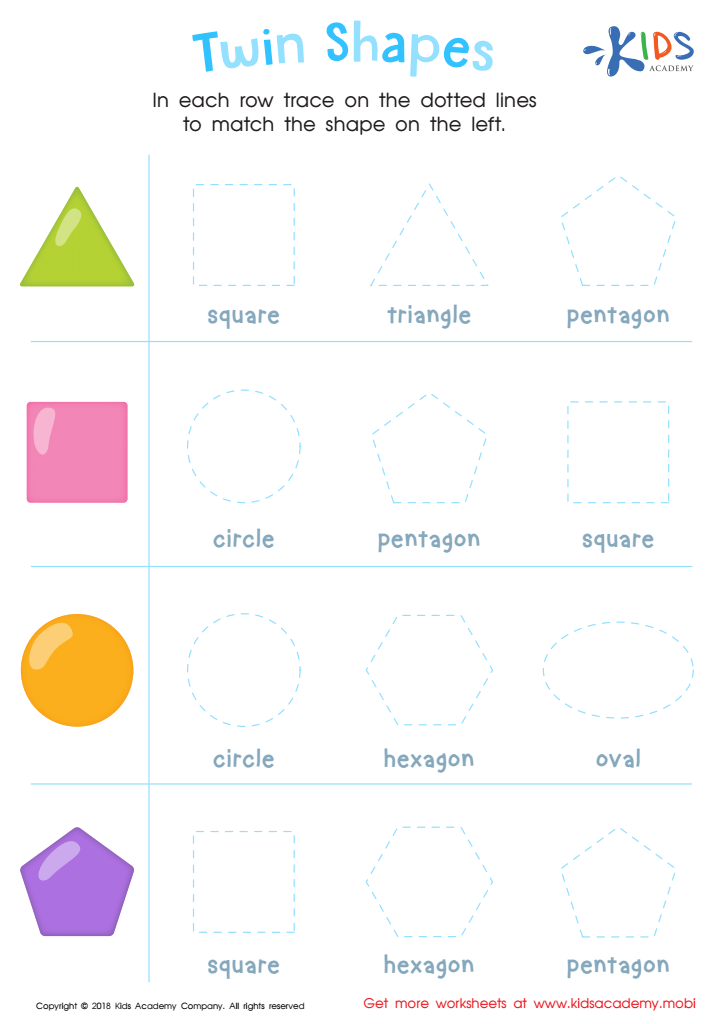
Twin Shapes Dot-to-Dot Worksheet
Test your child's ability to copy with this worksheet. Ask them to find and name the four shapes on the left. Then, they must match each with the dotted lines on the right. Help your child with all four shapes in this fun exercise.
Twin Shapes Dot-to-Dot Worksheet
Worksheet
Join Kids Academy for Free
Who is primarily going to use this learning content?








Comparing shapes in math for ages 4-9 is a vital educational activity because it lays the foundation for critical thinking, spatial awareness, and geometry skills, which are essential for more advanced math and everyday problem-solving. At this stage, young children are rapidly developing their cognitive abilities, and engaging them in comparing shapes helps strengthen their ability to observe, analyze, and categorize the world around them.
When children compare shapes, they learn to identify similarities and differences between various geometric figures, such as squares, circles, triangles, and rectangles. This practice enhances their vocabulary and builds a strong understanding of basic geometric properties, like the number of sides and corners. Additionally, comparing shapes fosters spatial reasoning skills, enabling children to grasp concepts of symmetry, balance, and proportion.
For parents and teachers, emphasizing shape comparison activities supports a holistic learning experience. These activities are often hands-on and interactive, making learning fun and more effective. By incorporating puzzles, building blocks, and drawing exercises, children can engage physically and visually with shapes.
Moreover, familiarity with shapes is foundational in numerous subjects beyond math, including art, science, and engineering. Children who develop strong shape recognition and comparison skills early on will be better prepared for future academic challenges. Therefore, parents and teachers should prioritize these activities to ensure children's well-rounded intellectual development.








