
Understanding equality Math Worksheets for Ages 4-9
7 filtered results
Difficulty Level
Grade
Age
-
From - To
Subject
Activity
Standards
Welcome to our Understanding Equality Math Worksheets for ages 4-9! Designed to instill foundational math skills, these engaging worksheets help young learners grasp the concept of equality through fun and interactive activities. They explore balancing equations, recognizing equal sides, and comparing quantities, fostering critical thinking and problem-solving abilities in early math. With colorful illustrations and age-appropriate exercises, children will enjoy practicing their understanding of equality while building confidence in their math skills. Perfect for classroom settings or home learning, our worksheets are here to support your child's mathematical journey. Start exploring these resources today and watch them flourish in math!
Favorites
With answer key
Interactive
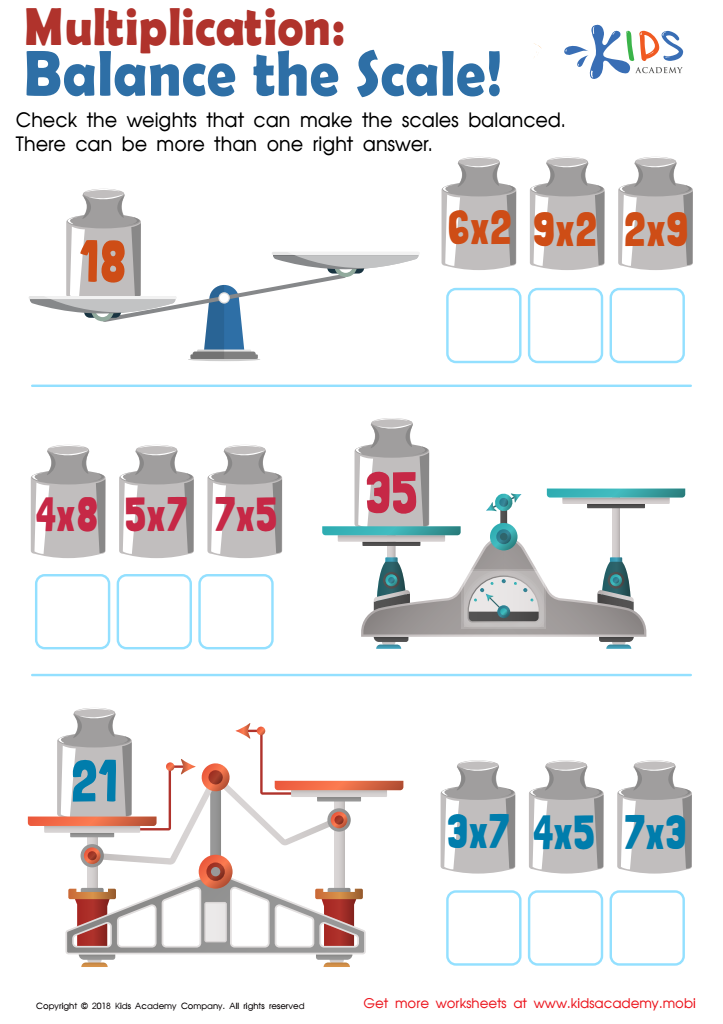
Balance the Scales Multiplication Worksheet
Challenge your child to practice math with our 'Balance the Scales' multiplication worksheet! Get them to solve each multiplication problem and select the weights that make them equal. Hint: it might be more than one!
 Assign to My Students
Balance the Scales Multiplication Worksheet
Worksheet
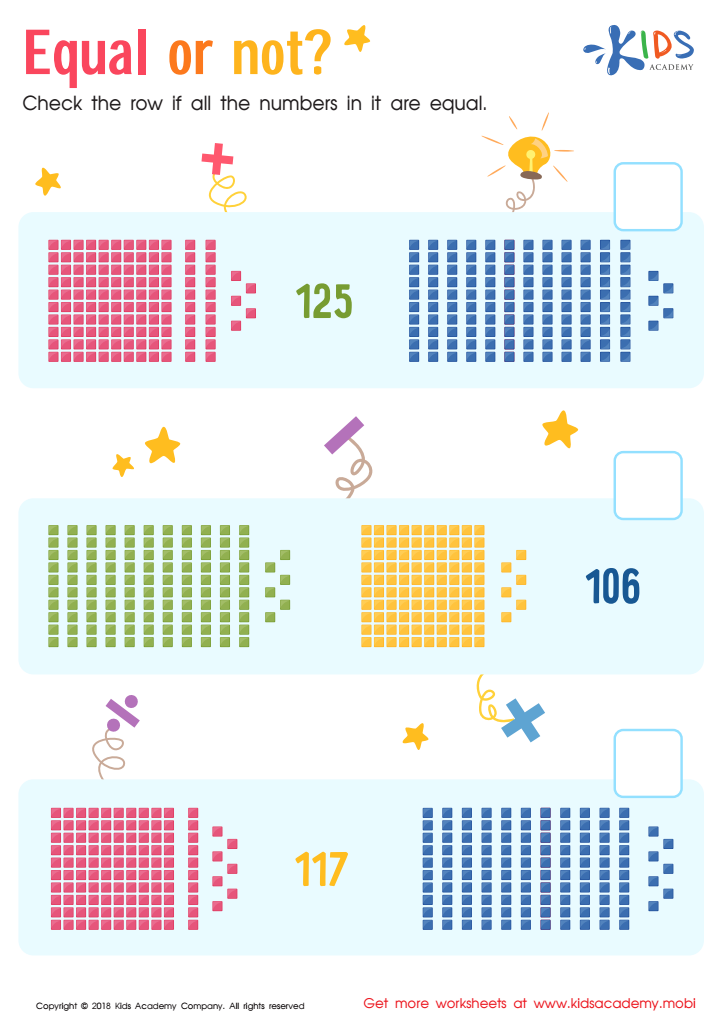
Equal or not Worksheet
To grow your child's learning, challenge them with new tasks. Stimulate their brains with activities that will build their knowledge and thinking skills. Take advantage of this worksheet exercise: ask your child to check the rows where all the numbers are equal. This simple exercise will improve their learning.
Equal or not Worksheet
Worksheet
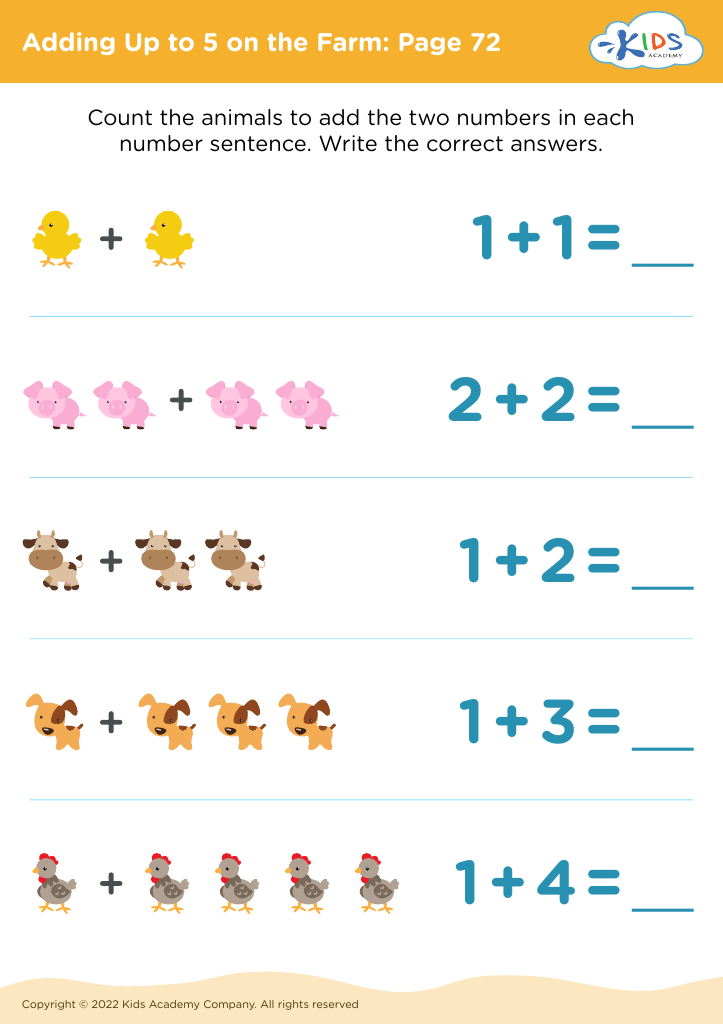
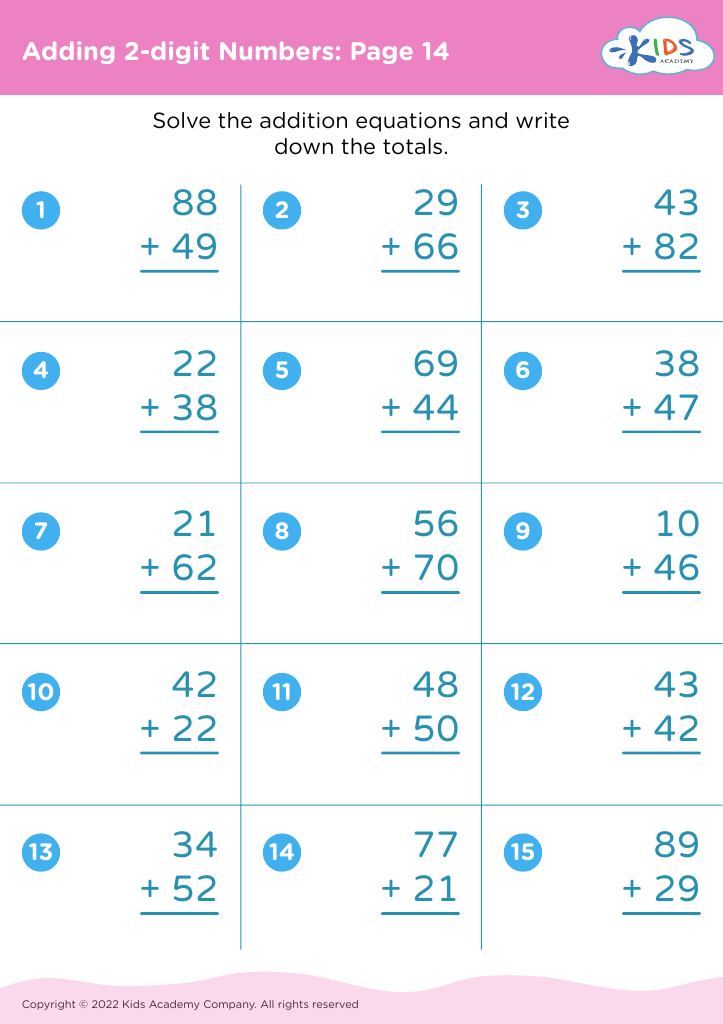
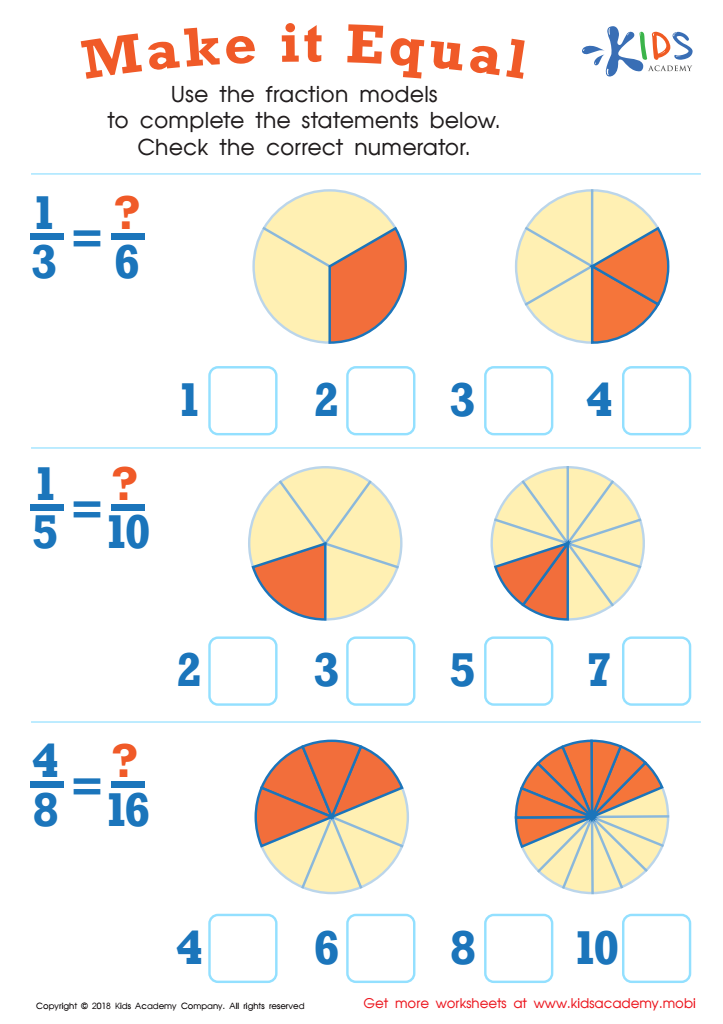
Make It Equal Worksheet
Ask your kids to complete the equations in the worksheet and find the correct numerator. Explain that numerators are the numbers at the top of a fraction and guide them as they count the shaded parts of the shapes. There are three equations to figure out.
Make It Equal Worksheet
Worksheet
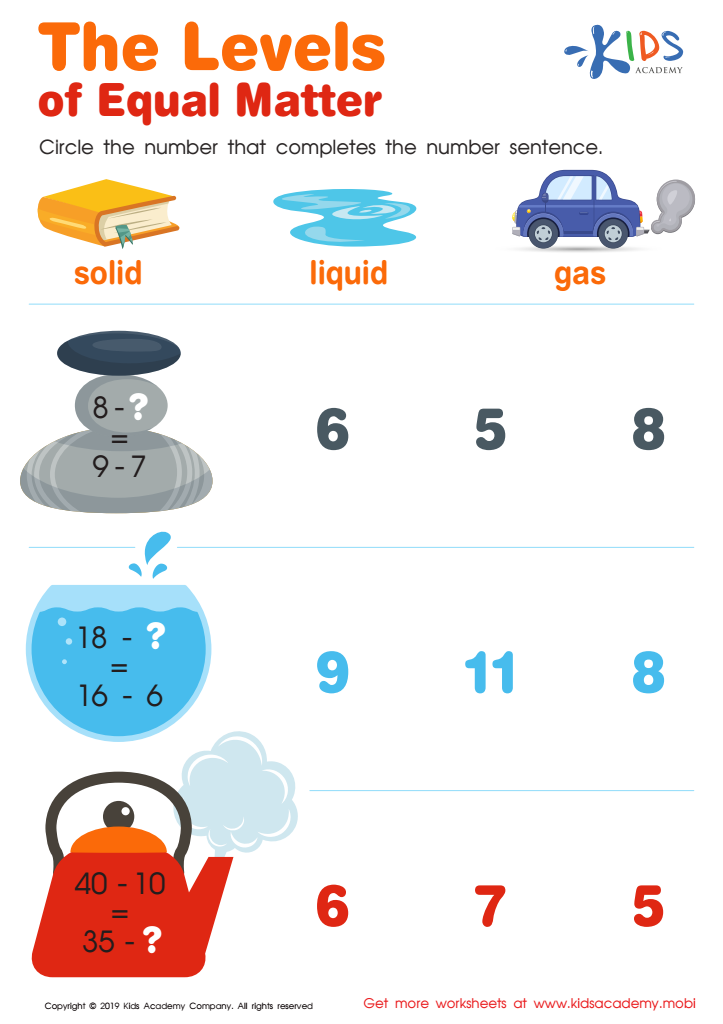
The Levels of Equal Matter Worksheet
Matter is anything that has weight and occupies space. Common examples include people, animals, objects and liquids. Have your kids understand this concept by looking at the levels of matter in this worksheet and completing the number sentence mathematical problems beneath.
The Levels of Equal Matter Worksheet
Worksheet
Join Kids Academy for Free
Who is primarily going to use this learning content?






Understanding equality in math is essential for children aged 4-9 as it lays the foundation for their overall mathematical development. At this stage, children begin to grapple with basic concepts of numbers, operations, and relationships. Introducing the concept of equality helps them grasp that both sides of an equation have the same value, fostering logical thinking and problem-solving skills.
When parents and teachers focus on teaching equality, they are reinforcing critical skills such as comparison, balance, and the understanding of numerical fairness. These skills are crucial for more advanced mathematical concepts, including addition, subtraction, and algebra, which they will encounter later in their academic journey.
Moreover, an understanding of equality fosters a sense of justice and fairness beyond math. It helps children develop social skills by encouraging them to share and collaborate, mirroring how one balances equations. Engaging children in discussions about equality can stimulate early 21st-century skills like critical thinking and reasoning.
Overall, prioritizing concepts of equality in math equips children with a toolkit for not only succeeding in mathematics but also for developing cognitive skills and social values that will benefit them throughout their lives.








