
Reading analog clocks Math Worksheets for Ages 5-7
8 filtered results
Difficulty Level
Grade
Age
-
From - To
Subject
Activity
Standards
Discover engaging Reading Analog Clocks Math Worksheets designed specifically for children ages 5-7. Our worksheets make learning to tell time fun and interactive, helping young learners grasp the fundamentals of reading hours and minutes on traditional analog clocks. With colorful designs and simple instructions, Kids Academy worksheets turn practice into a delightful experience. Perfect for both classroom and home use, our resources are tailored to build confidence and accuracy in young children. Start your child on the path to mastering time-telling skills today! Join Kids Academy and watch their confidence in reading analog clocks soar.
Favorites
With answer key
Interactive
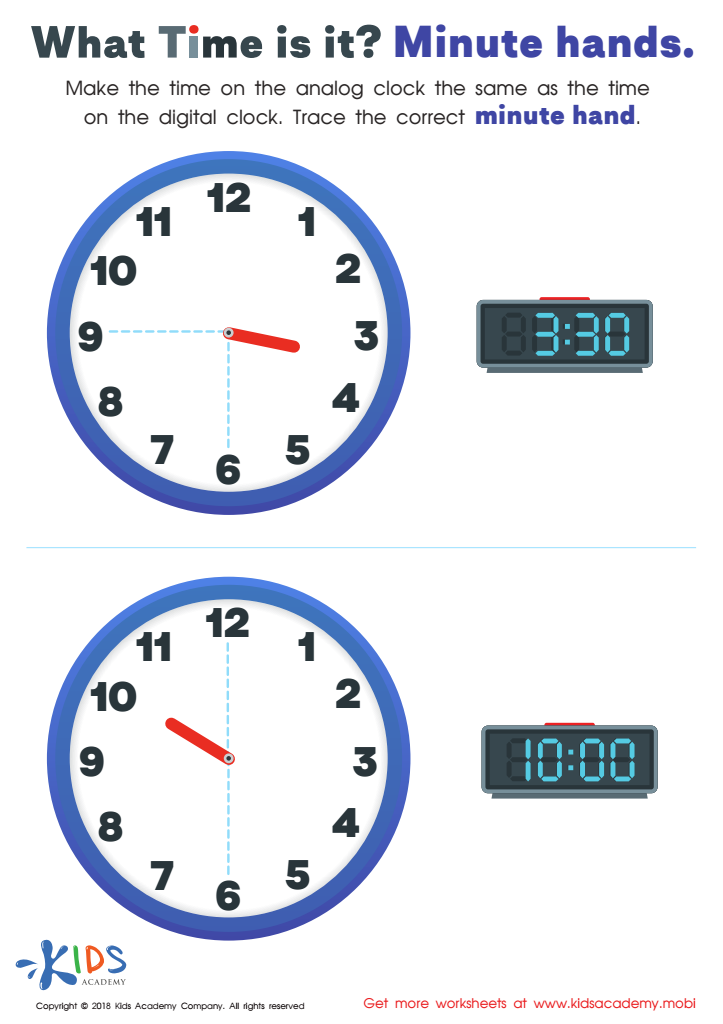
What Time Is it? Minute Hands Worksheet
Help your kids telling time with the minute hand correctly with this tracing sheet. Trace the correct minute hand to make the time on the analog clock the same as the time on the digital clock. Give them a pictured demonstration of how to do it and you'll be all set!
 Assign to My Students
What Time Is it? Minute Hands Worksheet
Worksheet
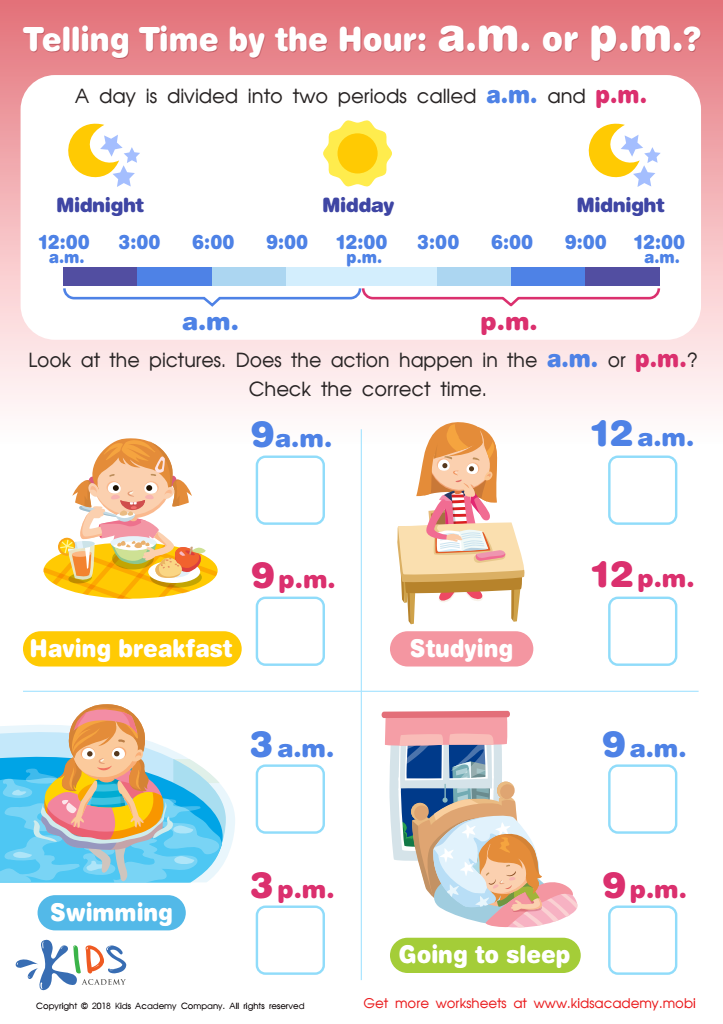
Tilling Time by the Hour: a.m. or p.m.? Worksheet
Can your child tell the time? This worksheet will help them learn. Explain a.m and p.m. and look at the pictures together. Ask your child if the activities happen in the a.m or p.m and help them check the correct time.
Tilling Time by the Hour: a.m. or p.m.? Worksheet
Worksheet
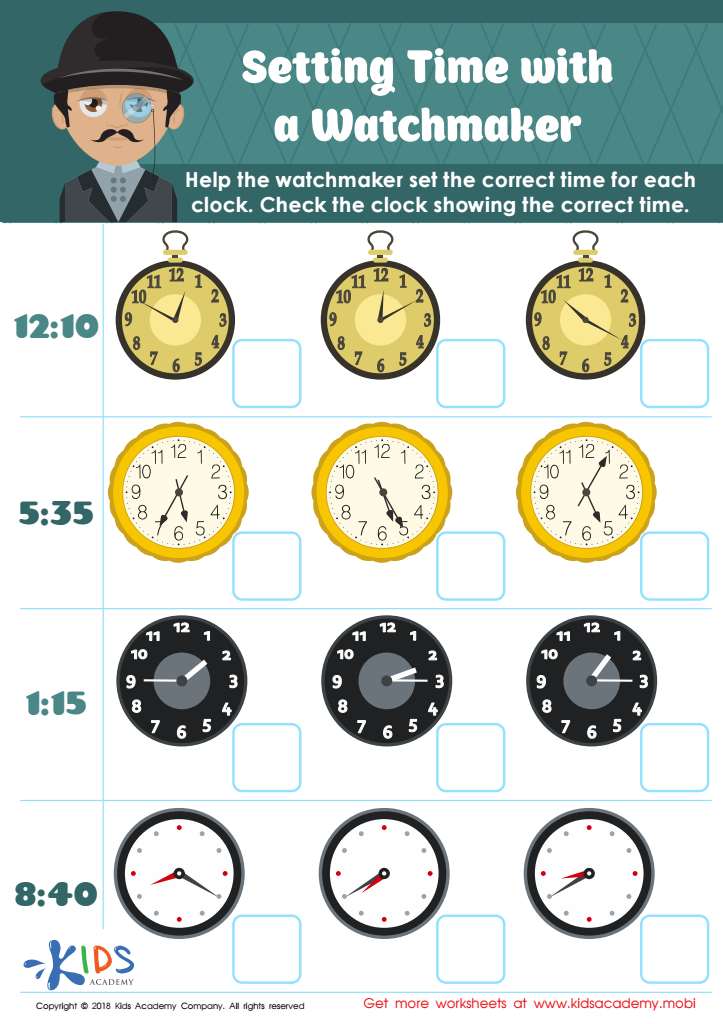
Setting Time with Watchmaker Worksheet
Can your kids tell the time? If so, this worksheet should be easy. Help them set the time for each clock: look at the time written on the left side and find the clock on the right side that matches.
Setting Time with Watchmaker Worksheet
Worksheet
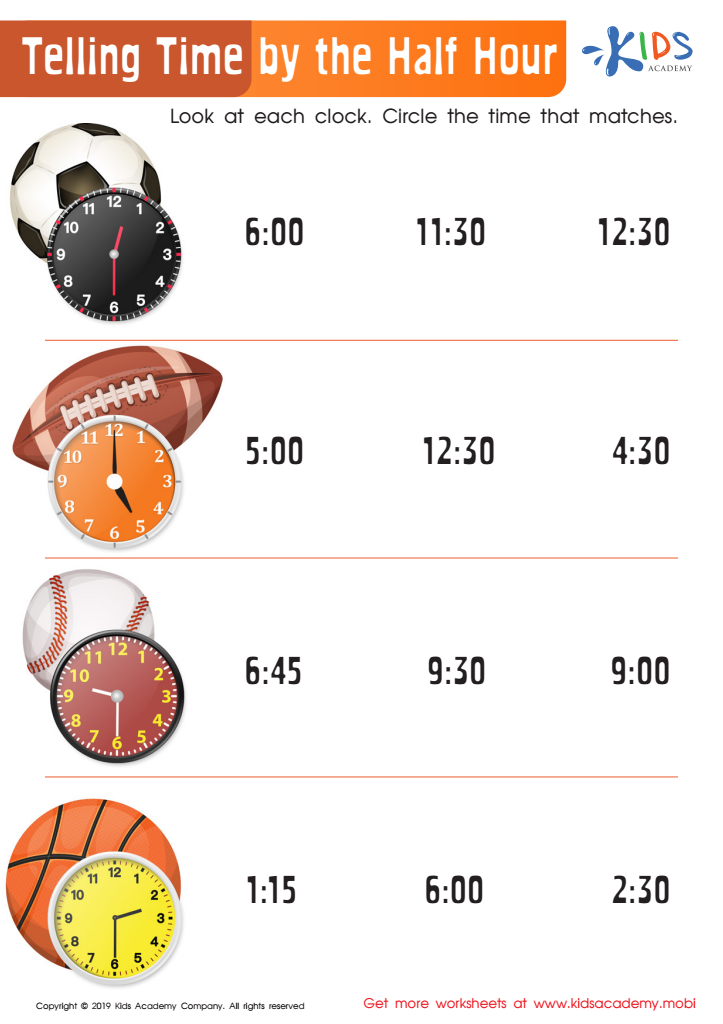
Telling Time by the Half Hour Worksheet
Teach kids to tell time with this worksheet! Four clocks are labeled with different times; help your child circle the right one. It's a great way to teach them to read analog and digital clocks, watches, and written times. Easy and fun learning!
Telling Time by the Half Hour Worksheet
Worksheet
Join Kids Academy for Free
Who is primarily going to use this learning content?







Reading analog clocks is an essential skill that parents and teachers should emphasize for children aged 5-7. Initial exposure to this task aids in the development of both mathematical and cognitive abilities that are crucial for early learners. Understanding how to read an analog clock instills a sense of time management and awareness from a young age. It introduces foundational math concepts such as counting by fives, recognizing numbers, and understanding sequences.
Moreover, reading an analog clock enhances a child's ability to decipher the relationship between hours, minutes, and seconds. It integrates visual-spatial skills as children learn to interpret the positioning of the clock hands relative to the numbers. This fosters a practical understanding of fractions and basic arithmetic, like addition and subtraction, as they calculate elapsed time or figure out how much time is left until the next activity.
Incorporating this skill into daily routines allows for continual practice, leading to greater familiarity and ease. By blending storytelling, hands-on practice, and interactive games, the learning process can be engaging and fun. Ultimately, mastering analog clocks equips children with useful, lifelong time-telling abilities and reinforces fundamental math concepts, setting the groundwork for more complex numerical applications in the future.








