
Understand number relationships Math Worksheets for Ages 5-7
3 filtered results
Difficulty Level
Grade
Age
-
From - To
Subject
Activity
Standards
Explore our "Understand Number Relationships" math worksheets designed specifically for children ages 5-7. These engaging resources help young learners grasp essential numerical concepts, from recognizing and comparing numbers to understanding basic addition and subtraction. Each worksheet encourages hands-on practice, aiding in the development of critical thinking and problem-solving skills in a fun and interactive way. Ideal for preschool and early elementary classrooms or at-home learning, our carefully curated activities are aligned with educational standards to foster a solid mathematical foundation. Download our worksheets today and empower your child to build their confidence and mastery in mathematics!
Favorites
With answer key
Interactive
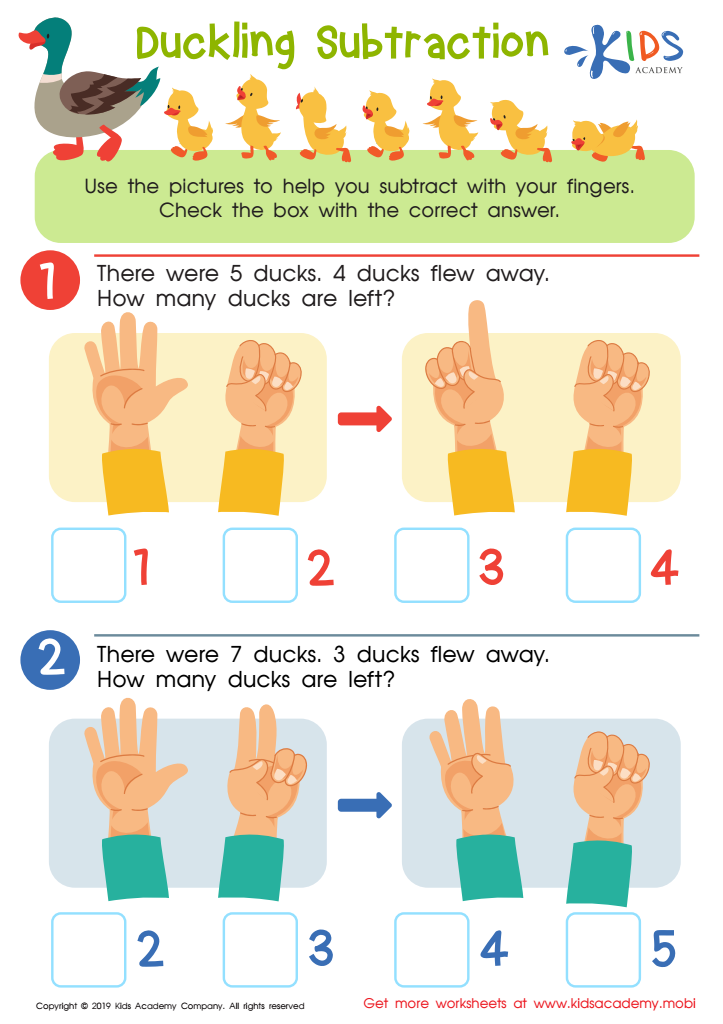
Duckling Subtraction Worksheet
Help your students learn equations and math with this fun worksheet. There are two questions to solve with the help of the pictures. Ask them to subtract with their fingers and check the box with the correct answer. This makes math easier and more enjoyable!
 Assign to My Students
Duckling Subtraction Worksheet
Worksheet
Join Kids Academy for Free
Who is primarily going to use this learning content?








Understanding number relationships is crucial for children aged 5-7 as it forms the foundation for all future math learning. At this age, students are beginning to grasp fundamental concepts such as addition, subtraction, and basic number operations. By recognizing how numbers relate to one another—such as greater than, less than, and equal to—children develop critical thinking and problem-solving skills that go beyond mere memorization of facts.
Parents and teachers should care about fostering these skills because a strong grasp of number relationships builds confidence in math abilities, which can reduce anxiety around the subject. When children understand that numbers can represent quantities, they can more easily manipulate them in various scenarios—like counting objects, solving simple equations, or understanding patterns. This foundational understanding also aids in real-world applications, such as working with money, telling time, or measuring ingredients in cooking.
Moreover, positive experiences with math at a young age can ignite a lifelong love of learning and curiosity about the world of numbers. Supporting children in this developmental stage not only prepares them for more complex mathematical concepts in the future but also enhances their overall cognitive development. Therefore, engaging with number relationships is a worthwhile investment for both parents and teachers.








