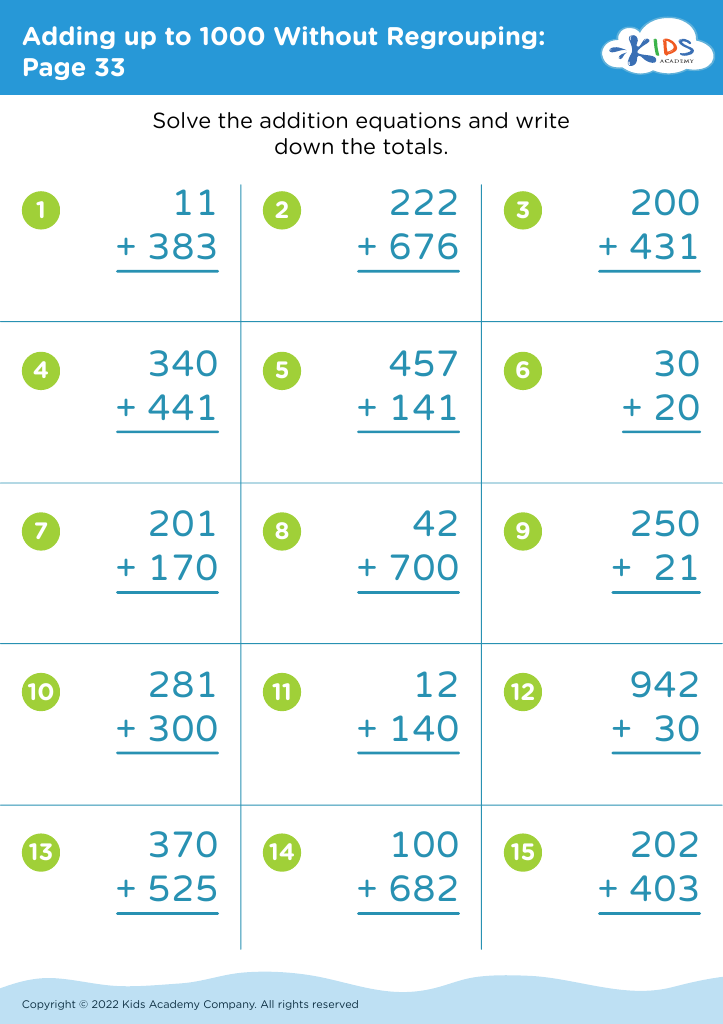



Adding up to 1000 without regrouping for ages 5-8 is a fundamental skills that lays a strong numerical foundation in young children. It helps to build their confidence and competence in handling numbers without getting bogged down by complex algorithms like carrying over or regrouping. At this age, simpler arithmetic helps children develop a strong mental tape for numbers and their relationships, making future mathematical concepts more accessible and less intimidating.
Practicing addition without regrouping ensures that children fully comprehend what each digit represents in multiple-digit numbers. This understanding is crucial as they progress to more advanced topics, such as regrouping and later, concepts like subtraction, multiplication, and division. By mastering non-regrouping addition, students build their number sense, improve their problem-solving skills, and cultivate patience and persistence through repetitive practice.
Furthermore, it empowers young learners to approach mathematical problems with a foundational toolkit, bolstering their overall academic confidence and aptitude. Early positive experiences with math can influence attitudes towards the subject, establishing an enduring growth mindset and curiosity towards learning. Therefore, it becomes essential for parents and teachers to prioritize and support children in mastering these basic arithmetic skills. By doing so, they help in laying a cornerstone for future educational success.








