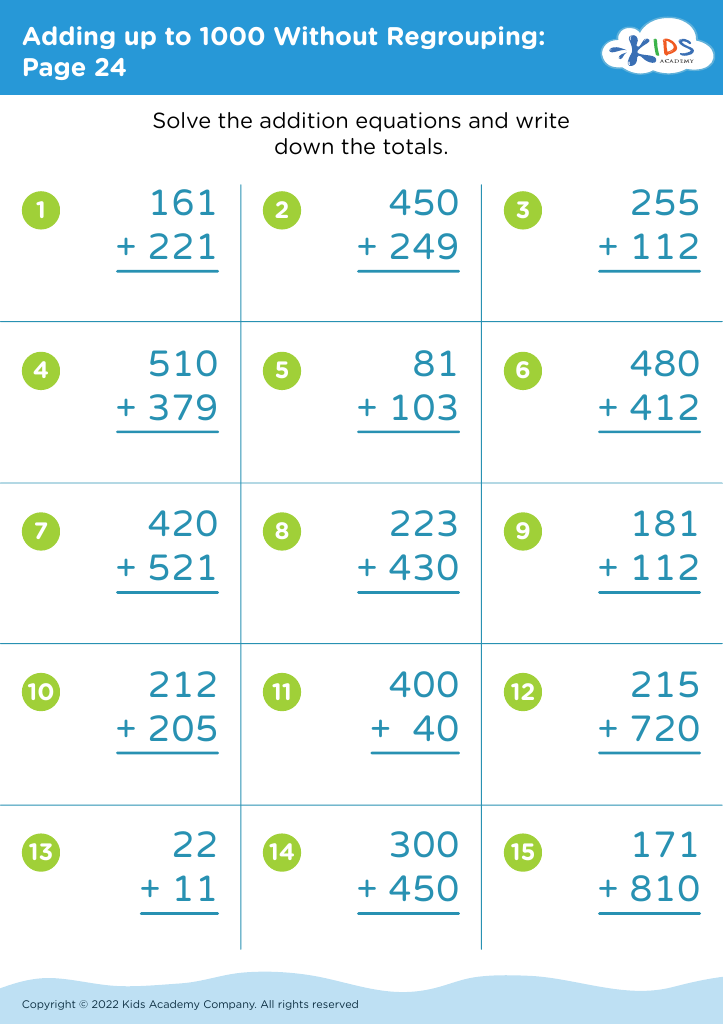
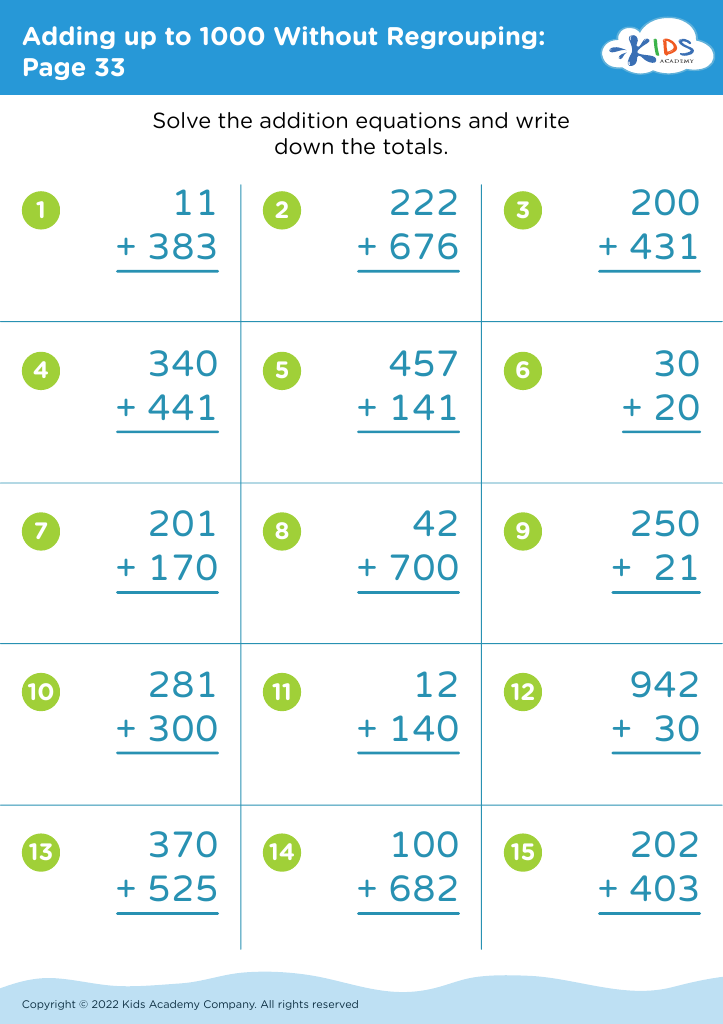
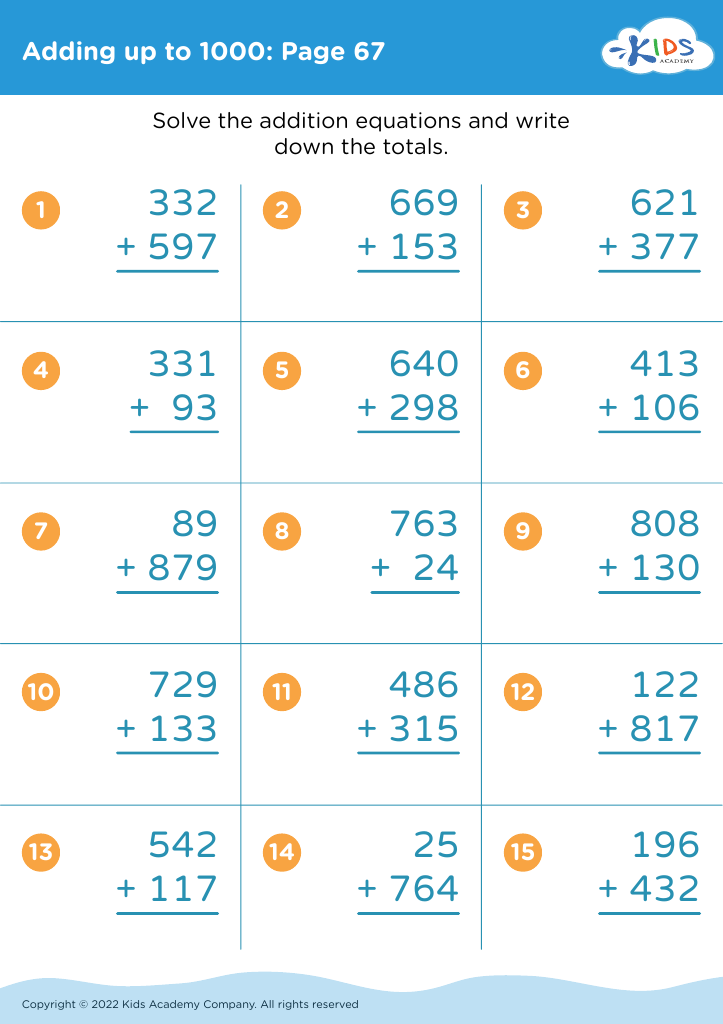




Teaching young children about adding up to 1000 is crucial for several reasons. First, it fosters foundational mathematical skills essential for their overall academic development. At ages 5-8, children are in a critical learning phase; grasping addition concepts helps them understand more complex mathematical operations later on.
Furthermore, working with numbers up to 1000 introduces children to place value, number sense, and mental math strategies, all of which enhance their confidence in using mathematics in everyday situations. This understanding helps students visualize quantities, recognize patterns, and improve their problem-solving skills.
Additionally, teaching addition to 1000 can enhance cognitive abilities and critical thinking skills. Children engage in hands-on activities, like using manipulatives or number lines, making the learning process more interactive and enjoyable. As they collaborate with peers or adults, they develop social skills and learn to communicate their mathematical reasoning.
Moreover, having a strong grasp of addition paves the way for future success in various fields, from science to finance. Thus, parents and teachers should prioritize these skills within this age group to ensure children build a solid foundation that supports their lifelong learning journey. Ultimately, it contributes to a child's overall confidence and enjoyment in learning.








