Color Identification Addition & Subtraction Worksheets for Ages 5-8 - Page 2
27 filtered results
-
From - To
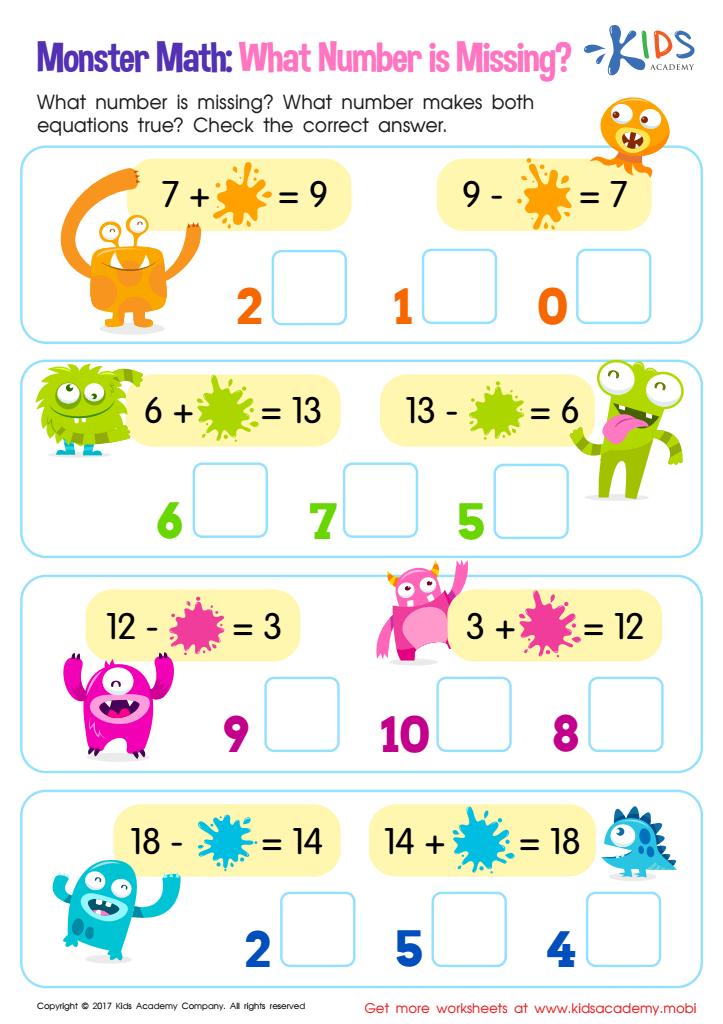
Missing Number: Monster Math Worksheet
 Assign to My Students








Color identification in addition and subtraction activities offers numerous benefits for children aged 5 to 8, highlighting its importance for parents and teachers in early education. Firstly, using colors can capture a child's attention and make learning more enjoyable. When mathematical concepts are presented with vibrant colors, children are more likely to engage and retain information.
Moreover, color coding can enhance understanding of mathematical operations. Associating colors with numbers or concepts helps children visually distinguish between different elements, ultimately improving their problem-solving skills. For example, using different colors for addends in an addition problem can make the process clearer and more intuitive.
Additionally, incorporating colors into math activities supports the development of fine motor skills through physical interactions with colorful manipulatives, such as blocks or counters. This multisensory approach also fosters creativity, allowing children to express themselves while learning foundational math skills.
Finally, parents and teachers who emphasize color identification in math can boost a child's confidence, making them more likely to participate and explore mathematical concepts freely. In summary, integrating color identification into addition and subtraction tasks not only makes learning fun but also builds critical foundational skills essential for future academic success.








