
Understanding Perimeter Geometry Worksheets for Ages 5-8
3 filtered results
Difficulty Level
Grade
Age
-
From - To
Subject
Activity
Standards
Discover the exciting world of perimeter geometry with our engaging worksheets designed for children aged 5-8! These age-appropriate materials focus on teaching young learners how to measure and understand the perimeter of various shapes. Each worksheet features vibrant illustrations and interactive exercises that make learning fun and accessible. From counting edges to simple problems, our resources reinforce foundational math skills essential for future success. Perfect for both classroom and home use, these worksheets promote logical thinking and problem-solving abilities while giving children confidence in their mathematical understanding. Help your child explore geometry today with our comprehensive perimeter worksheets!
Favorites
With answer key
Interactive
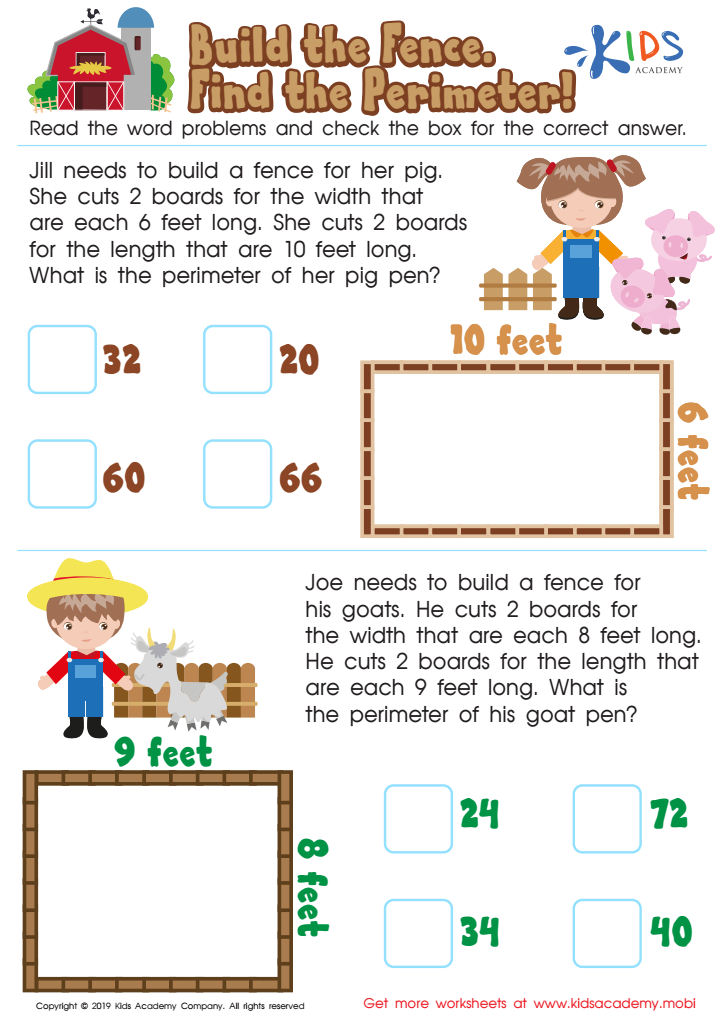
Build the Fence, Find the Perimeter Worksheet
This worksheet is great for kids needing extra help with geometry and maths. Read the problems to your kids and assist them in answering them correctly by ticking the box. This way, they'll be combining their addition and subtraction skills with literacy to help them learn.
 Assign to My Students
Build the Fence, Find the Perimeter Worksheet
Worksheet











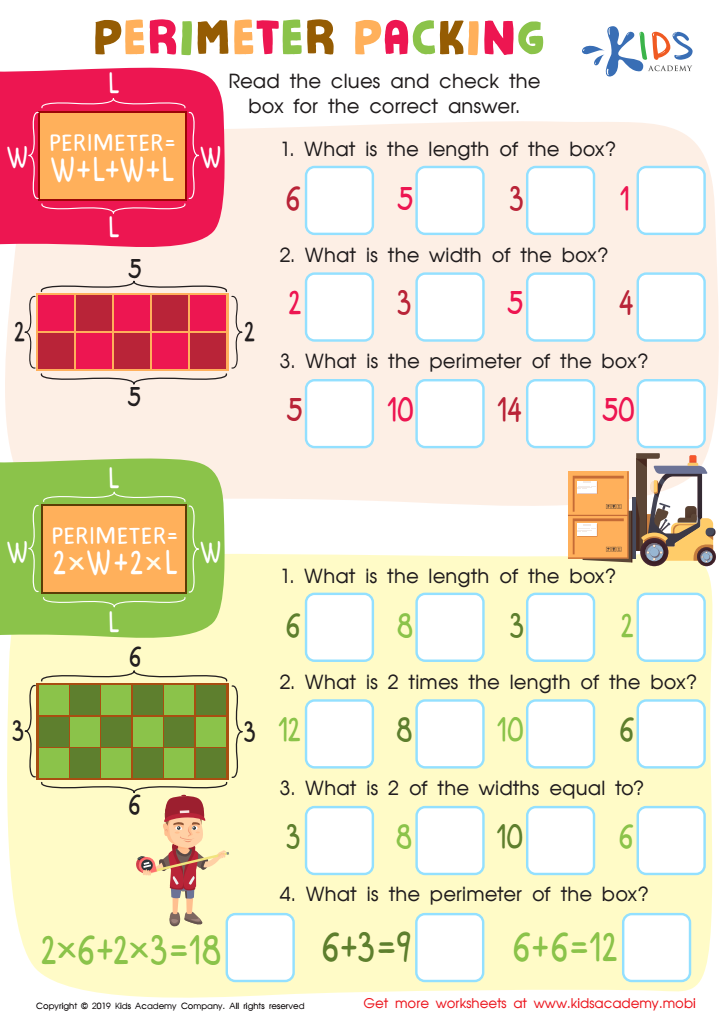
Perimeter Parking Worksheet
Geometry can be daunting for kids, but you can make it easy with simple exercises and familiar objects. Check out this worksheet with two sections of questions. Guide your kids to read clues and check the correct answer box. Help them become better at solving geometry problems.
Perimeter Parking Worksheet
Worksheet
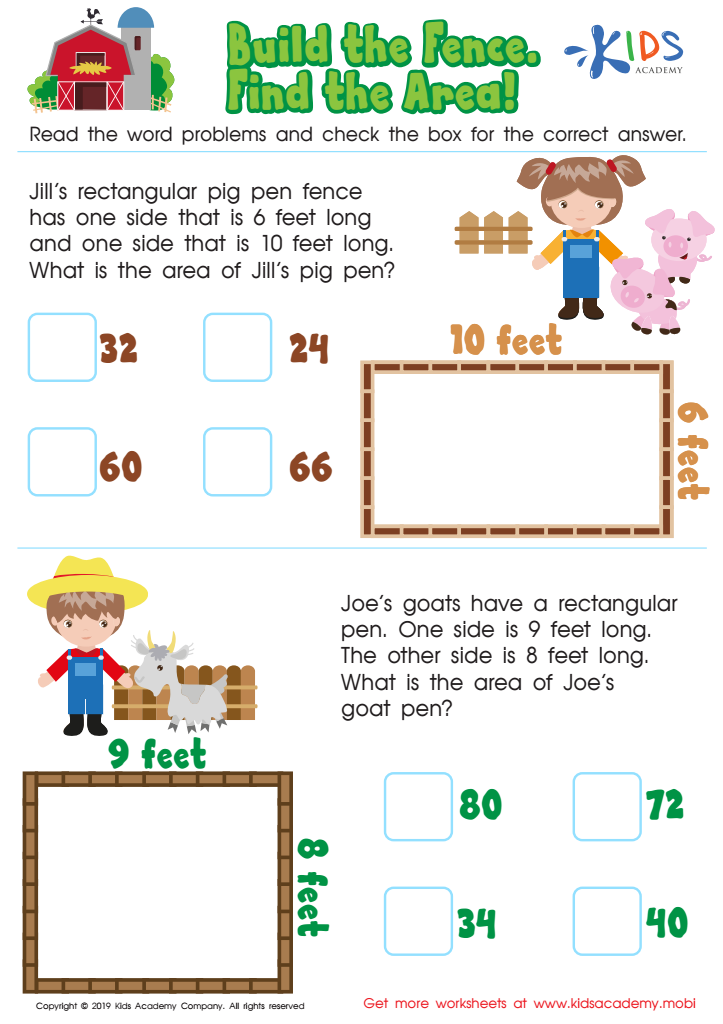
Build the Fence, Find the Area Worksheet
Help your kids gain skills in mathematics with this simple worksheet. Kids can refresh their addition and subtraction to solve geometry problems. Read the word problems and then help them check the box for the correct answer if they need extra help. This worksheet is great for improving kids' familiarity with basic equations.
Build the Fence, Find the Area Worksheet
Worksheet
Join Kids Academy for Free
Who is primarily going to use this learning content?








Understanding perimeter geometry for children aged 5 to 8 is crucial for their overall mathematical development. At this stage, children are beginning to develop spatial awareness and fundamental math skills, and learning about perimeter provides a concrete way to engage with these concepts.
First, grasping the idea of perimeter helps children understand measurement—one of the foundational elements of mathematics. It allows them to explore how to calculate distances around shapes, improving both their practical skills and their cognitive understanding of space.
Additionally, perimeter geometry fosters problem-solving and critical thinking. When children learn to calculate the perimeter of various shapes, they begin to think logically and systematically. This thinking process lays the groundwork for more advanced mathematical concepts later on, such as area and volume.
Moreover, teaching perimeter can be integrated into hands-on activities, making math fun and interactive. This kinesthetic learning engages children, helping to bridge the gap between abstract numbers and real-world applications.
Ultimately, parents and teachers should care about perimeter geometry because it not only builds essential math skills but also sparks curiosity, creativity, and a lifelong love for learning in young minds.








