
Fine motor skills (writing numbers) Numbers Worksheets for Ages 5-8
3 filtered results
Difficulty Level
Grade
Age
-
From - To
Subject
Activity
Standards
Developing fine motor skills is essential for young learners, and our "Fine Motor Skills (Writing Numbers) Worksheets" for ages 5-8 provide an engaging way for children to practice. These worksheets focus on writing numbers with precision, helping children enhance their dexterity and control. Through fun exercises, kids will trace, copy, and write numbers, reinforcing their understanding while improving their handwriting. Perfect for home or classroom use, our resources cater to varying skill levels, ensuring each child can progress at their own pace. Explore imaginative and interactive activities that inspire a love for learning and mathematics! Start your child's writing journey today!
Favorites
With answer key
Interactive
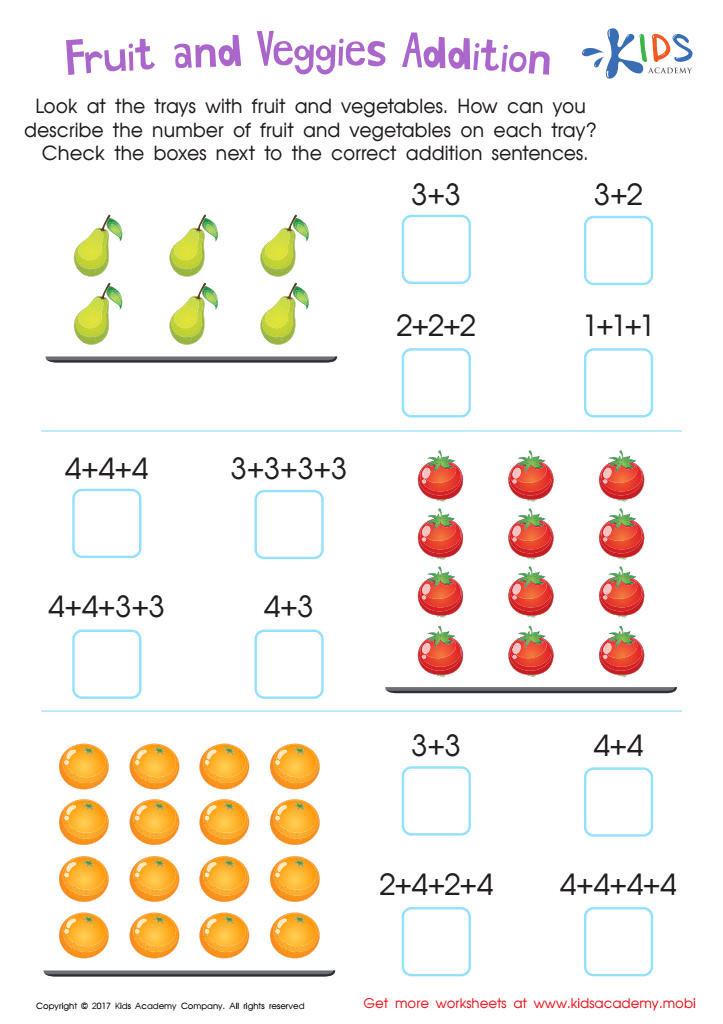
Fruit and Veggies Worksheet
It promotes problem-solving and analytical skills as kids match pictures to correct addition sentences. Help your child go beyond simple addition with this PDF worksheet!
 Assign to My Students
Fruit and Veggies Worksheet
Worksheet

A Hundred Pineapples Worksheet
Can your child count in tens? Show them how to count 100 boxes in stacks of tens. A worksheet can help them understand the concept. Ask them to count boxes of pineapples in stacks of tens and circle the truck with 100 pineapples.
A Hundred Pineapples Worksheet
Worksheet

Finding 4 in the Forest Worksheet
Before starting, have your kids count as high as they can. Ask them to identify the setting and point out the 4s. Trace 4 and draw your own. Help your kids circle all the 4s they can find in the forest. How far can they count? How well did they find the hidden 4s?
Finding 4 in the Forest Worksheet
Worksheet
Join Kids Academy for Free
Who is primarily going to use this learning content?








Fine motor skills, particularly in writing numbers, are crucial for children aged 5-8 as they lay the foundation for various academic and life skills. During these formative years, children develop the small muscle control and coordination necessary to hold pencils, form letters, and write numbers legibly. Strong fine motor skills are essential not only for handwriting but also for everyday tasks such as buttoning shirts and using utensils.
Parents and teachers should care about fostering these skills because they directly impact a child's confidence and engagement in learning. A child struggling with writing numbers may find math intimidating, potentially leading to social emotional challenges such as frustration or a reluctance to participate in class activities. Engaging children in playful, hands-on learning activities helps to enhance their fine motor abilities while making learning enjoyable.
Additionally, mastery of writing numbers is essential for later mathematical understanding and problem-solving. As children progress in school, fine motor skills serve as the basis for more complex tasks, from taking notes to completing standardized tests. By actively supporting the development of fine motor skills, parents and teachers contribute to a child's overall growth, academic success, and lifelong learning.








