
Analog clock reading Math Worksheets for Ages 5-8
4 filtered results
Difficulty Level
Grade
Age
-
From - To
Subject
Activity
Standards
Help your child master time-telling skills with our engaging Analog Clock Reading Math Worksheets, specifically designed for ages 5-8. These worksheets incorporate fun illustrations and interactive activities that make learning to read analog clocks enjoyable and effective. Your little ones will learn to identify hour and minute hands, read time to the hour, half-past, and quarter-hour. With clear instructions and progressive challenges, these worksheets encourage independence and confidence in math. Perfect for at-home learning or classroom use, our resources aim to support your child's mathematical development and enhance critical thinking skills. Get started on the path to time mastery today!
Favorites
With answer key
Interactive
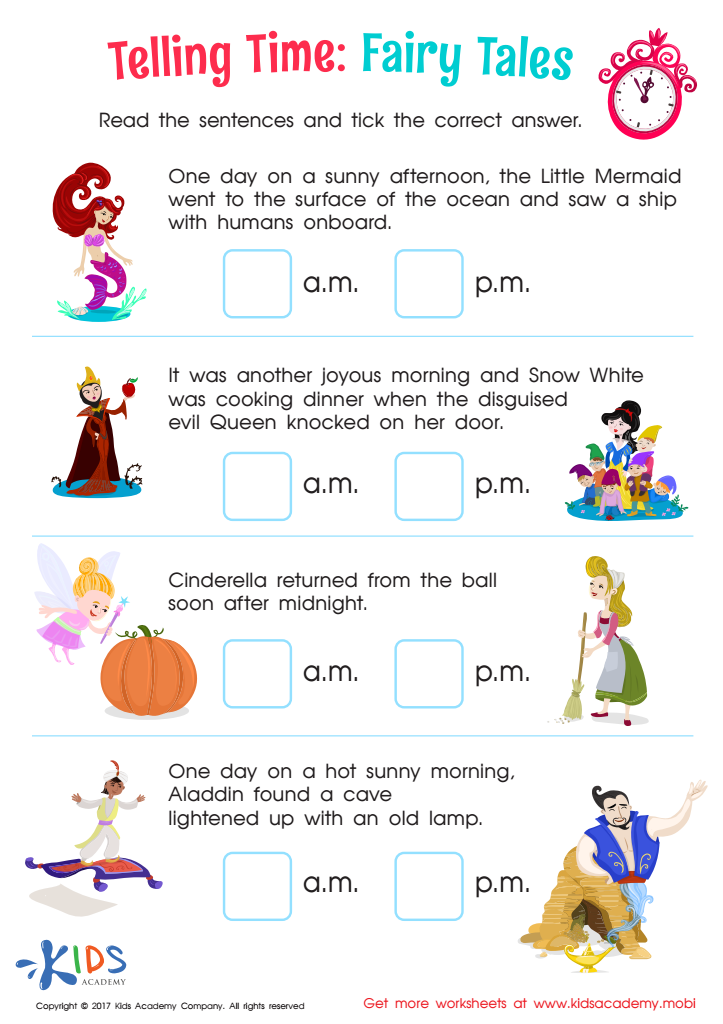
Telling Time: Fairy Tales Worksheet
Bring your child's imagination to life with classic fairy tales! This colorful telling time worksheet has it all: The Little Mermaid, Cinderella, and more! Plus, your child will have fun learning to distinguish a.m. from p.m. with this charming worksheet.
 Assign to My Students
Telling Time: Fairy Tales Worksheet
Worksheet
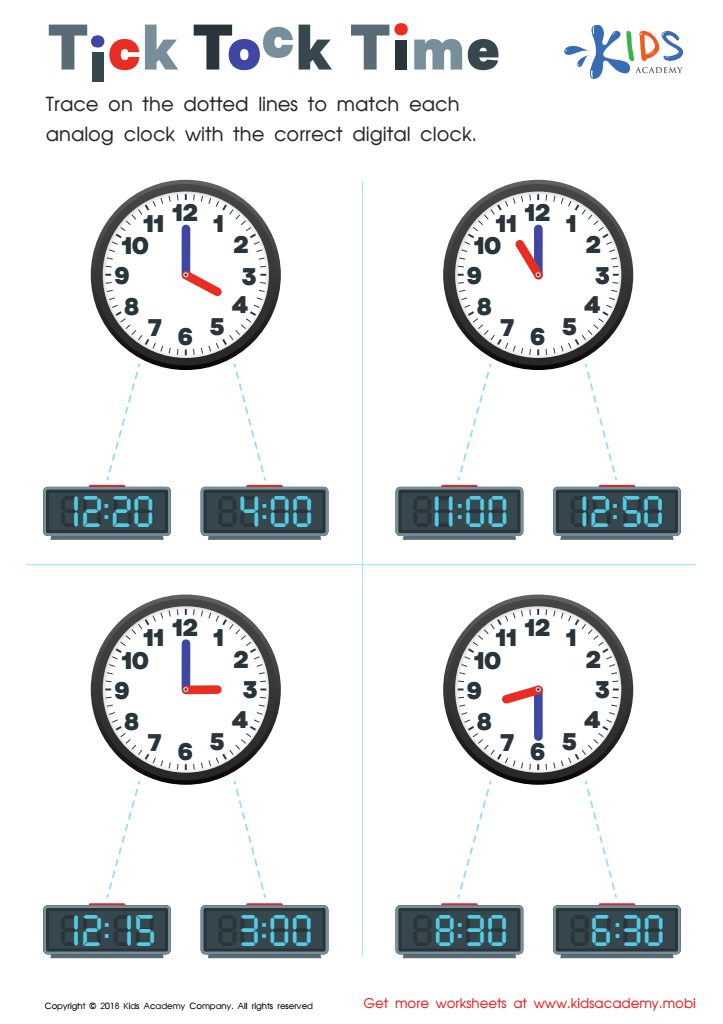
Tick Tock Time Worksheet
Trace the dotted lines on this worksheet to match analog and digital clocks! It's a great way to help your kids learn time-telling. They'll get better at converting analog to digital, and vice versa. Get your children to try it - it's a fun way to practice!
Tick Tock Time Worksheet
Worksheet
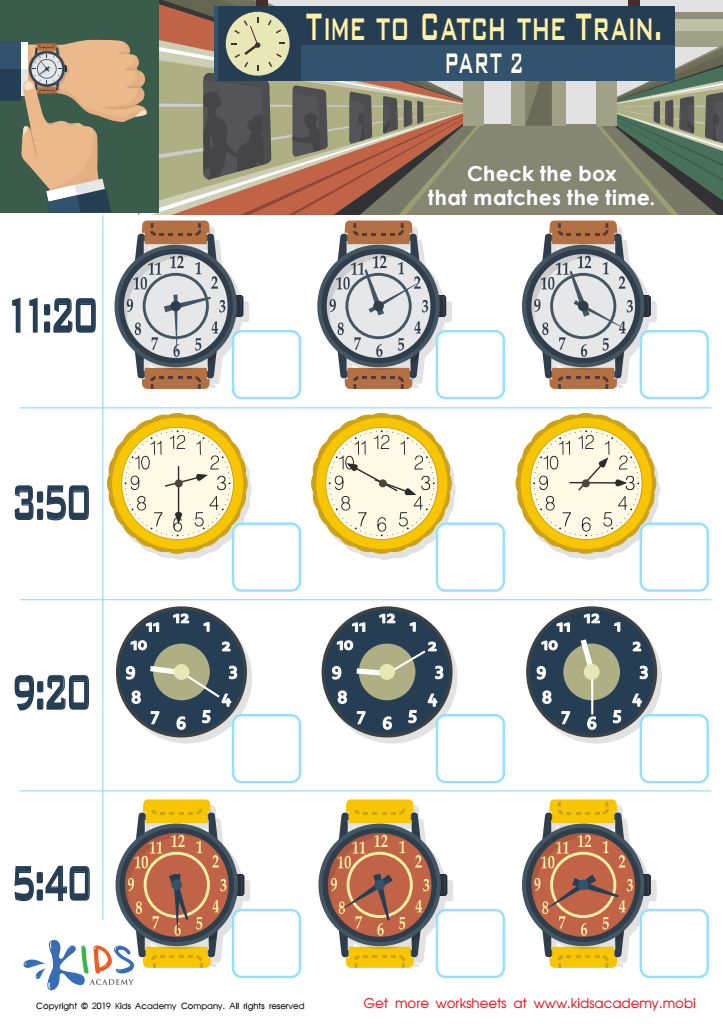
Time to Catch the Train Part 2 Worksheet
Teach your kids the importance of telling time and how to do it. Explain that there are multiple ways to show the time, such as written on the left side or watches in the picture. Guide them to check the box that matches the time. Knowing the time is essential to get things done and create order. Ensure your kids understand this and they will reap the benefits.
Time to Catch the Train Part 2 Worksheet
Worksheet
Join Kids Academy for Free
Who is primarily going to use this learning content?







Teaching children to read analog clocks is crucial for their development, especially for ages 5-8. Understanding how to read an analog clock not only enhances their mathematical skills but also aids in their overall cognitive development. It combines visual-spatial reasoning, number recognition, and the application of time concepts, encouraging kids to connect mathematical theory with practical, everyday experiences.
Parents and teachers should care about this skill because it instills a sense of time management and independence. Learning to tell time on an analog clock allows children to be aware of the passing hours, helping them realize when it's time for specific activities such as meals, school, or play. Additionally, it promotes critical thinking as they learn to understand the relationship between hour and minute hands, fractions, and the division of time into segments.
Moreover, reading an analog clock often reinforces the understanding of patterns and increments, laying the groundwork for future mathematical concepts. This skill helps build confidence in their abilities, encouraging children to take responsibility for their own schedules. Therefore, teaching kids to read analog clocks provides essential life skills alongside foundational math competencies, making it a valuable focus for parents and educators alike.








