
Fraction comparison Math Worksheets for Ages 5-8
33 filtered results
Difficulty Level
Grade
Age
-
From - To
Subject
Activity
Standards
Explore our engaging Fraction Comparison Math Worksheets designed specifically for children ages 5-8! These worksheets provide a fun and interactive way for young learners to develop their understanding of fractions and enhance their critical thinking skills. Each worksheet is tailored to help kids compare and order fractions through vivid visuals and simple exercises. Perfect for classroom activities or at-home practice, our fraction comparison resources support educational growth while keeping learning enjoyable. Join us in making math an exciting journey for your little ones as they master the foundations of fractions with confidence and clarity!
Favorites
With answer key
Interactive
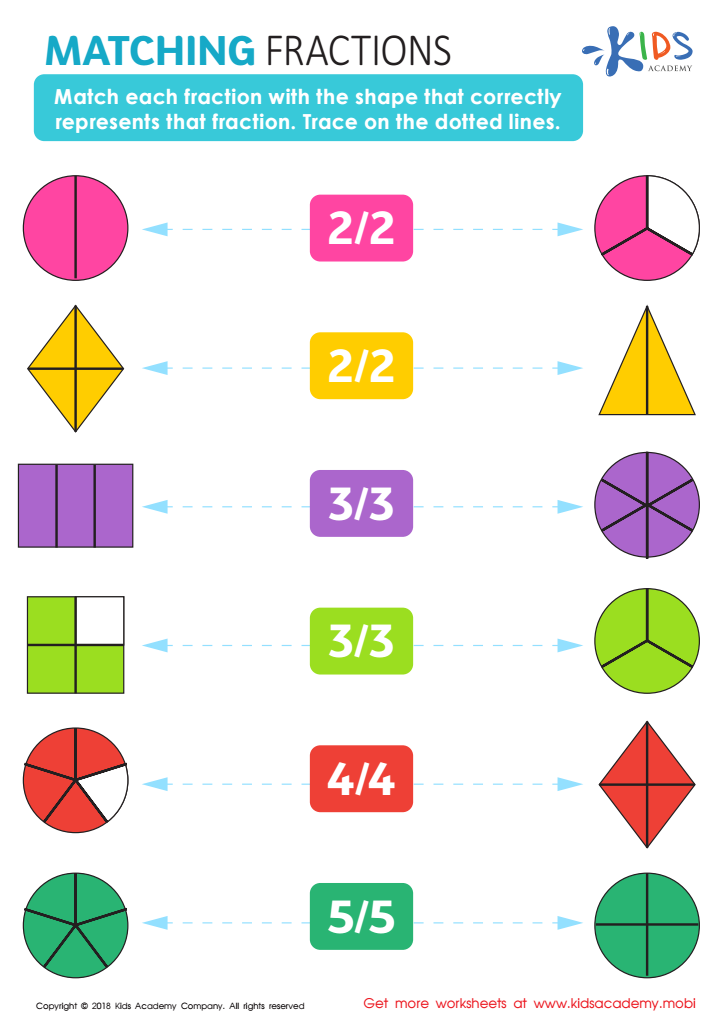
Matching Fractions Worksheet
This worksheet uses colorful images to engage students. On the left are six shapes, mirrored on the right, with fractions in the middle. Students must match up the fraction with the right shape. It's a fun way to sharpen fractions skills!
 Assign to My Students
Matching Fractions Worksheet
Worksheet
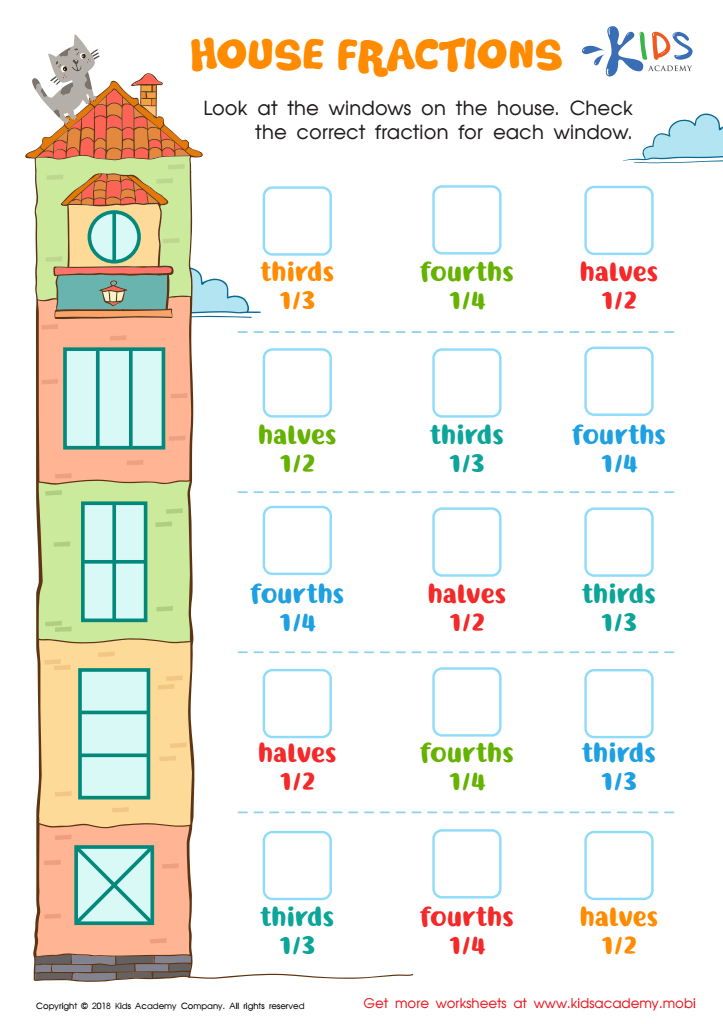
House Fractions Worksheet
Test your child's knowledge of fractions with this worksheet! Have them examine the windows of a house and select the correct fraction from the options given. This is a great way to see how much they understand about wholes, fractions, halves, one thirds, and one fourths.
House Fractions Worksheet
Worksheet
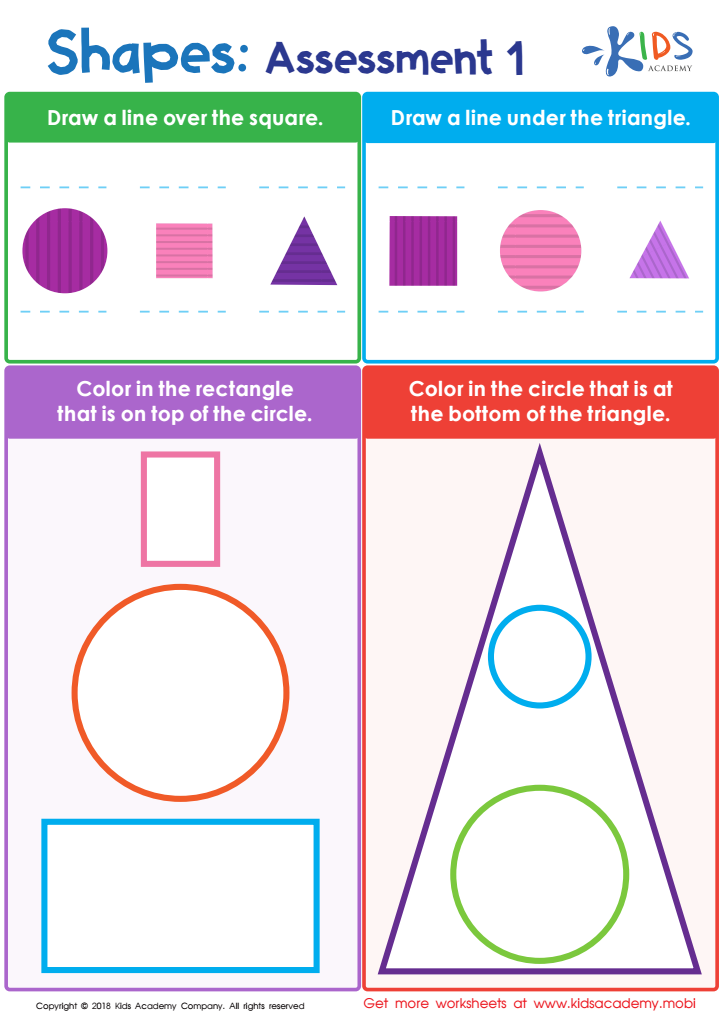
Shapes: Assessment 1 Worksheet
Test your students' understanding of the four basic shapes - circle, square, triangle and rectangle - with this assessment worksheet. Get them to draw a line over or under the shape indicated in the directions to show they can identify it correctly.
Shapes: Assessment 1 Worksheet
Worksheet
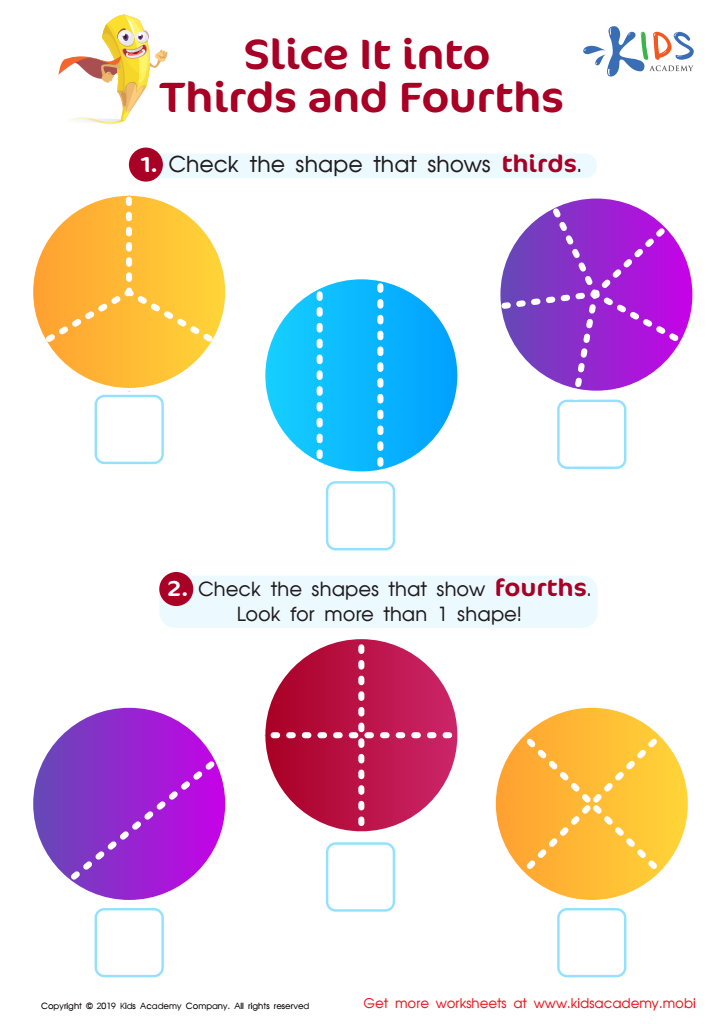
Slice in Thirds Fourths Worksheet
This worksheet helps kids learn fractions visually by dividing circles into thirds and fourths. They will learn that fractions must be equal parts, not just sets, by choosing the right colorful circles. It's an easy way to master fractions and have fun doing it!
Slice in Thirds Fourths Worksheet
Worksheet
Join Kids Academy for Free
Who is primarily going to use this learning content?







Understanding fraction comparison is essential for children aged 5-8 as it lays the foundation for critical mathematical skills and reasoning. At this age, children are developing their number sense, and conceptualizing fractions helps them grasp parts of a whole, an idea that extends beyond math and into real-life situations.
When parents and teachers emphasize fraction comparison, they encourage logical thinking and problem-solving skills. Children learn to recognize how different quantities relate to each other, enhancing their ability to make informed decisions and judgments, which is crucial as they encounter various scenarios in daily life. For example, understanding that 1/2 is larger than 1/4 enables them to analyze portions in a pizza or compare different lengths or amounts.
Moreover, mastering fraction comparison serves as a stepping stone for more complex math concepts in the future, such as addition, subtraction, and even algebra. It builds confidence in their mathematical abilities, fostering a positive attitude towards learning. Engaging children in fun fraction-related games and activities makes the learning process enjoyable and interactive, ensuring they develop a solid understanding that will benefit them in higher grades. Ultimately, prioritizing fraction comparison is an investment in their long-term academic growth.








