
Identifying fractions Math Worksheets for Ages 5-8
5 filtered results
Difficulty Level
Grade
Age
-
From - To
Subject
Activity
Standards
Explore our engaging "Identifying Fractions" math worksheets designed specifically for children ages 5-8. These interactive resources help young learners grasp the fundamental concepts of fractions in a fun and approachable way. Through colorful visuals and practical exercises, children will familiarize themselves with halves, thirds, and other fractions while developing critical math skills. Each worksheet is crafted to boost confidence and encourage problem-solving abilities, making math enjoyable. Perfect for both classroom activities and at-home learning, our worksheets support early childhood education by providing a solid foundation in number comprehension. Start your child's fraction journey today with our delightful printable resources!
Favorites
With answer key
Interactive
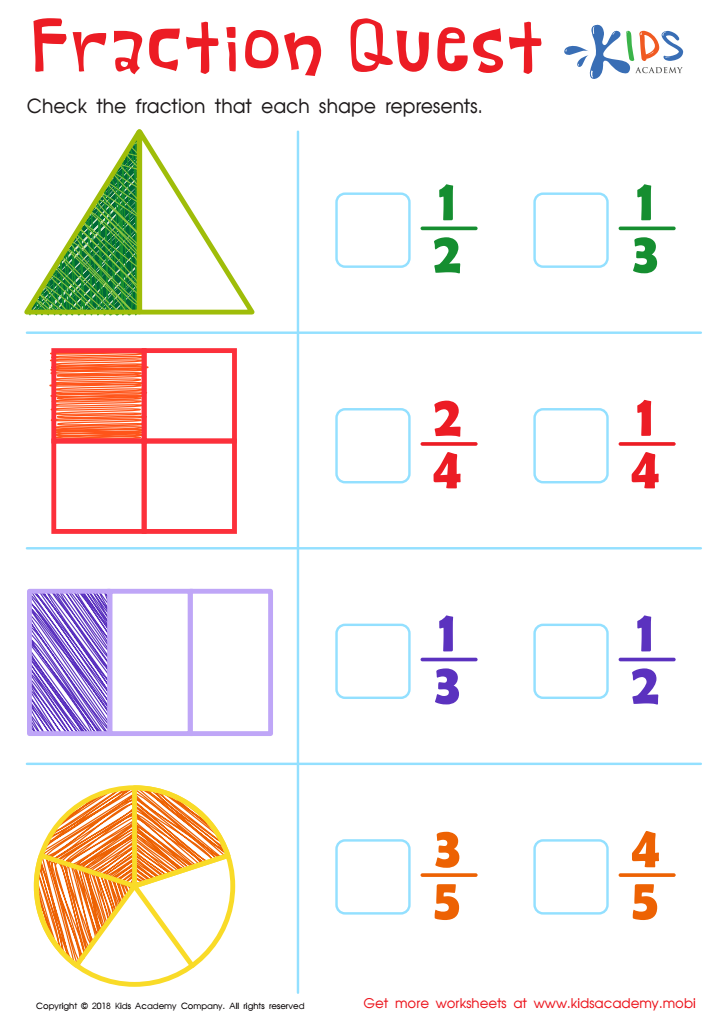
Fraction Quest Worksheet
This colorful and educative worksheet can help kids conquer their fractions struggles. Ask them to identify the four shapes, then the fractions they represent. They can then check the correct answers from the options given.
 Assign to My Students
Fraction Quest Worksheet
Worksheet
Join Kids Academy for Free
Who is primarily going to use this learning content?




Identifying fractions is a crucial mathematical skill for children aged 5-8 that lays the groundwork for further mathematical concepts. At this age, children are developing their numerical understanding and learning to classify and categorize information. By helping students grasp the concept of fractions, parents and teachers equip them with tools to better understand division, ratios, and even decimals as they progress in their education.
Understanding fractions fosters a sense of number sense and spatial awareness. It assists children in recognizing parts of a whole, whether that is through segments of a pizza, slices of cake, or segments of a circle. When children understand fractions visually and conceptually, they build confidence in their mathematical abilities, which is essential for positive attitudes towards math in the future.
Moreover, fractions often appear in real-life situations, like dividing food or sharing toys, making learning relevant and engaging. When parents and teachers encourage students to identify fractions, it promotes critical thinking and problem-solving skills. In essence, identifying fractions bridges concrete learning with abstract mathematics, making it a significant focus in early education that lays the foundation for lifelong math skills.








