Understanding measurements Math Worksheets for Ages 5-8 - Page 2
26 filtered results
-
From - To
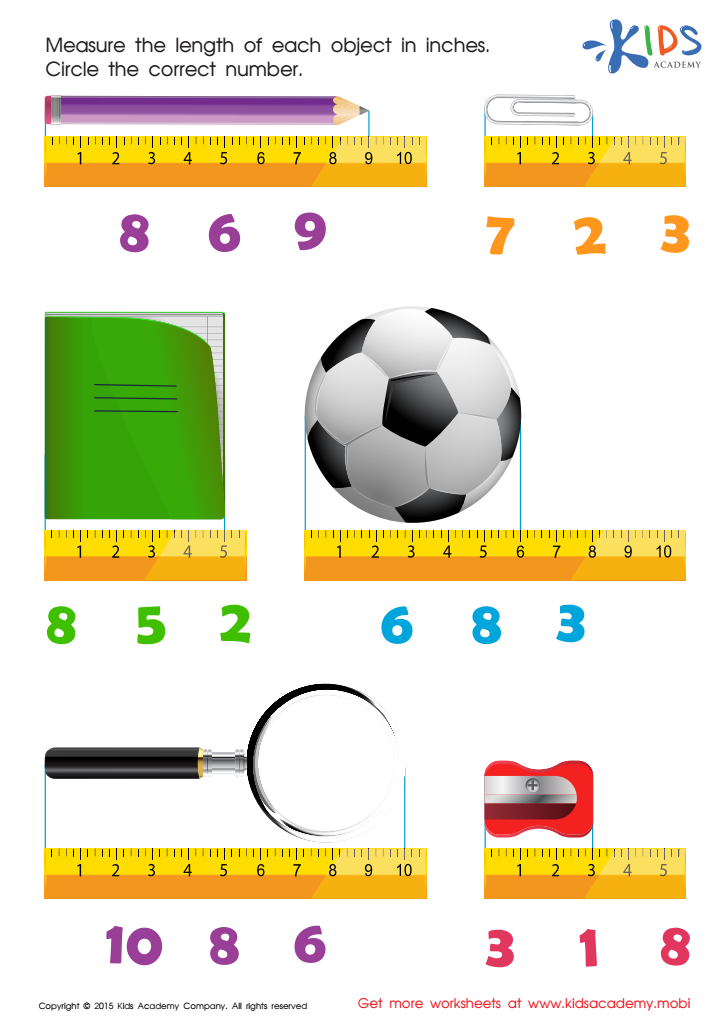
Learning measuring objects in inches Worksheet
 Assign to My Students
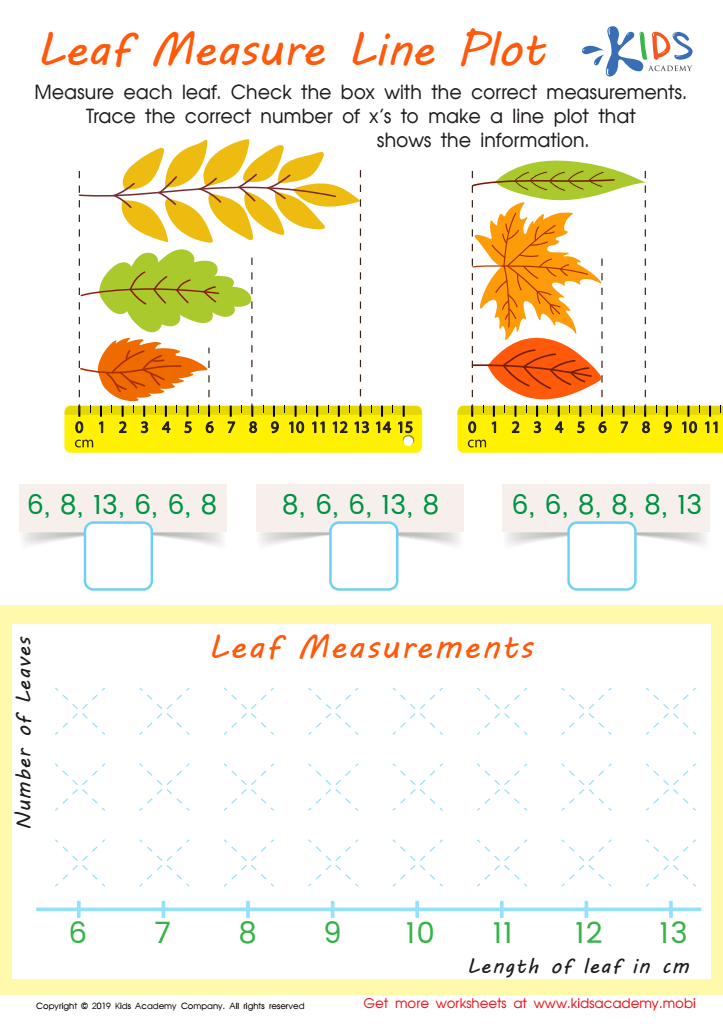
Leaf Measure Line Plot Worksheet






Understanding measurements in mathematics is vital for children ages 5-8 as it lays a foundation for both academic success and practical life skills. At this developmental stage, children are naturally curious and eager to explore the world around them. Introducing measurement concepts—such as length, weight, volume, and time—promotes critical thinking and helps children make connections between mathematics and daily life.
When parents and teachers emphasize measurement, they assist children in developing spatial awareness and comparison skills. Children learn to categorize objects, understand their attributes, and solve problems through hands-on activities, which can lead to improved reasoning and analytical skills. Measurement is often integrated into real-world scenarios—like baking, shopping, or building—which fosters a deeper understanding of mathematical concepts while enhancing creativity and engagement.
Moreover, a solid grasp of measurements builds confidence in dealing with more complex math topics later on. This foundational knowledge is also essential for more structured learning in future grades, where the concepts of measurement become increasingly sophisticated. By prioritizing measurement learning in early education, parents and teachers set children on a path to becoming competent, confident learners who can navigate mathematical challenges effectively.








