
Understanding prepositions Writing Worksheets for Ages 5-8
4 filtered results
Difficulty Level
Grade
Age
-
From - To
Subject
Activity
Standards
Help your child master grammar with our "Understanding Prepositions Writing Worksheets for Ages 5-8." These engaging worksheets are designed to teach young learners prepositions through fun, interactive exercises. Perfect for children in kindergarten to second grade, each worksheet offers a variety of activities such as sentence completion, matching exercises, and visual aids. By incorporating illustrations and simple sentences, we ensure that learning prepositions becomes an enjoyable experience. Improve your child's writing and comprehension skills today with these easy-to-follow worksheets, helping them build a strong foundation for future language development. Ideal for both home and classroom use.
Favorites
With answer key
Interactive
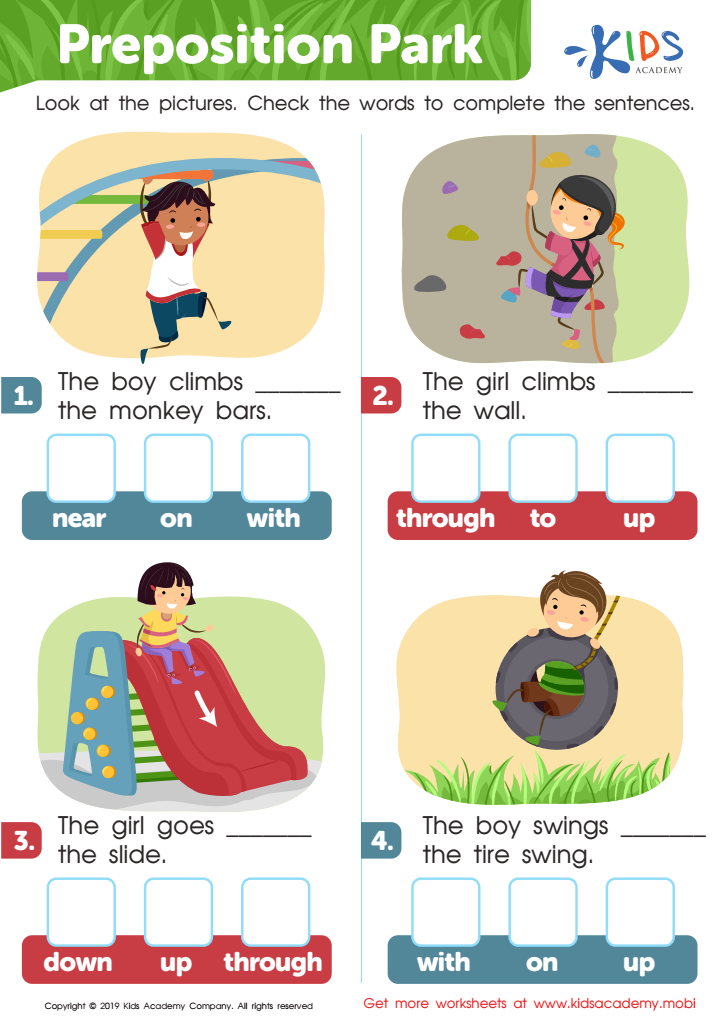
Preposition Park Worksheet
.
Check kids' understanding of prepositions by reminding them it's a word used to show location, direction or time. Look at the four pictures and ask what the kids are doing. Read the sentences below and help them check the words to complete them.
 Assign to My Students
Preposition Park Worksheet
Worksheet
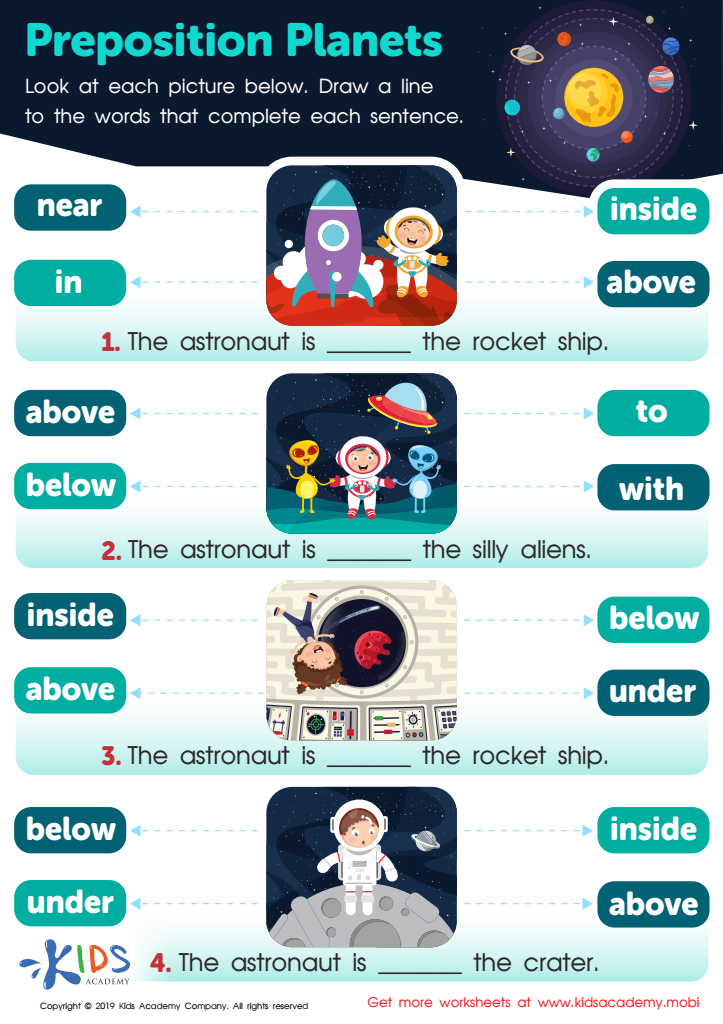
Preposition Planets Worksheet
Remind your child about outer space: which planet do we live on, and who travels there for research? Explain that prepositions show location, direction, and time. Look at the worksheet with colorful pictures of astronauts. Help your kids draw lines to the words that complete each sentence.
Preposition Planets Worksheet
Worksheet
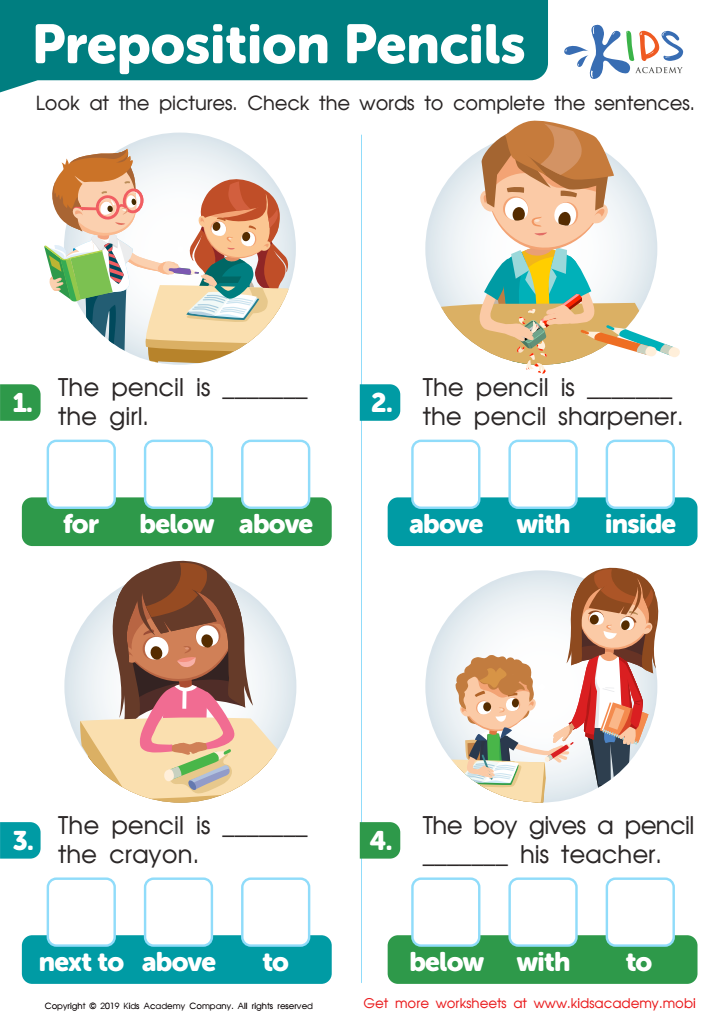
Preposition Pencils Worksheet
Constructing sentences follows rules. Parts of speech like nouns, verbs, adverbs, pronouns, and prepositions help. This worksheet focuses on prepositions. Explain prepositions to your child, then examine the pictures together and help them complete the sentences.
Preposition Pencils Worksheet
Worksheet
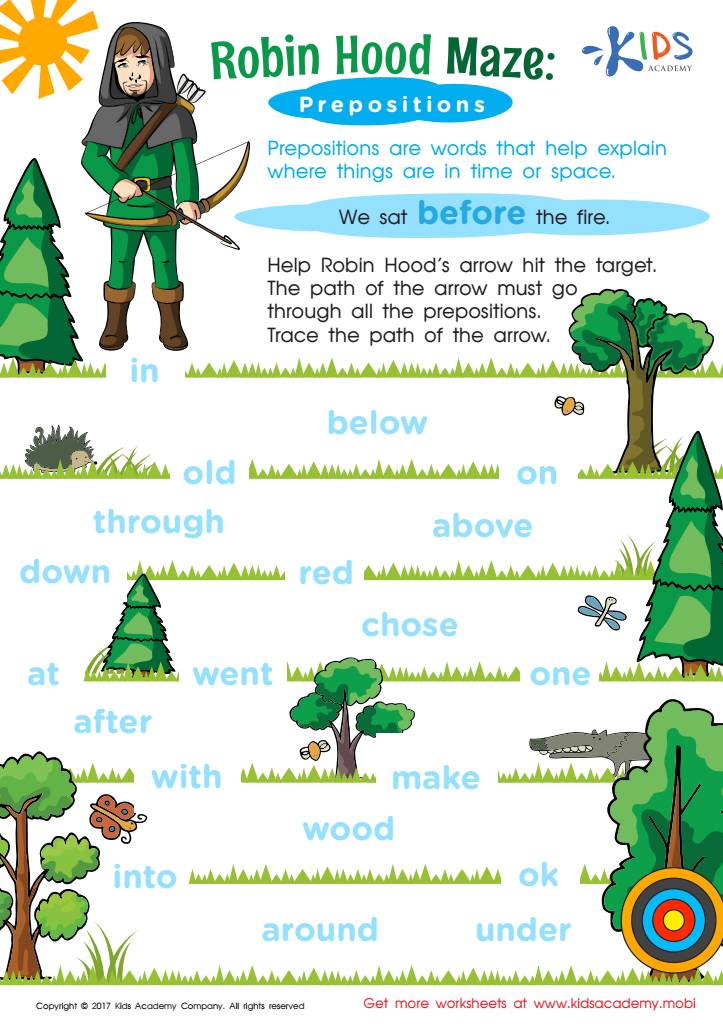
Prepositions Worksheet
Learn prepositions with this PDF worksheet for 3rd grade! Through a fun Robin Hood story, find prepositions as you help Robin shoot his arrow! A great way to learn and have fun!
Prepositions Worksheet
Worksheet
Join Kids Academy for Free
Who is primarily going to use this learning content?







Understanding prepositions is crucial for children aged 5-8 as it forms the foundation for effective communication and academic success. Prepositions are words that link nouns, pronouns, and phrases to other words in a sentence, explaining relationships involving location, direction, time, and manner. Early familiarity with prepositions helps children construct meaningful and coherent sentences, enhancing their ability to express thoughts, needs, and emotions clearly.
From a parent's perspective, helping children grasp prepositions can enrich daily conversations and foster cognitive development. It allows children to follow instructions accurately, describe their environment confidently, and engage more deeply in imaginative play. These skills are pivotal for social development, as they help children navigate interactions with peers and adults more effectively.
For teachers, teaching prepositions empowers students to succeed academically. Prepositions are integral to mastering reading comprehension and writing coherence. A solid understanding of prepositions aids decoding text contexts, grasping storylines, and understanding informational content. When writing, these skills enable students to connect ideas logically and produce narratives with rich detail and clarity.
Overall, prioritizing preposition education at an early stage sets a strong linguistic foundation for future communication skills, boosting both social and academic proficiency essential for a child’s long-term growth and success.








