Basic Addition Tracing Numbers Worksheets for Ages 6-9
3 filtered results
Difficulty Level
Grade
Age
-
From - To
Subject
Activity
Standards
Enhance your child's math skills with our Basic Addition Tracing Numbers Worksheets designed for ages 6-9! These worksheets blend fun tracing activities with basic addition problems to provide a comprehensive learning experience. Perfect for young learners, they help students practice number formation while building foundational math skills. Each printable worksheet visualizes numbers and addition steps, making it easy for kids to grasp essential concepts. Ideal for classroom or home use, these resources promote numerical confidence and improve fine motor skills. Start your child’s journey to math mastery with our engaging and educational worksheets.
Favorites
With answer key
Interactive
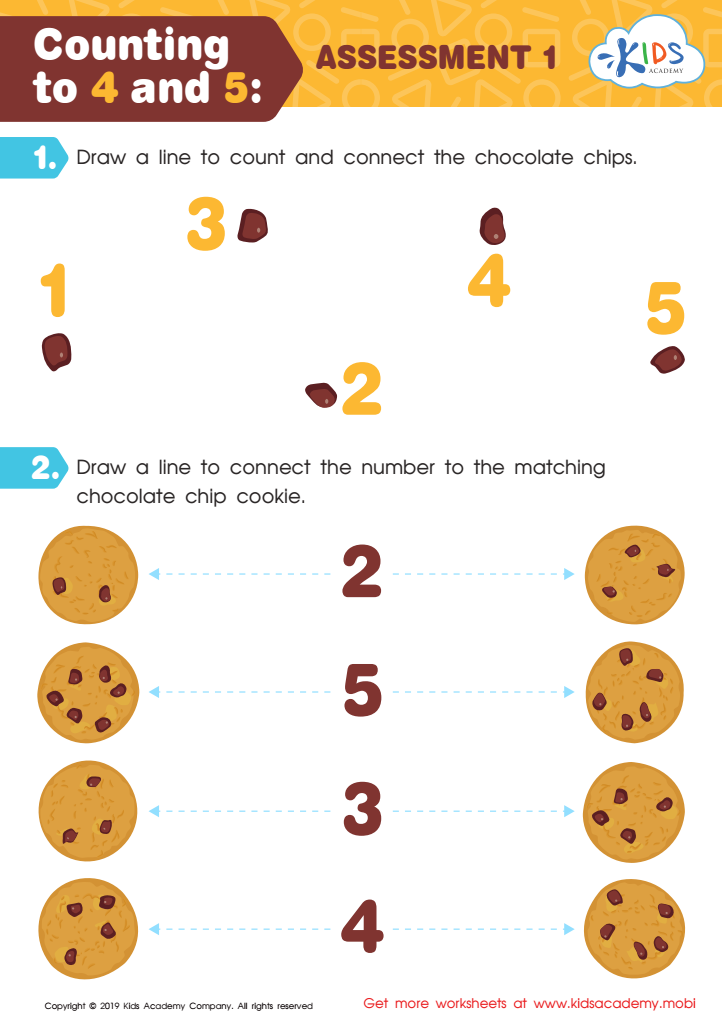
Counting to 4 and 5: Assessment 1 Worksheet
Counting correctly is essential for your little one. Make it fun by counting common objects or items they love. This worksheet includes chocolate chips - help them count then draw a line to connect them. Then draw a line between the number and the matching chip. They'll love it!
 Assign to My Students
Counting to 4 and 5: Assessment 1 Worksheet
Worksheet
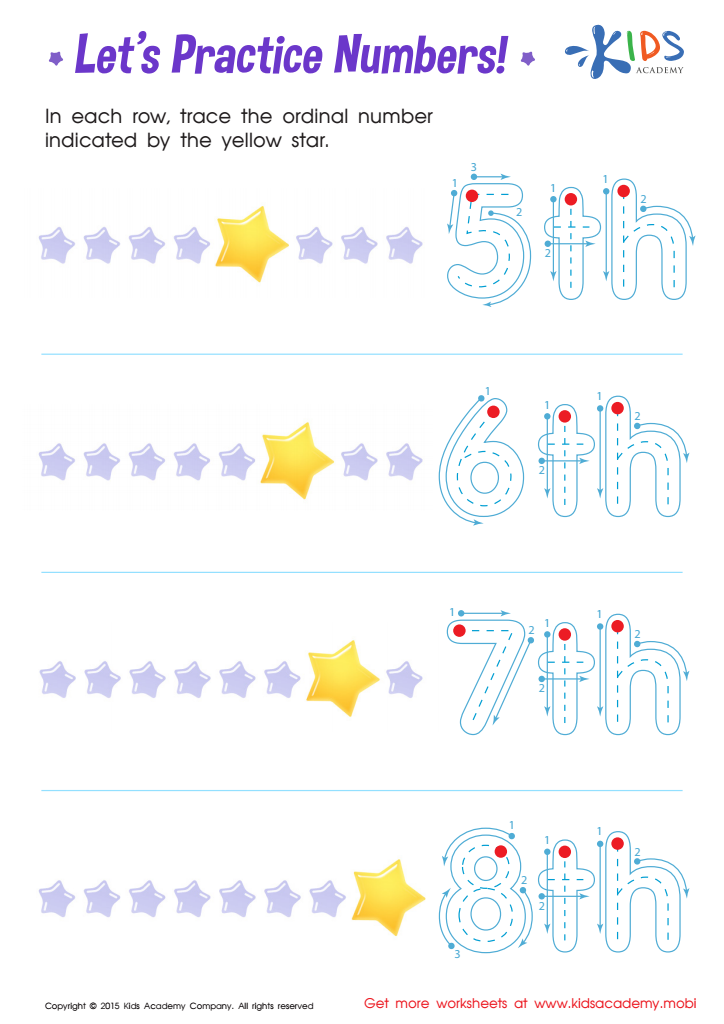
Ordinal Numbers: Let's Practice Numbers Printable
Worksheet
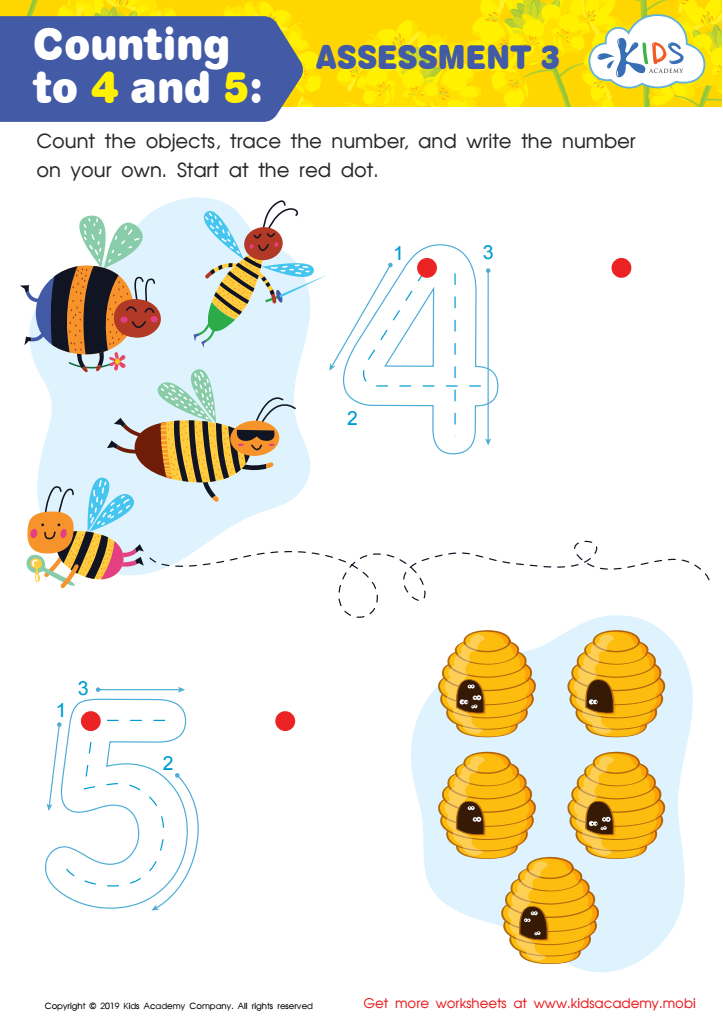
Counting to 4 and 5: Assessment 3 Worksheet
Help your kids learn to count with fun objects and items they like - like the bees in this worksheet. Ask them to count, trace the number, and write it down. Give guidance, starting at the red dot. This is an important first step in math and your kids will love it!
Counting to 4 and 5: Assessment 3 Worksheet
Worksheet
Join Kids Academy for Free
Who is primarily going to use this learning content?








Basic Addition Tracing Numbers is a foundational skill for children aged 6-9 that significantly bolsters their early math development. At this crucial stage, young learners are transitioning from counting objects to understanding mathematical concepts, and tracing numbers provides a hands-on, tactile learning experience that solidifies these concepts.
By tracing numbers, children reinforce their understanding of number shapes while simultaneously practicing their fine motor skills, which are critical for writing fluently. This dual practice ensures they can process mathematical problems more confidently and accurately write their solutions. Incorporating addition into this tracing practice helps establish the connection between numerical symbols and quantities.
Parents and teachers should care about these activities because proficiency in basic addition is a gateway to more complex problem-solving skills. Engaging with addition tracing numbers fosters a positive attitude towards math, reducing anxiety and building early confidence. Furthermore, mastering addition at an early age supports academic success across all subjects as mathematical skills are linked to logical thinking and problem-solving abilities.
Investing time in basic addition tracing numbers equips children with the foundational math fluency necessary for future academic achievements and practical life skills, ensuring they develop a well-rounded, robust understanding of mathematics in its simplest and most engaging form.