
Understanding Simple Machines Reading Worksheets for Ages 6-9
3 filtered results
Difficulty Level
Grade
Age
-
From - To
Subject
Activity
Standards
Discover the engaging world of simple machines with our "Understanding Simple Machines" reading worksheets designed for children ages 6-9. These worksheets aim to enhance reading comprehension while introducing young learners to essential concepts involving levers, pulleys, inclined planes, and more. With colorful illustrations and age-appropriate language, students will grasp fundamental mechanical principles, fostering both curiosity and creativity. Each worksheet includes entertaining activities and questions that promote critical thinking and reinforce learning objectives. Perfect for teachers and parents alike, these resources provide an enjoyable way to inspire future engineers while developing vital literacy skills. Enhance your child’s education today!
Favorites
With answer key
Interactive
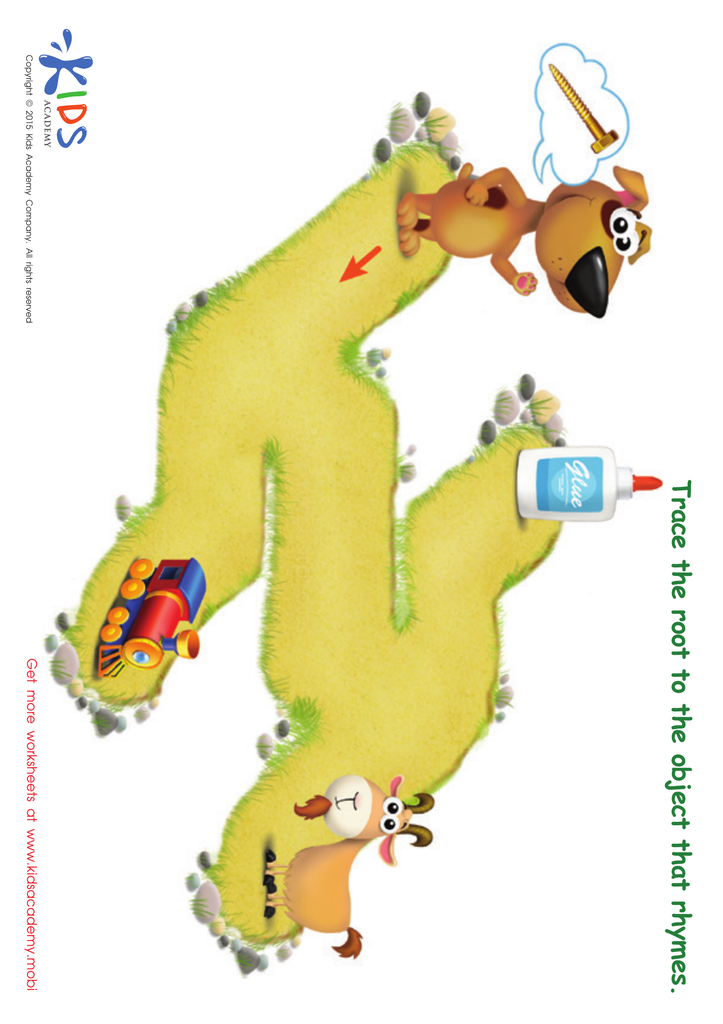
Screw Rhyming Words Worksheet
Worksheet
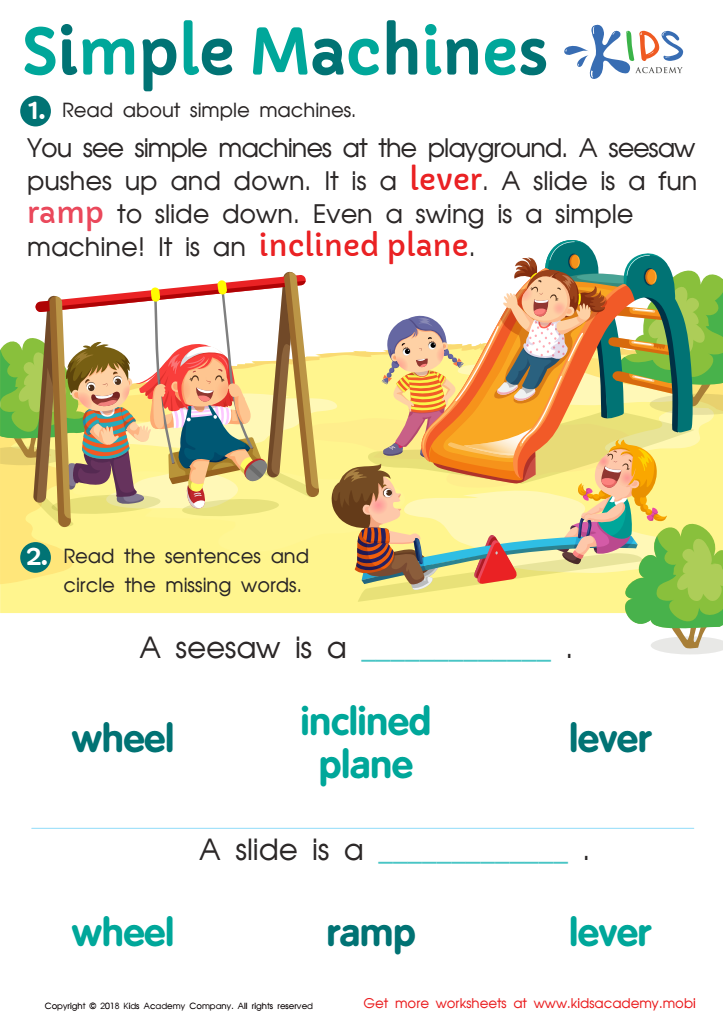
Simple Machines Worksheet
At the playground, your kids likely love to play and swing. Swings are simple machines – they work by using force to move something. Read the following sentences to them, with some words missing - help them fill in the blanks. Simple machines make work easier by __changing__ the size or __direction__ of a force. Swings use a _fulcrum_ and a _lever_ to move.
 Assign to My Students
Simple Machines Worksheet
Worksheet
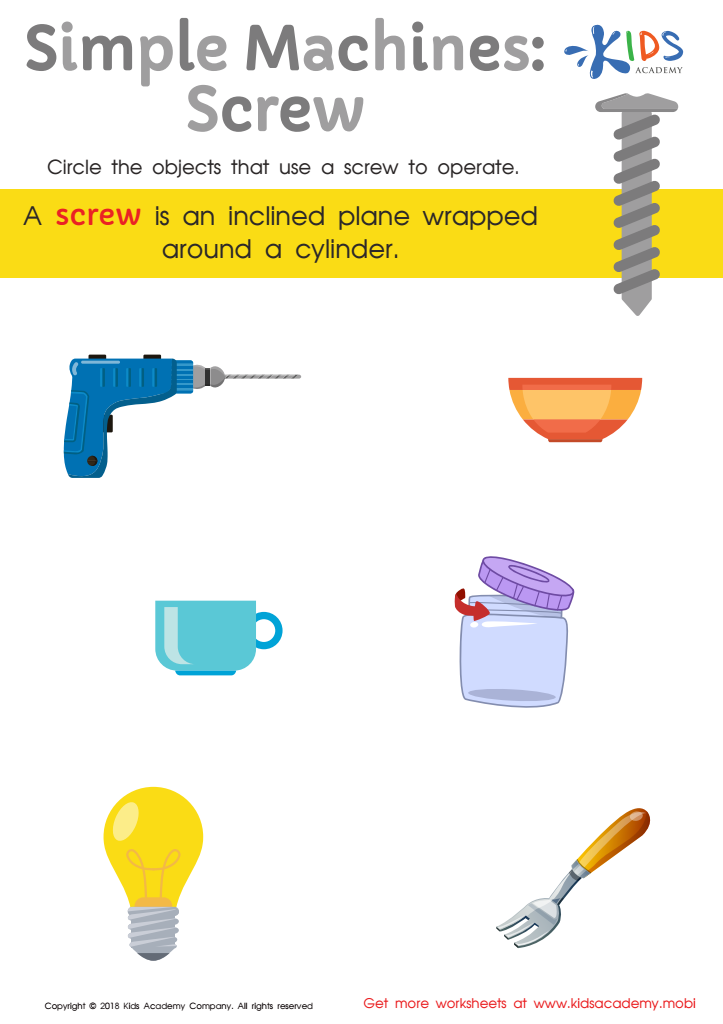
Simple Machines: Screw Worksheet
Explain to your kids that learning about simple machines can be fun - like the swings they love on the playground. Ask them to name some of their favorites. Point out that screws are used to connect simple machines. Then, look at pictures together and have your kids circle the objects that use a screw.
Simple Machines: Screw Worksheet
Worksheet
Join Kids Academy for Free
Who is primarily going to use this learning content?







Understanding simple machines is essential for young learners aged 6-9 as it lays the foundation for critical thinking, problem-solving, and an appreciation of the world around them. Simple machines, including levers, pulleys, wheels, and inclined planes, are fundamental concepts that explain how everyday tasks are made easier. By teaching children about these tools, we equip them with the ability to recognize mechanics in their environment, enhancing their observational skills.
Parents and teachers should care about this topic because it sparks curiosity, encourages exploration, and fosters STEM (Science, Technology, Engineering, and Mathematics) learning opportunities. Engaging with simple machines through playful, hands-on activities can stimulate children’s imagination and creativity, leading to a deeper understanding of basic engineering principles.
Moreover, understanding simple machines can enhance literacy skills, as reading about these concepts expands vocabulary and comprehension abilities. The interdisciplinary approach not only relates to science but also connects with art and storytelling, enriching a child’s learning experience.
By cultivating an interest in mechanical principles, we empower children to think innovatively and approach challenges with confidence, preparing them for a future where problem-solving skills are vital. Supporting this exploration nurtures a curious mindset that benefits all areas of schooling and personal development.








