Fraction simplification Worksheets for 6-Year-Olds
7 filtered results
-
From - To
Boost your child's math skills with our "Fraction Simplification Worksheets for 6-Year-Olds"! These printable worksheets are designed to make learning fun and engaging for young minds. With colorful and easy-to-understand exercises, children can grasp the fundamental concept of simplifying fractions effortlessly. The worksheets not only enhance basic math skills but also build confidence in handling more complex problems in the future. Perfect for both classroom and at-home learning, our worksheets ensure a solid mathematical foundation. Let your child enjoy learning with our expertly crafted resources, fostering a love for math from an early age!
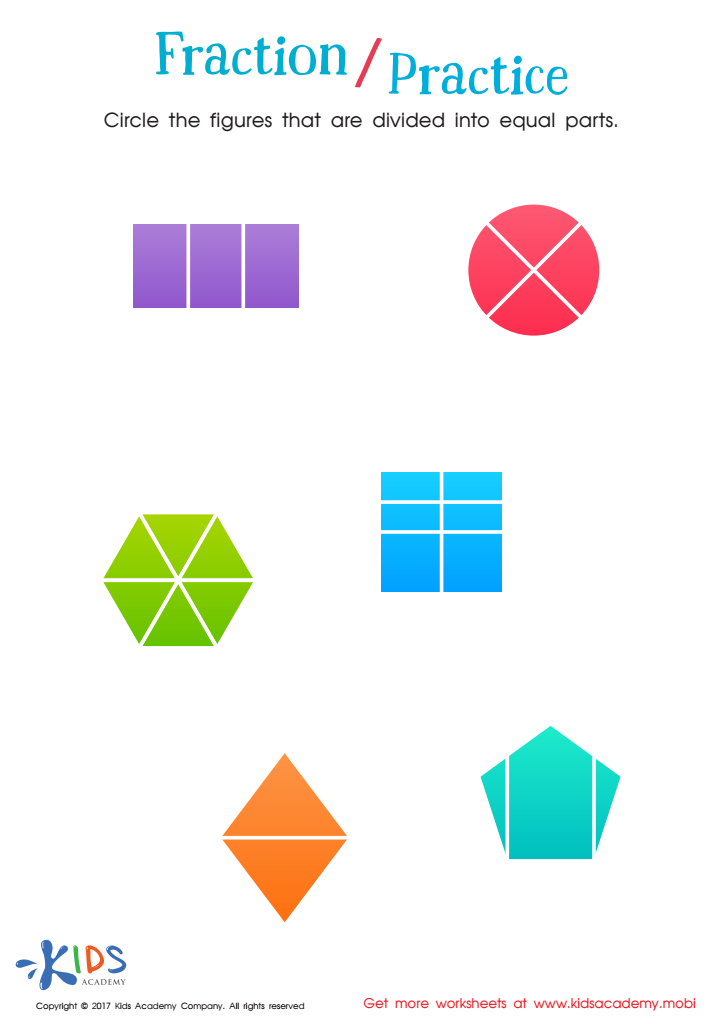
Fractions: Shapes Worksheet
 Assign to My Students
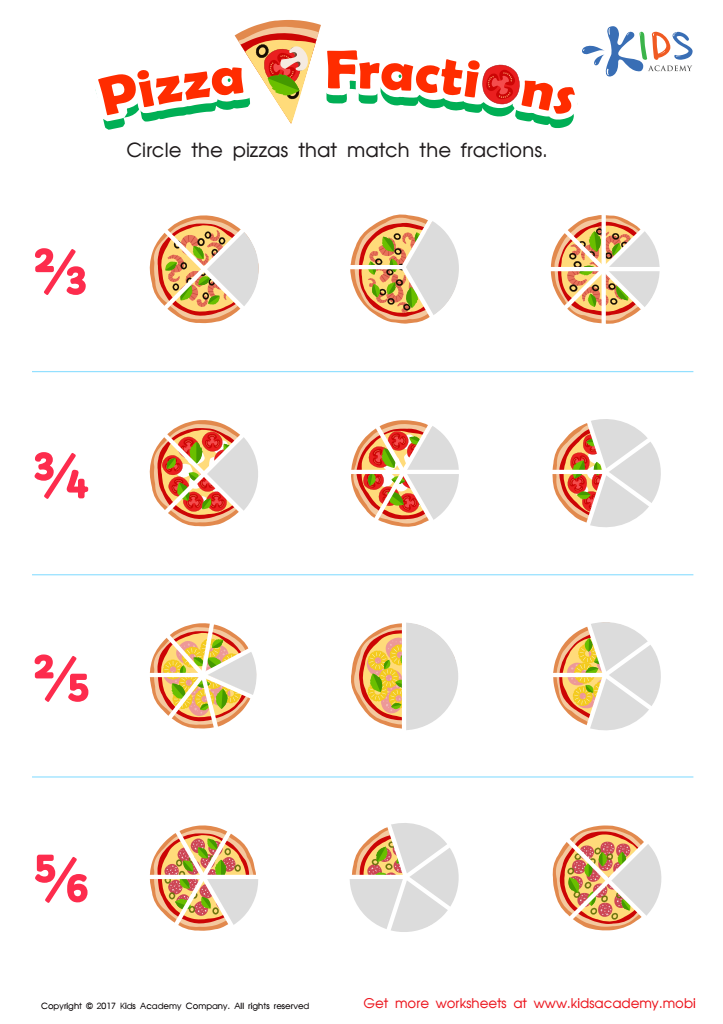
Fractions: Pizza Printable





Parents and teachers should care about teaching fraction simplification to 6-year-olds because it lays a foundational math skill crucial for later academic success. Simplifying fractions helps children grasp the concept of equivalent fractions, which fosters a deeper understanding of proportions, ratios, and multiple mathematics operations such as addition, subtraction, multiplication, and division involving fractions.
Early exposure to fraction simplification helps develop critical thinking and problem-solving skills. It encourages young children to look at numbers analytically, understanding both the parts (numerator and denominator) and the whole. This analytical approach improves their overall number sense and ability to work flexibly with numbers.
Moreover, mastering fraction simplification builds their confidence and reduces apprehension about more complex math topics they will encounter in higher grades. A child comfortable with fractions is better poised to tackle algebra, geometry, and advanced arithmetic.
Practically, the life skills benefits are immense. From halving recipes to understanding discounts during shopping, fraction literacy is interwoven into everyday activities. Early familiarity allows children to interact with and understand their environment more effectively.
Ultimately, when parents and teachers invest time in teaching fraction simplification early, they help build a robust mathematical foundation, setting children up for future academic achievements and day-to-day practical application.








