Spatial understanding Worksheets for 6-Year-Olds
3 filtered results
-
From - To
Boost your child's spatial reasoning skills with our engaging Spatial Understanding Worksheets designed for 6-year-olds. These expertly crafted exercises help young learners grasp essential concepts such as shapes, patterns, and spatial relationships in a fun, interactive way. By navigating through a variety of puzzles and tasks, kids enhance their ability to visualize and manipulate objects in space, critical for future success in math and science. Our worksheets are perfect for supplementing classroom learning or for home education. Encourage your child's cognitive development and problem-solving abilities with these enjoyable and educational worksheets. Download now and start exploring!
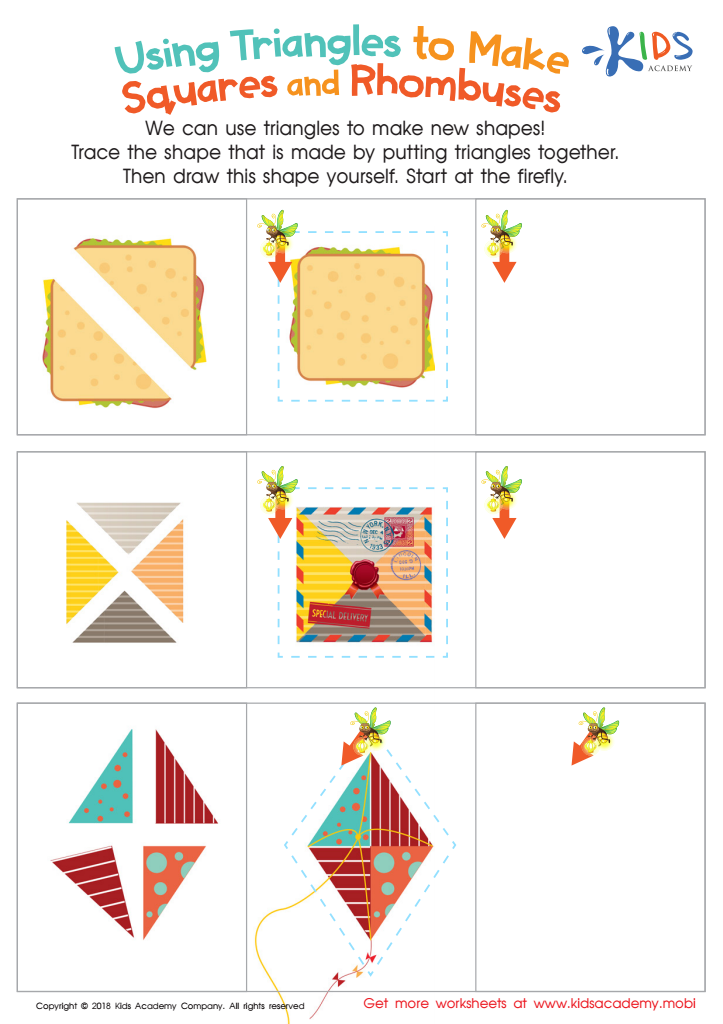
Using Triangles to Make Squares and Rhombuses Worksheet
 Assign to My Students
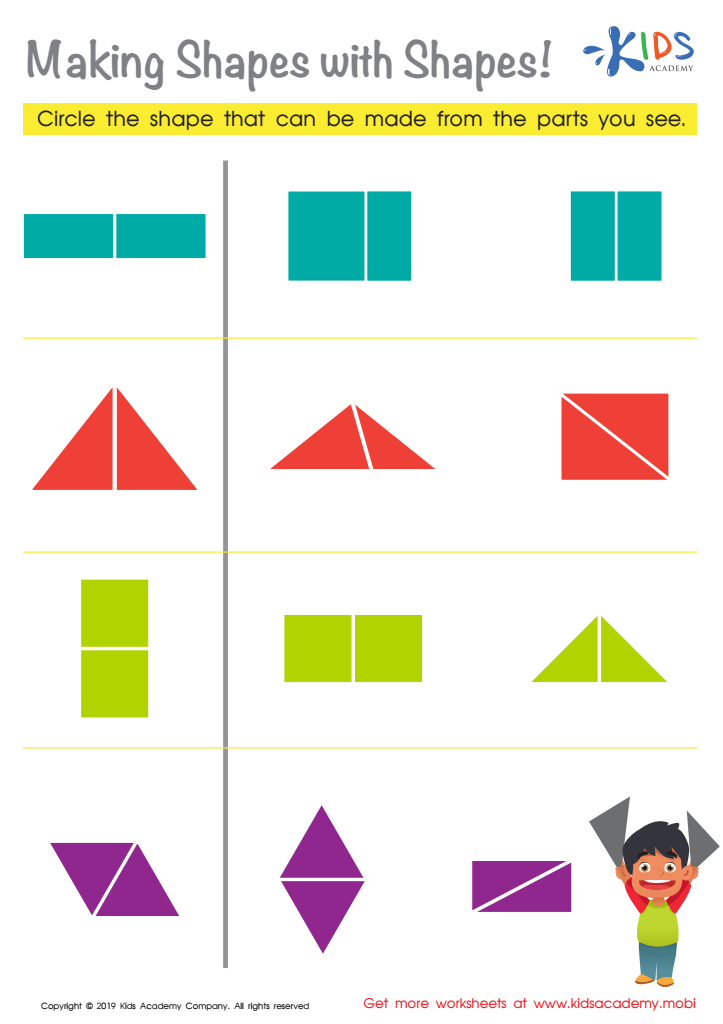
Making Shapes with Shapes Worksheet
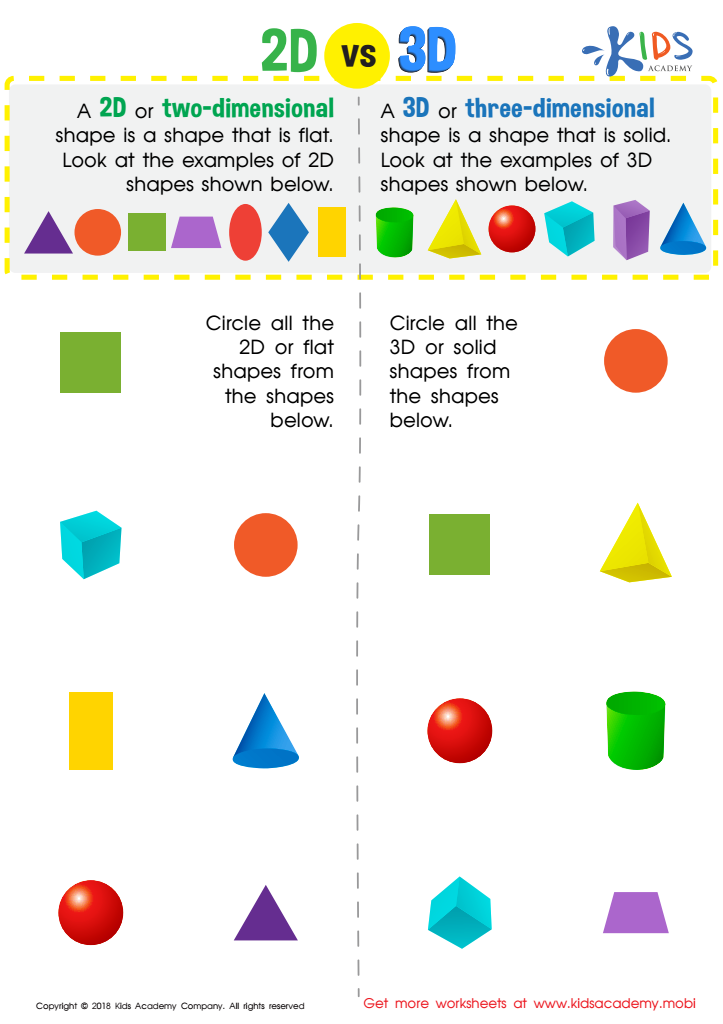
2D vs 3D Shapes Worksheet







Spatial understanding is a fundamental cognitive skill crucial for a child's overall development and success in various academic and life activities. For 6-year-olds, sharpening this skill can significantly enhance their capabilities in mathematics, especially in understanding concepts of geometry, measurement, and problem-solving, which form the cornerstone of STEM education.
Parents and teachers should recognize that spatial awareness helps children make sense of the world around them. It allows them to understand relationships between objects, navigate through their environment, and develop better hand-eye coordination. For instance, when children play with building blocks, they learn about dimensions, balance, and spatial relationships, which are the building blocks for more complex skills like mathematical reasoning and even language development.
Moreover, strong spatial skills are linked to improved creativity and critical thinking. Children with well-developed spatial awareness are better at visualizing and manipulating objects, which can contribute to enhanced imagination and better storytelling abilities.
Furthermore, spatial reasoning is a predictor of future success. Studies show that children with higher spatial skills are likely to excel in fields such as science and engineering.
By nurturing spatial skills through activities like puzzles, drawing, and play, parents and teachers are not just supporting academic growth but also fostering a well-rounded, problem-solving mindset that will benefit children throughout their lives.








