Understanding skip-counting Numbers Worksheets for 6-Year-Olds
3 filtered results
-
From - To
Unlock the magic of numbers with our "Understanding Skip-Counting Numbers Worksheets for 6-Year-Olds." Skip-counting helps children recognize number patterns, enhancing their arithmetic and problem-solving skills. These worksheets offer engaging exercises designed to make learning fun and effective. As your child progresses, they will build confidence in counting by 2s, 5s, and 10s—key foundations for future math success. Tailored for young learners, our colorful and interactive resources captivate their growing minds. Visit Kids Academy to explore these specially crafted worksheets that turn math practice into an exciting adventure. Perfect for both classroom use and at-home reinforcement!
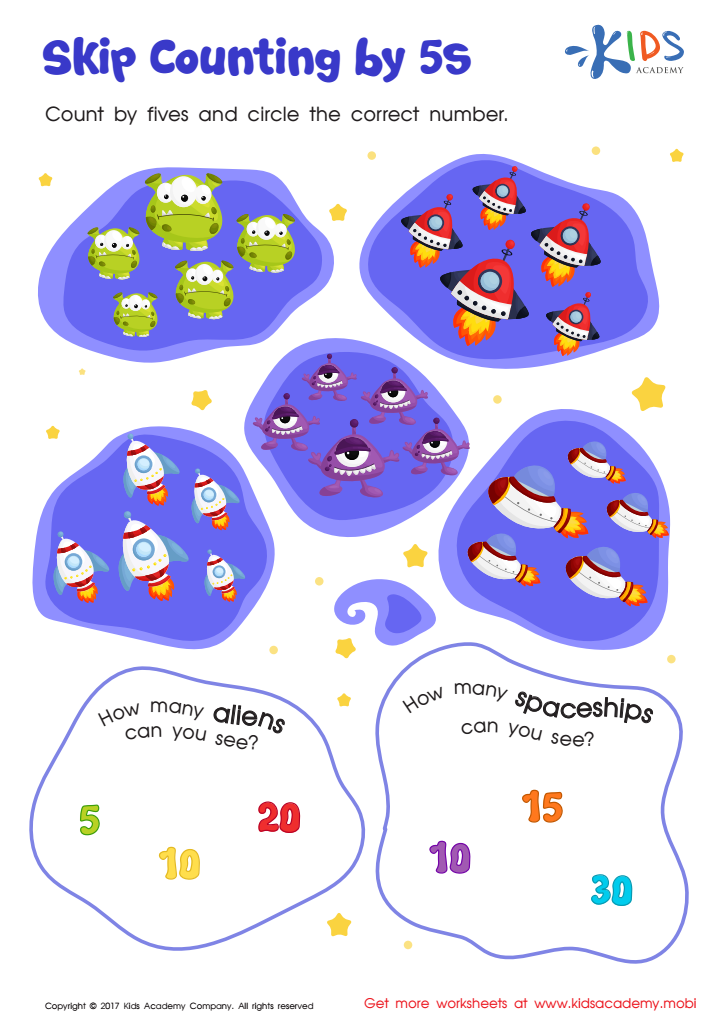
Skip Counting by 5s: Aliens and Spaceships Printable
 Assign to My Students
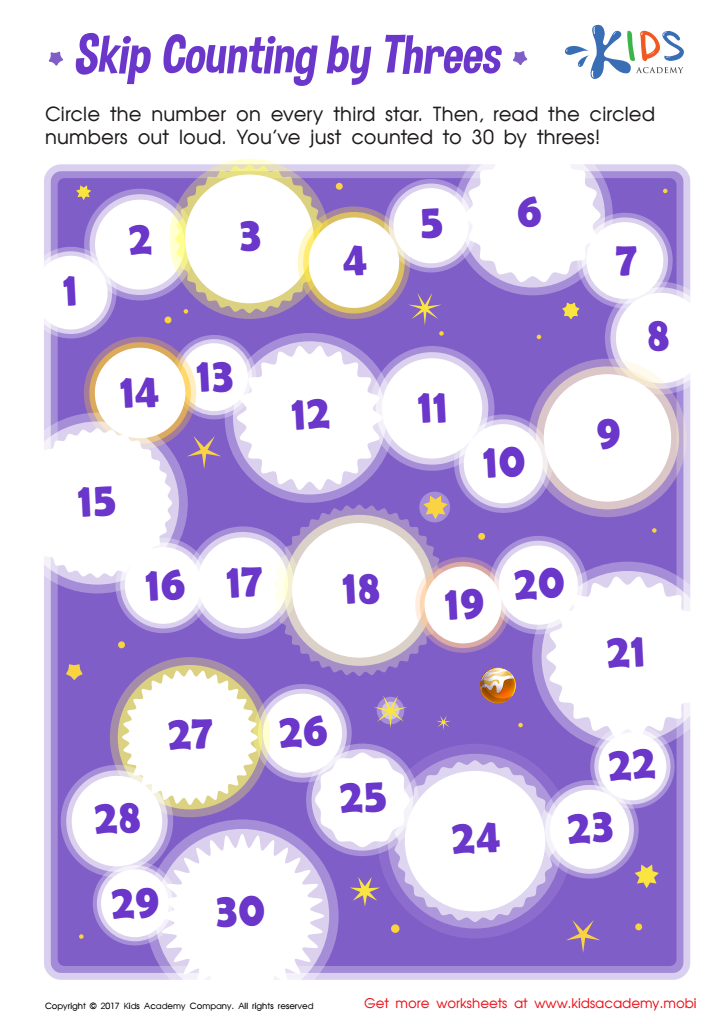
Skip Counting By Three Printable
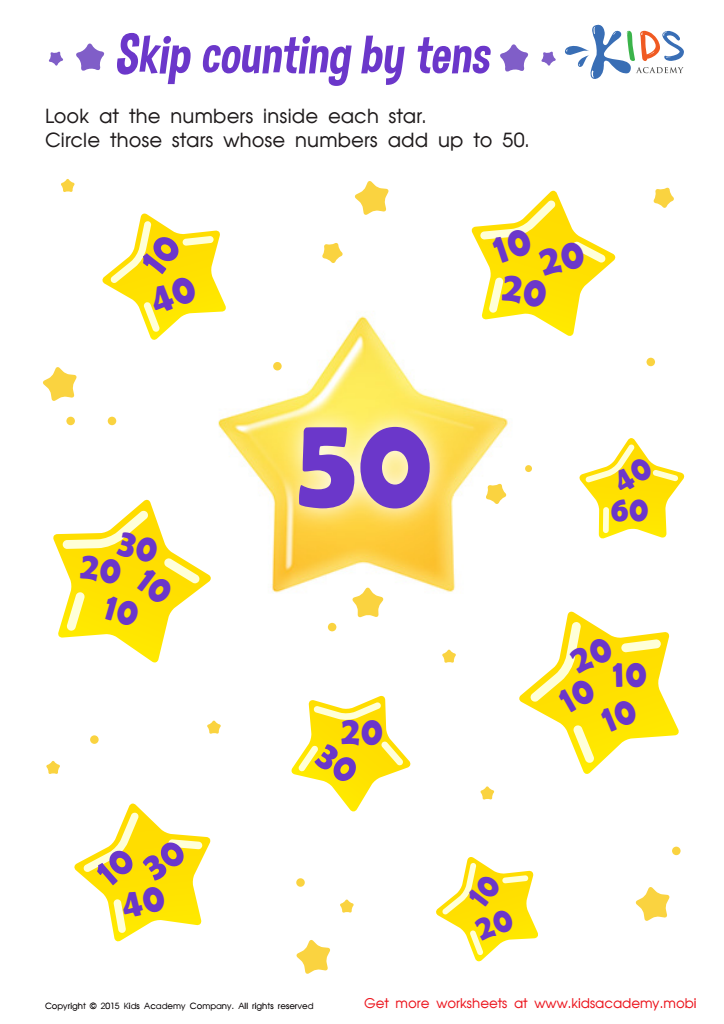
Learn Dozens: Skip Counting by Tens Printable







Understanding skip-counting is crucial for 6-year-olds as it lays a foundational skill that impacts their mathematical development. Skip-counting involves counting forward or backward by a number other than one, such as counting by twos, fives, or tens. This ability is more than just a fun exercise; it plays a significant role in several key areas.
Firstly, skip-counting helps children develop a strong number sense, an awareness of numbers and their relationships. This understanding is essential for mastering addition and subtraction more efficiently as it allows children to count in groups rather than individually, saving time and reducing errors.
Secondly, skip-counting is the groundwork for multiplication and division concepts. For example, counting by fives is a precursor to understanding the multiplication fact that 5 times 3 equals 15. This familiarity makes the later introduction of these operations more intuitive.
Additionally, skip-counting improves pattern recognition, a critical cognitive skill that supports problem-solving and logic. Recognizing these patterns in numbers builds a child's overall mathematical thinking competency.
For parents and teachers, encouraging skip-counting practice builds confidence in young learners and paves the way for their success in more complex mathematical tasks. Integrating skip-counting into daily activities through songs, rhymes, and physical movements can make this learning process both effective and enjoyable.








