
Space knowledge Science Worksheets for 6-Year-Olds
3 filtered results
Difficulty Level
Grade
Age
-
From - To
Subject
Activity
Standards
Embark on an interstellar adventure with our Space Knowledge Science Worksheets designed for 6-year-olds! These engaging and educational printables from Kids Academy introduce young learners to the wonders of our universe. Featuring fun activities and exercises, the worksheets cover fascinating topics like planets, stars, and the solar system. Each worksheet aims to foster curiosity and a love for space while developing essential science skills. Perfect for classroom use or at-home learning, our worksheets make space exploration accessible and enjoyable for young minds. Ignite your child's astronomical journey today with our expertly crafted space-themed educational resources!
Favorites
With answer key
Interactive
 Assign to My Students
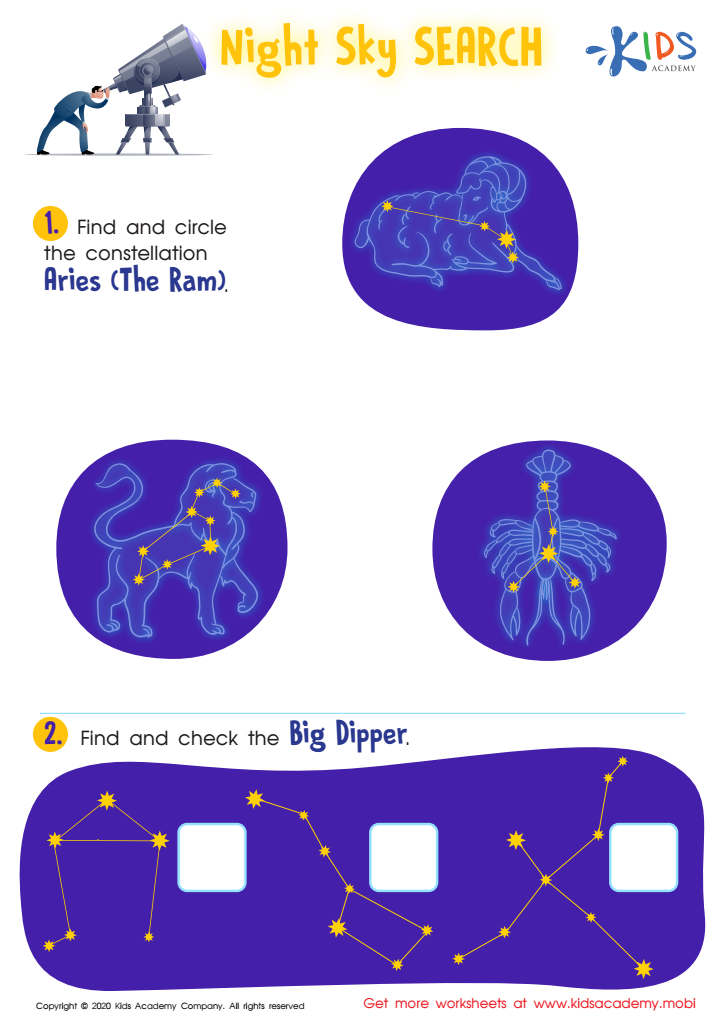
Night Sky Search Worksheet
Gaze up into the night sky and spot the stars! Your little astronomer can learn about Aries and Big Dipper constellations with this science worksheet. Simply find the ram for Aries and check the box for Big Dipper. Then, when the weather is right, go outside and look for them in the night sky!
Night Sky Search Worksheet
Worksheet
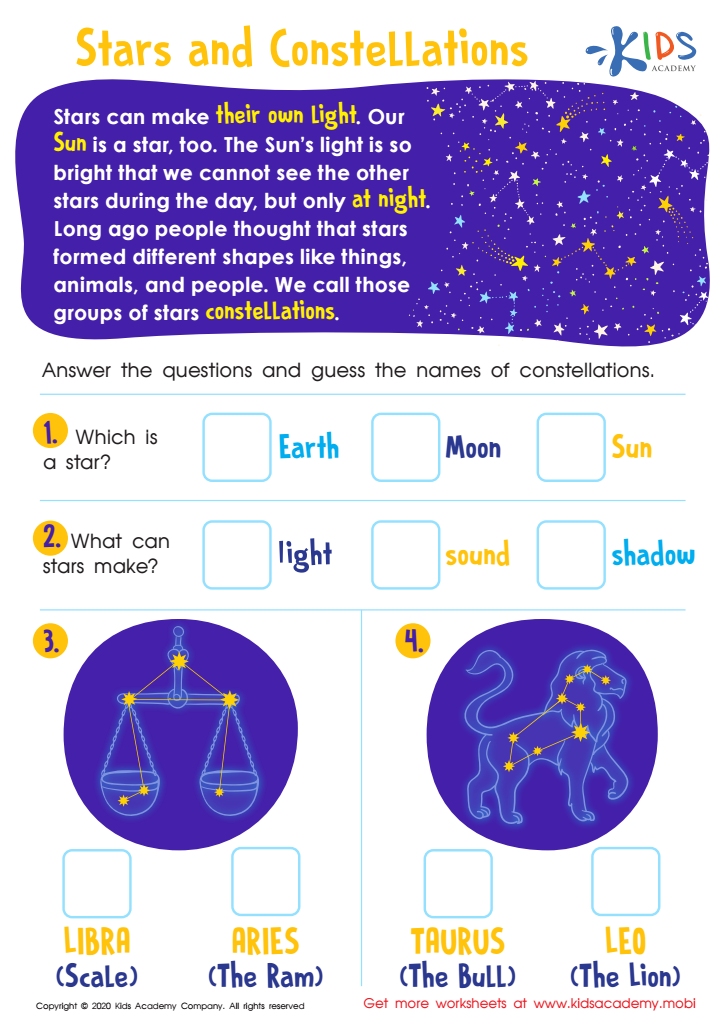
Stars and Constellations Worksheet
Learn about stars and constellations with this entertaining worksheet! Read the passage at the top of the page to gain an understanding of stars, then test your child's knowledge with the questions below. Check the right answers and finish this science worksheet with your child - they'll be amazed that stars can make their own light, just like the sun!
Stars and Constellations Worksheet
Worksheet
Join Kids Academy for Free
Who is primarily going to use this learning content?







Space knowledge science might seem complex, but introducing it to 6-year-olds is incredibly valuable. At this age, children are naturally curious and have a tremendous capacity for wonder. Learning about space nurtures this curiosity and can inspire a lifelong interest in science and exploration.
Firstly, space science encourages critical thinking and problem-solving. When children ask questions like, "Why does the moon change shape?" they learn to search for answers and understand the world around them. This fosters a scientific mindset that is beneficial across all areas of learning.
Secondly, understanding basic space concepts can help children grasp bigger picture ideas like our place in the universe. These discussions can build their imagination, creativity, and perspective. Visualizing planets, stars, and galaxies expands their comprehension beyond their immediate surroundings.
Moreover, early exposure to space science can lay the groundwork for future STEM (science, technology, engineering, and mathematics) skills. With the growing demand for STEM-related professions, equipping children with a solid science foundation from an early age positions them for future educational and career opportunities.
Lastly, learning about space can be engaging and fun! Activities like star gazing, building simple rockets, or even watching animated space adventures can make learning joyful. Overall, space science boosts curiosity, critical thinking, imagination, and future readiness, making it an essential part of early education.







