Map reading skills Our Planet and Environment Worksheets for Ages 7-9
1 filtered results
-
From - To
Discover engaging "Map Reading Skills: Our Planet and Environment" worksheets, designed specifically for children aged 7-9 at Kids Academy! Foster essential geography skills with interactive exercises that help young learners understand cardinal directions, interpret map symbols, and read different types of maps. These printable worksheets make learning about our planet and its diverse environments both fun and educational. Perfect for classroom or at-home learning, these activities build critical thinking and spatial awareness in young students, promoting a deeper appreciation for geography and environmental science. Start exploring today and watch your child's map reading abilities soar!
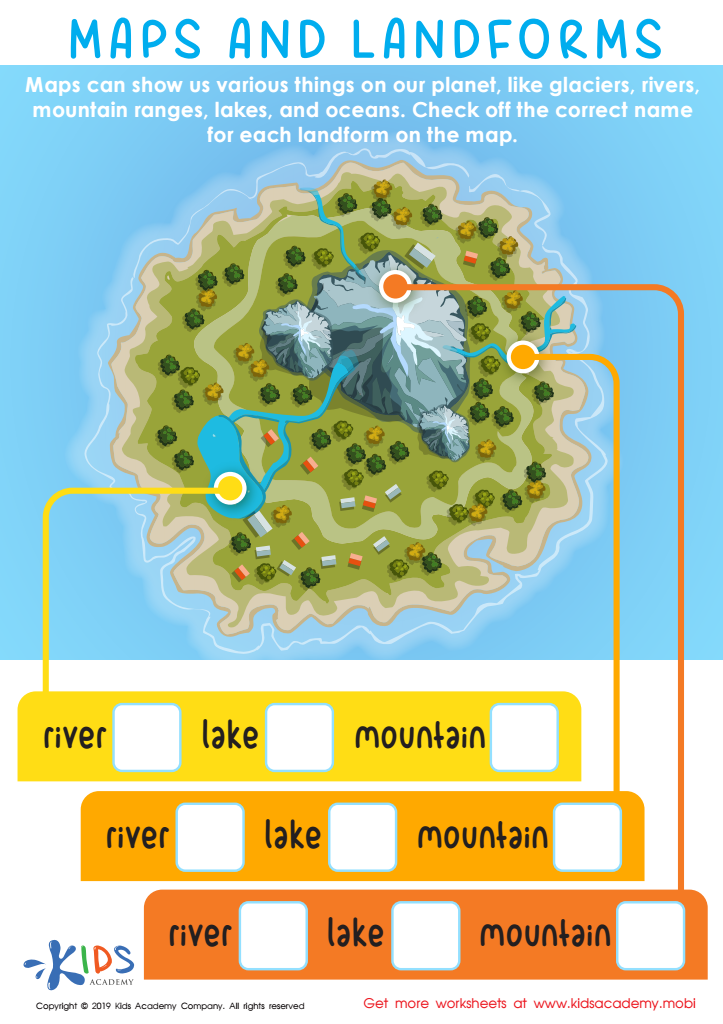
Maps and Landforms Worksheet
 Assign to My Students





Map reading skills are essential for children ages 7-9 as they foster critical thinking, spatial awareness, and a deeper understanding of our planet and environment. At an age when curiosity and learning are at their peak, teaching children to read maps can ignite an interest in geography, cultures, and natural phenomena, providing them with a more comprehensive worldview.
Firstly, maps enhance spatial thinking, which is pivotal in problem-solving and understanding abstract concepts in subjects like math and science. It helps children visualize locations and how they are related, improving cognitive skills that aid in both academic and everyday activities.
Moreover, maps serve as a gateway to environmental education. By understanding maps, children can grasp crucial themes such as climate zones, natural resources, and human impact on the earth. This knowledge sparks an early awareness of environmental issues, fostering a sense of responsibility and stewardship towards the planet.
Furthermore, map reading encourages independence and self-confidence. As children become adept at using maps, they feel more empowered and capable, which boosts their self-esteem and promotes lifelong learning.
In a globalized world, understanding how to navigate and interpret maps isn't just an academic exercise—it's a vital life skill. Supporting children in developing these abilities sets a foundation for informed, responsible, and engaged global citizens.







