
Number comparison Numbers Worksheets for Ages 8-9
4 filtered results
Difficulty Level
Grade
Age
-
From - To
Subject
Activity
Standards
Explore our engaging Number Comparison Worksheets designed specifically for children aged 8-9. These worksheets aim to strengthen your child's understanding of comparing numbers with fun, interactive exercises. Our comprehensive resources help children practice identifying larger and smaller numbers, using inequality symbols, and mastering the concept of equal values. By incorporating real-life examples and colorful illustrations, students are encouraged to improve their numerical reasoning in a visually stimulating environment. Perfect for classroom use or at-home learning, these worksheets are crafted to build confidence and proficiency in number comparison, ensuring a solid foundation in essential math skills. Enhance your learning experience today!
Favorites
With answer key
Interactive
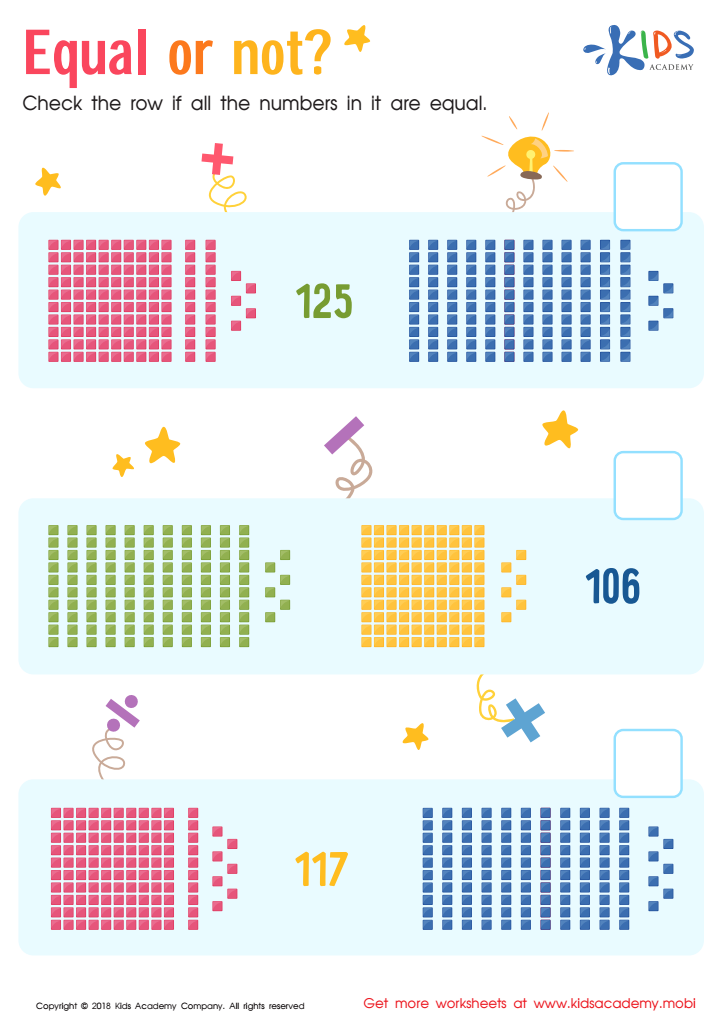
Equal or not Worksheet
To grow your child's learning, challenge them with new tasks. Stimulate their brains with activities that will build their knowledge and thinking skills. Take advantage of this worksheet exercise: ask your child to check the rows where all the numbers are equal. This simple exercise will improve their learning.
 Assign to My Students
Equal or not Worksheet
Worksheet
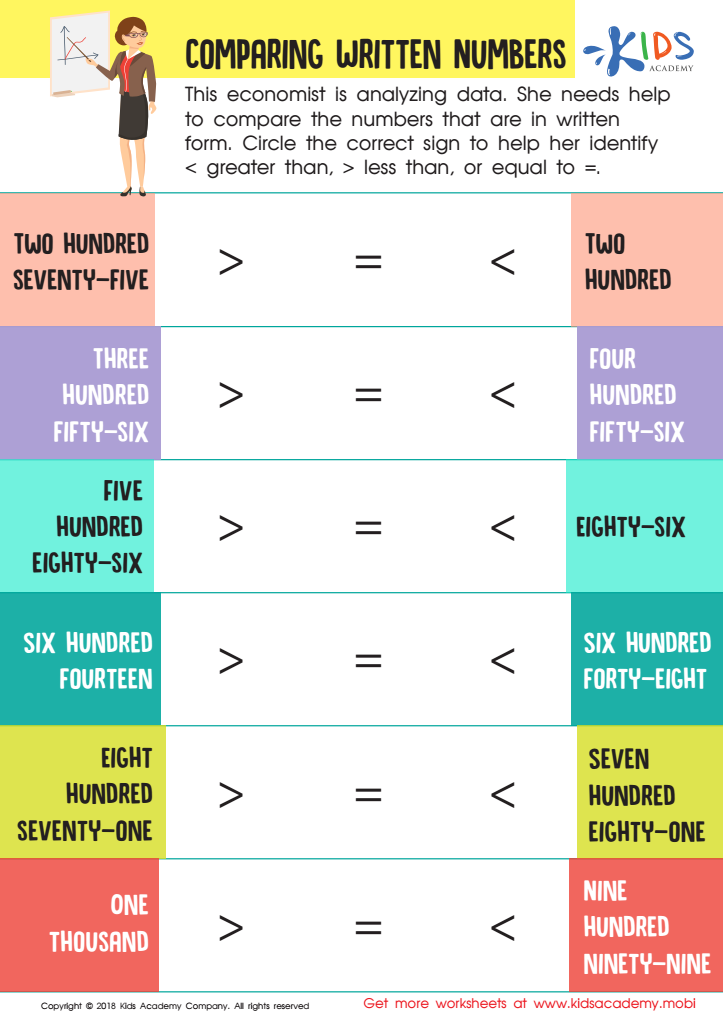
Comparing Written Numbers Worksheet
Children need to grasp that numbers come in different forms. This exciting PDF provides practice for comparing values written as words. Young economists can analyze the number pairs, then circle the sign (<, =, or >) to make comparisons true.
Comparing Written Numbers Worksheet
Worksheet
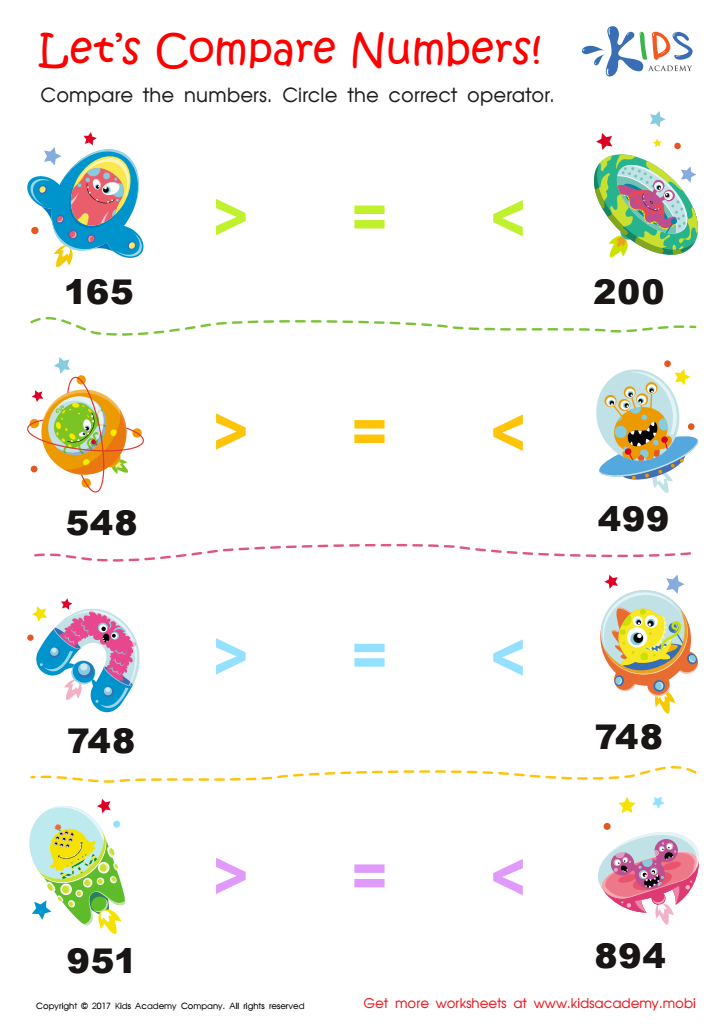
Comparing Numbers Worksheet for 2nd Grade
Alien friends are back to help your child learn to compare numbers using >, < and = symbols. This 2nd grade worksheet will challenge them with larger numbers!
Comparing Numbers Worksheet for 2nd Grade
Worksheet
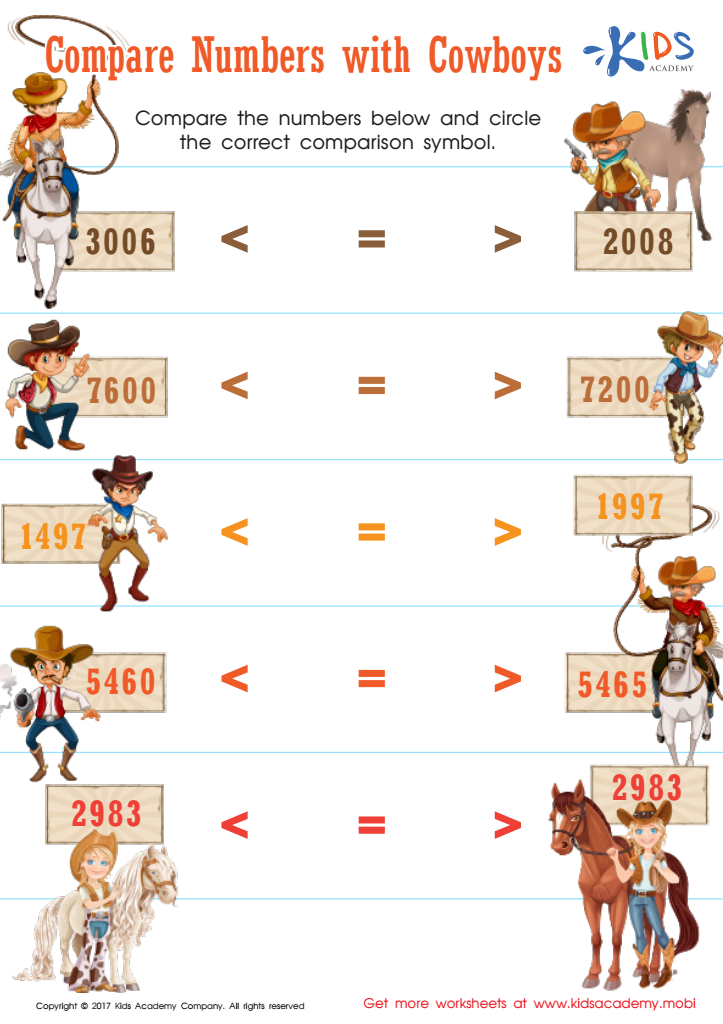
Compare Numbers Worksheet for 3rd Grade
Time to get a roundup on big numbers! Help your 3rd grader practice comparing thousands with this compare numbers worksheet. They'll use >, <, and = symbols for tricky numbers. Jump in and join the cowboys!
Compare Numbers Worksheet for 3rd Grade
Worksheet
Join Kids Academy for Free
Who is primarily going to use this learning content?



%20(1).jpg)




Number comparison is a fundamental skill that plays a crucial role in a child's mathematical development, particularly for students aged 8-9. At this stage, children are transitioning from basic arithmetic to more complex mathematical concepts, making number comparison essential for their cognitive growth.
Firstly, understanding number comparison helps children develop a strong foundation for problem-solving. It enhances their ability to identify larger or smaller quantities, which is important for grasping concepts like addition, subtraction, and ordering numbers. Mastering this skill boosts number sense, leading to greater confidence in mathematics.
Secondly, number comparison is vital for comparative reasoning. Being able to assess and analyze different values allows students to make informed decisions, whether in real-life situations (like shopping or budgeting) or during math lessons.
Lastly, educators and parents should recognize that mastering this skill promotes independence. As children become proficient in comparing numbers, they learn to approach mathematical problems with a certain degree of self-reliance, preparing them for more challenging concepts in the future. Encouraging practice with number comparison now lays the groundwork for their success in math and beyond, contributing to their overall academic achievement.








