Building vocabulary Math Worksheets for 8-Year-Olds
3 filtered results
-
From - To
Enhance your 8-year-old's math skills with our engaging Building Vocabulary Math Worksheets! Designed to support young learners, these worksheets introduce essential math terms and concepts in a fun, interactive way. Through a variety of exercises like matching, fill-in-the-blanks, and word searches, kids can expand their math vocabulary while mastering critical skills. Our worksheets cater to different learning styles, ensuring that every child can build confidence and understanding in mathematics. Perfect for both classroom and home use, these resources will make learning math enjoyable and accessible. Start your child’s journey towards math literacy today with our comprehensive, user-friendly worksheets!
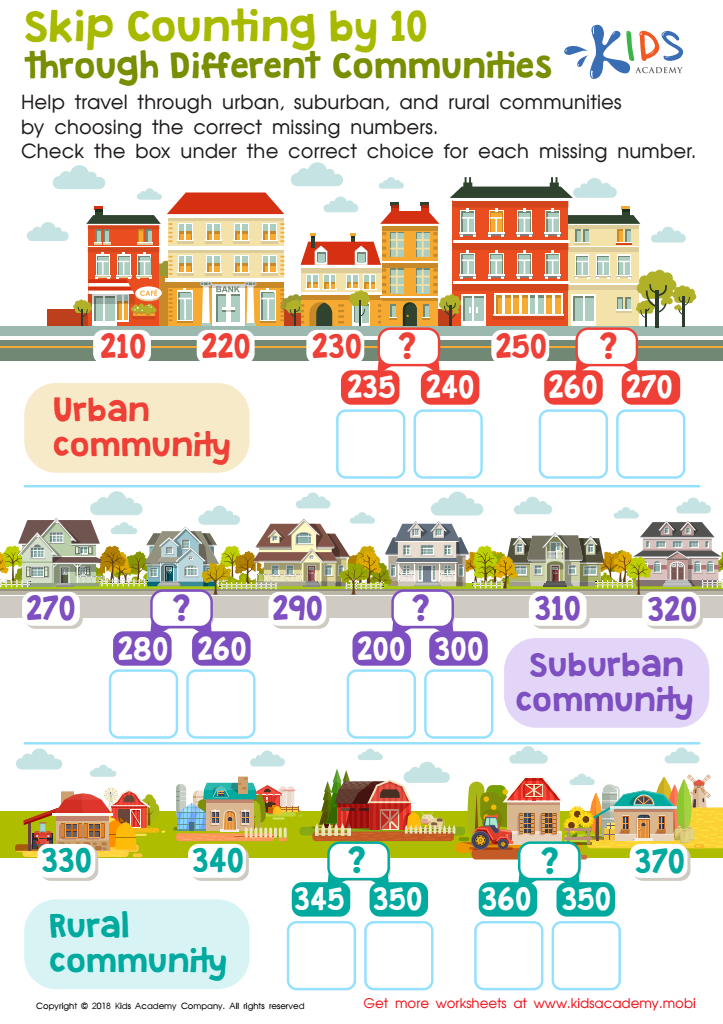
Skip Counting by 10 through Different Communities Worksheet
 Assign to My Students








Building vocabulary in math for 8-year-olds is crucial for several reasons. At this age, children are transitioning from basic arithmetic to more complex problem-solving and mathematical concepts. An enhanced math vocabulary allows them to clearly articulate their thinking, understand instructions, and engage more effectively in mathematical discussions. When children have a robust vocabulary, they can better comprehend word problems and follow multi-step solutions, which is essential in developing critical thinking skills.
Furthermore, a strong math vocabulary aids in bridging gaps between mathematical language and everyday language, fostering a deeper understanding of concepts. It promotes confidence in expressing thoughts and ideas, making learning more enjoyable and interactive. This foundational vocabulary is not just applicable in the classroom; it extends to real-life scenarios where math is used, such as shopping, cooking, or planning a schedule.
Parents and educators play a vital role in cultivating this vocabulary through conversations and activities that integrate math language in engaging contexts. Investing time in building math vocabulary helps children become proficient and confident learners, paving the way for future academic success while developing a positive attitude toward math. Ultimately, enriched math vocabulary equips children with essential tools they need for lifelong learning.








