
Money identification Math Worksheets for 8-Year-Olds
4 filtered results
Difficulty Level
Grade
Age
-
From - To
Subject
Activity
Standards
Introduce your child to the basics of financial literacy with our Money Identification Math Worksheets, tailored for 8-year-olds. These engaging printables from Kids Academy are designed to make learning fun and interactive. Your child will master identifying coins and bills, understanding their values, and practicing simple money calculations. Boost their confidence and math skills with exercises that align with educational standards while promoting critical thinking and problem-solving. Perfect for both classroom and home use, these worksheets provide a strong foundation for future financial success. Start your child’s journey to becoming money-smart today!
Favorites
With answer key
Interactive
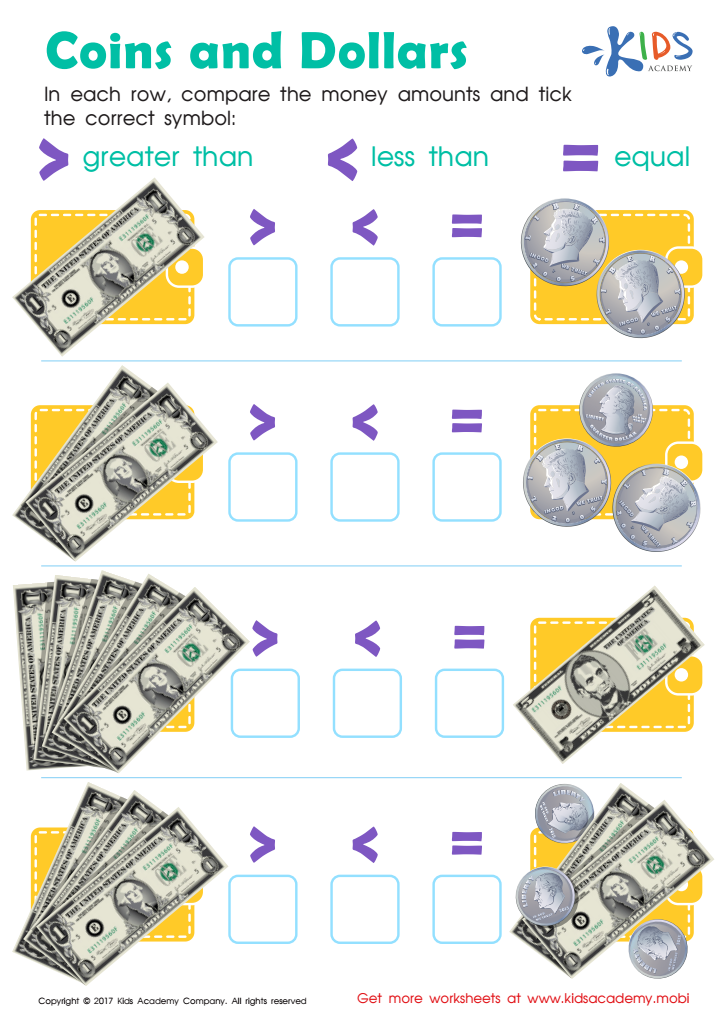
Money: Coins Dollars Printable
Motivate your kid to learn and practise essential math skills, like 'greater than' and 'less than', by introducing the importance of money! The money worksheet "Coins and Dollars" will give them a hands-on experience of counting coins and dollars, making math symbols more memorable.
 Assign to My Students
Money: Coins Dollars Printable
Worksheet
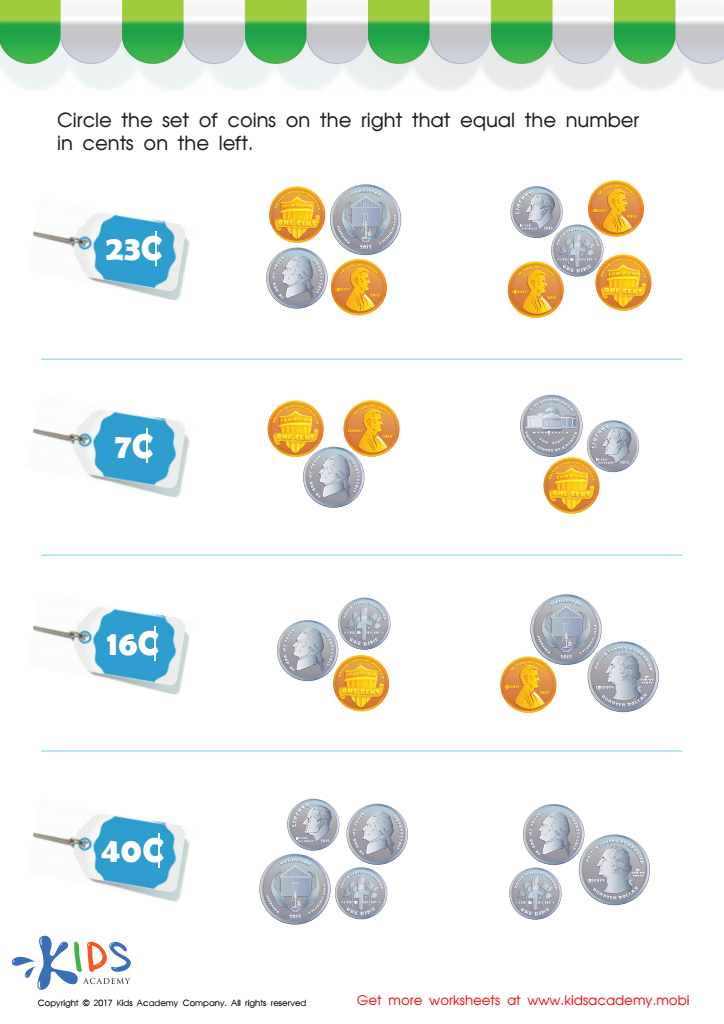
Picking the Coins You Need Money Worksheet
Let's learn to count money with Parents and Kids Academy! Investigate a real shop together: buy a globe, pencils, books, and a school bag using coins. Then, circle the coins you'll need. Visit our website for more free and fun money games for kids!
Picking the Coins You Need Money Worksheet
Worksheet
Join Kids Academy for Free
Who is primarily going to use this learning content?






Understanding money identification and basic math concepts is crucial for 8-year-olds, and it's something parents and teachers should consider vitally important. At this developmental stage, children are ready to grasp the concept of different coin and bill values, laying down the foundation for financial literacy. This knowledge helps in fostering a sense of responsibility and independence as children start participating in simple transactions, such as buying snacks or toys.
Learning to identify and count money bolsters key mathematical skills, including addition, subtraction, multiplication, and division. These operations are much more engaging for kids when they involve something as tactile and relatable as money. By practicing with real-world scenarios, children can better understand concepts that might otherwise seem abstract.
Beyond mathematics, money identification also teaches important life skills such as making change, budgeting, and saving. These skills contribute to a child's confidence and decision-making abilities, preparing them for more complex financial tasks later on. Furthermore, mastering these concepts in early childhood sets the stage for more mature financial understanding and responsibility in adolescence and adulthood. In a world where financial capability is key to independence, these early lessons are invaluable, and thus, parents and teachers should prioritize them in a child’s learning journey.








