Identifying fractions Math Worksheets for 9-Year-Olds
3 filtered results
-
From - To
Explore our engaging Identifying Fractions Math Worksheets designed specifically for 9-year-olds! These thoughtfully crafted worksheets aim to strengthen your child's understanding of fractions through a variety of problem types. Activities include visual aids, real-life scenarios, and fun exercises that promote hands-on learning. With captivating illustrations and interactive questions, your child will easily grasp the concepts of numerator and denominator, simplifying fractions, and identifying equivalent fractions. Our resources are perfect for enhancing classroom learning or providing extra practice at home. Dive into our collection and watch your child's confidence in math soar as they master the world of fractions!
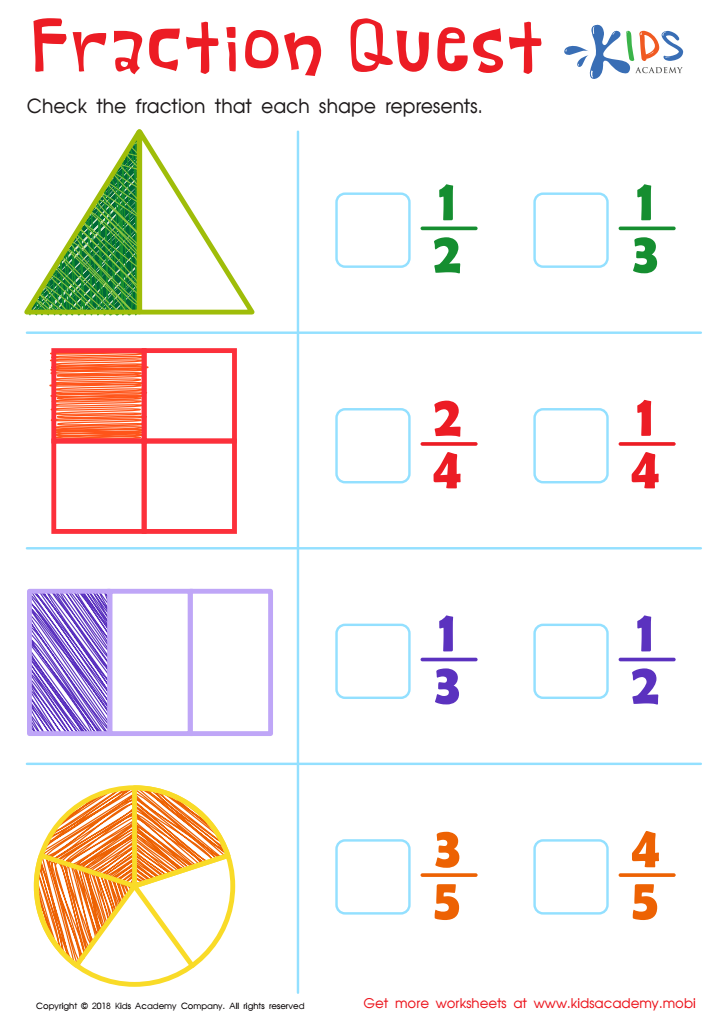
Fraction Quest Worksheet
 Assign to My Students




Identifying fractions is a crucial skill for 9-year-olds, serving as a foundation for advanced mathematical concepts. Parents and teachers should care about this because a solid understanding of fractions enhances a child's ability to understand the world around them. Fractions are not just abstract numbers; they appear in daily life—like sharing food, measuring ingredients for recipes, or understanding time.
A grasp of fractions helps children develop critical thinking and problem-solving skills. As they work with fractions, they learn to recognize parts of a whole, manipulate numbers, and relate them to real-world situations. This knowledge supports their performance in future math topics, such as decimals, percentages, and ratios, ensuring that they are well-prepared for higher level math.
Additionally, understanding fractions can boost confidence and encourage a positive attitude towards math. When students can successfully identify and work with fractions, they are less likely to develop math anxiety. For parents, fostering this skill through playful, engaging activities at home, or through fun lessons by teachers, helps create a supportive environment where children can thrive mathematically and build self-esteem in their learning journey. Thus, focusing on fractions not only enhances mathematical ability but also promotes broader cognitive and life skills.








