
Normal Elementary Phonics Worksheets Activities With Answers for 9-Year-Olds
1 filtered results
Difficulty Level
Grade
Age
-
From - To
Subject
Activity
Standards
Explore the world of phonics with our innovative Normal Elementary Phonics Worksheets Activities! Designed specifically for young learners, this engaging collection empowers students to master their phonetic skills in a fun and interactive way. Each worksheet is crafted with care, incorporating a variety of exercises that cater to different learning styles. What sets our activities apart is the inclusion of detailed answers, making it easy for students to learn from their mistakes and for parents or educators to guide them effectively. Dive into our phonics adventures today and watch your child's reading skills flourish!
Favorites
With answer key
Interactive
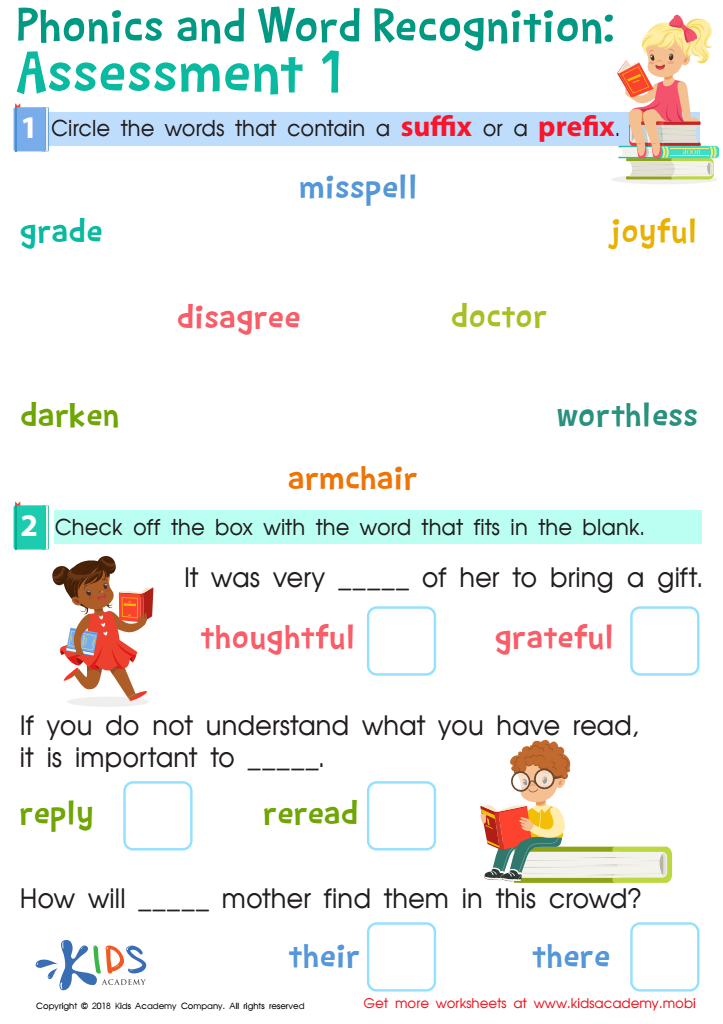
Phonics and Word Recognition: Assessment 1 Worksheet
Explain prefixes (words added to start of another word to give it a new meaning) and suffixes (added to end of word to change its meaning) to your kids with examples like 'unhappy' (prefix) and 'forgetful' (suffix). Now, help your child complete this worksheet, including circling words and checking boxes.
 Assign to My Students
Phonics and Word Recognition: Assessment 1 Worksheet
Worksheet
Learning Skills
Join Kids Academy for Free
Who is primarily going to use this learning content?







Normal Elementary Phonics Worksheets Activities with Answers offer a structured and interactive method for young learners to grasp the basics of reading and writing. Such activities are incredibly useful for several reasons, providing a solid foundation in phonics which is crucial for literacy development.
Firstly, phonics is the building block of reading. By engaging in Normal Elementary Phonics Worksheets Activities with Answers, students learn to associate letters with their sounds, an essential skill for decoding words. This association is fundamental to reading fluently and with comprehension. Through repetitive practice and reinforcement presented in these worksheets, students can master sound-letter correspondences much more effectively.
Secondly, these activities boost confidence and encourage independent learning. With answers provided, students can self-check their work, which not only reinforces learning but also builds their confidence in reading and writing. This feature is particularly beneficial as it promotes a positive learning experience, encouraging learners to engage more deeply with the material.
Moreover, Normal Elementary Phonics Worksheets Activities with Answers cater to diverse learning styles. Whether a child is a visual, auditory, or kinesthetic learner, phonics worksheets can be adapted to meet their unique learning needs. For instance, visual learners can benefit from colorful illustrations and letter formations, while kinesthetic learners can engage in cutting and pasting letters or matching activities.
Lastly, these worksheets offer a structured approach to learning phonics. The progression from simple to more complex phonetic concepts allows for a gradual increase in difficulty, ensuring that learners are not overwhelmed. This structured progression is crucial for building a comprehensive understanding of the English language’s phonetic system.
In conclusion, Normal Elementary Phonics Worksheets Activities with Answers are invaluable tools in the literacy development of young learners. They not only make phonics learning engaging and interactive but also lay a strong foundation for reading and writing skills, critical for academic success and beyond.








