Extra Challenge Tracing Shapes Worksheets for Ages 7-9
4 filtered results
Difficulty Level
Grade
Age
-
From - To
Subject
Activity
Standards
Discover our engaging Extra Challenge Tracing Shapes Worksheets, specially designed for children ages 7-9! These worksheets not only enhance fine motor skills but also promote shape recognition and coordination in a fun and interactive way. Kids will enjoy tracing various shapes, from basic geometric forms to more complex figures, fostering both creativity and precision. Our thoughtfully crafted activities cater to diverse learning styles, ensuring that every child can thrive while practicing essential skills. Perfect for use at home or in the classroom, these worksheets are an excellent resource to excite young learners about geometry and improve their academic confidence. Start tracing today!
Favorites
With answer key
Interactive
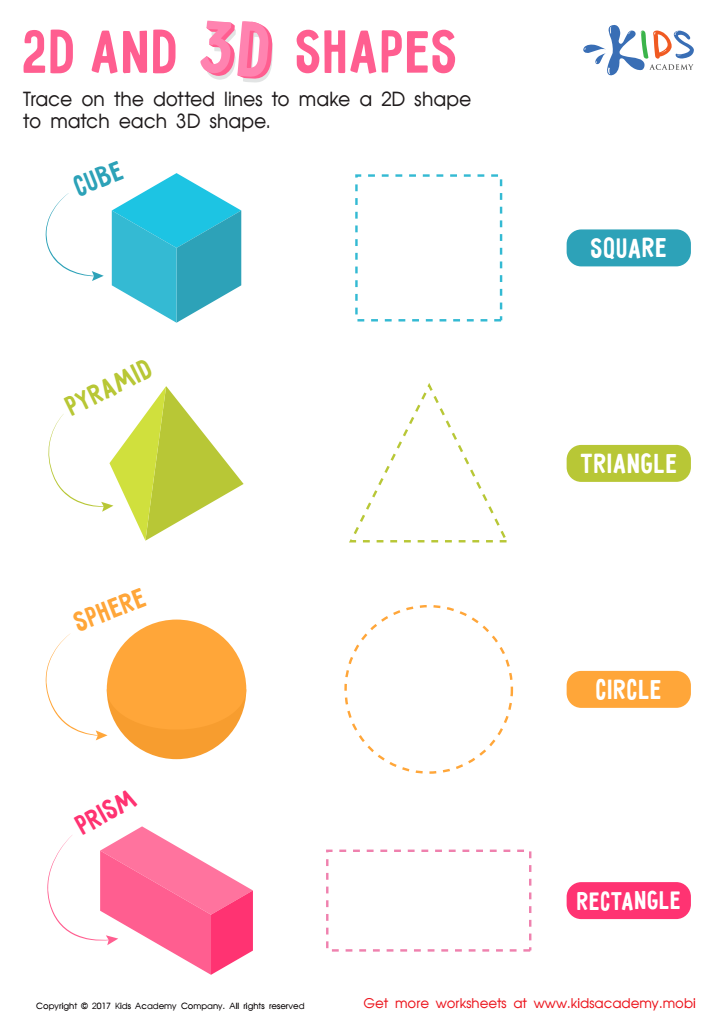
2D and 3D Shapes Worksheet
Introduce your child to 3D and 2D with this traceable worksheet. With dotted lines, help them trace and make a 2D shape for each 3D shape: square, triangle, rectangle, and circle. Show them there's more than one way to draw! You may have taken them to a 3D movie, or they've seen some fantastic 3D art. Now they can wonder no more.
 Assign to My Students
2D and 3D Shapes Worksheet
Worksheet
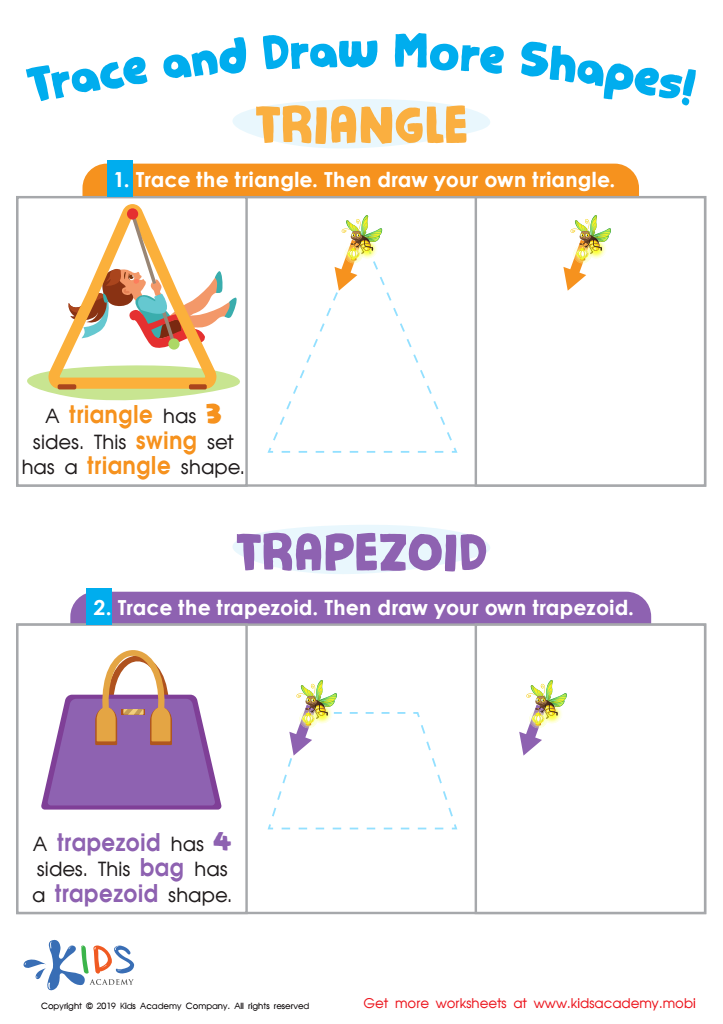
Trace and Draw More Shapes Worksheet
Help your kids with more learning! Look at images in the worksheet, read facts about the shapes, then help your kids trace and draw. This reinforces that learning is never done; use this simple worksheet to help your kids with school homework and more!
Trace and Draw More Shapes Worksheet
Worksheet
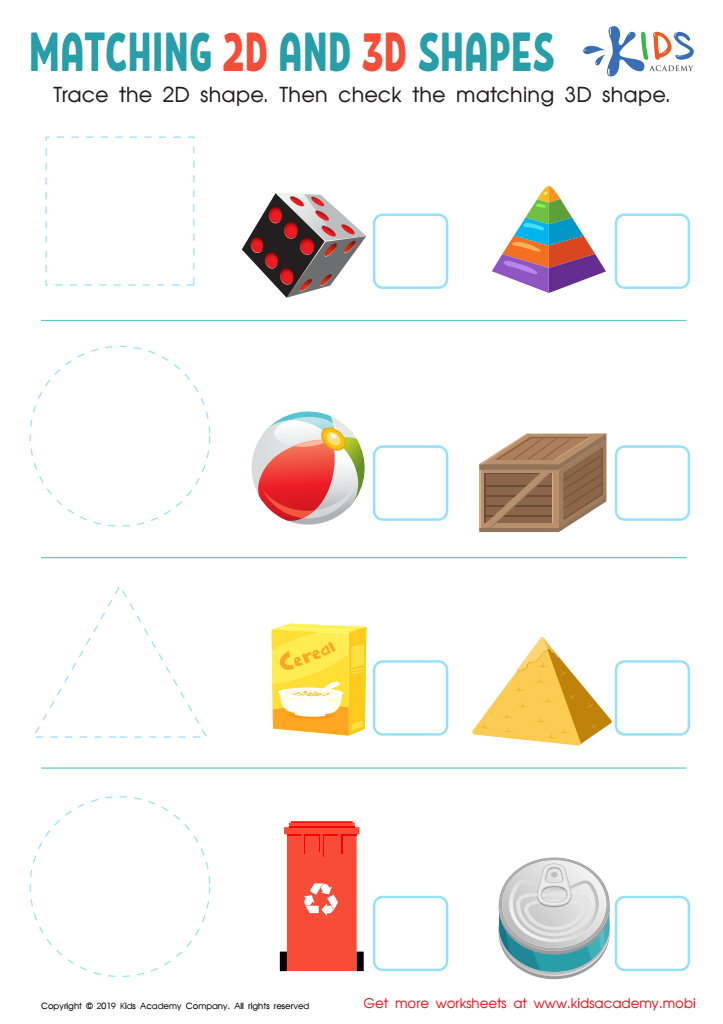
Matching 2D and 3D Shapes Worksheet
Before starting this worksheet, ask your kids what shapes they know and point out the 2D and 3D shapes on it. Help your kids trace the 2D shapes and then match them to the 3D versions. It'll be a fun new world for your kids to explore!
Matching 2D and 3D Shapes Worksheet
Worksheet
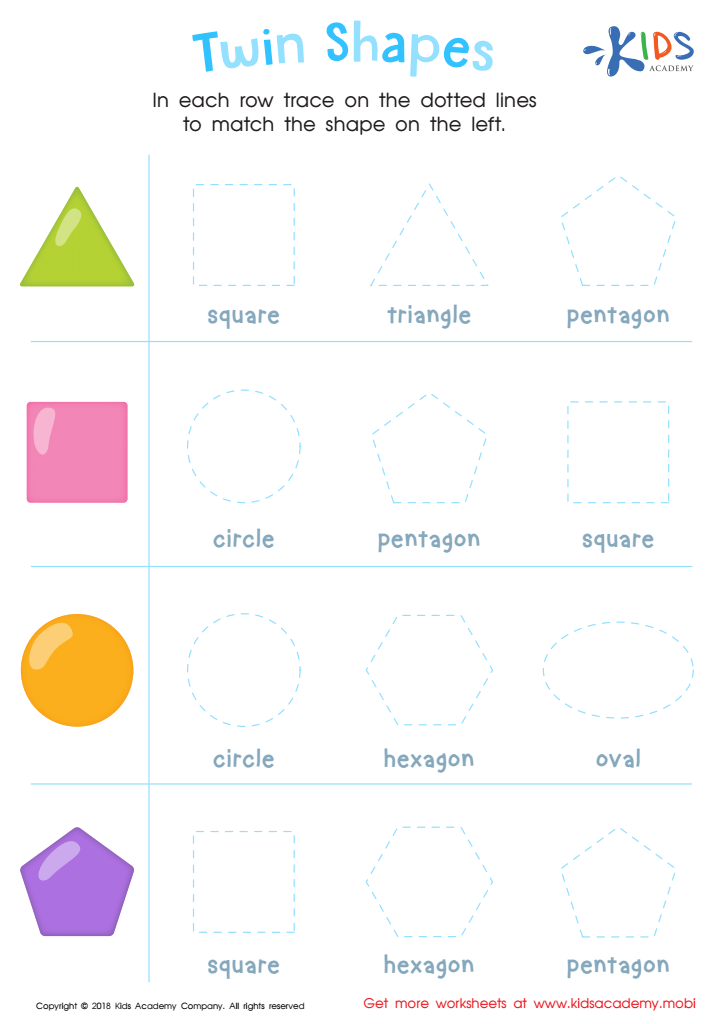
Twin Shapes Dot-to-Dot Worksheet
Test your child's ability to copy with this worksheet. Ask them to find and name the four shapes on the left. Then, they must match each with the dotted lines on the right. Help your child with all four shapes in this fun exercise.
Twin Shapes Dot-to-Dot Worksheet
Worksheet
Join Kids Academy for Free
Who is primarily going to use this learning content?








Parents and teachers should prioritize "Extra Challenge Tracing Shapes" for children ages 7-9 because this activity plays a pivotal role in developing essential cognitive and fine motor skills. At this age, children are enhancing their ability to recognize shapes and improve their hand-eye coordination, both of which are foundational for future learning in mathematics, art, and even reading.
Tracing shapes sharpens fine motor skills by requiring precision and control, fostering dexterity that is crucial for writing. The repetitive motion helps reinforce muscle memory, allowing children to gain confidence in their handwriting as they progress. Moreover, engaging with shapes also supports spatial awareness and geometric understanding, which are vital building blocks for more complex mathematical concepts.
Additionally, these activities promote concentration and focus. As children engage in tracing, they learn to pay attention to details, enhancing their ability to stay on task in other areas of learning. This is essential not just academically, but for developing self-discipline and perseverance.
Finally, including tracing as part of educational enrichment helps cultivate a love for learning. It turns academic skills into a fun and enjoyable experience, fostering a lifelong enthusiasm for education in a pressure-free environment. Thus, both parents and teachers should advocate for including such experiences in children's learning journeys.