Mental math practice Easy Addition & Subtraction Worksheets for Ages 4-9
3 filtered results
-
From - To
Enhance your child's numerical skills with our "Mental Math Practice Easy Addition & Subtraction Worksheets for Ages 4-9." Tailored for young learners, these worksheets offer a fun and engaging way to build foundational math abilities. Designed to sharpen mental calculations, each activity presents challenges appropriate for different skill levels, ensuring gradual and confident progress. Encourage independent learning while reinforcing classroom concepts, significantly improving speed and accuracy in solving basic math problems. Perfect for parents and educators, our printable worksheets provide a supportive tool for fostering a love for math at an early age. Explore now and boost your child's math proficiency!
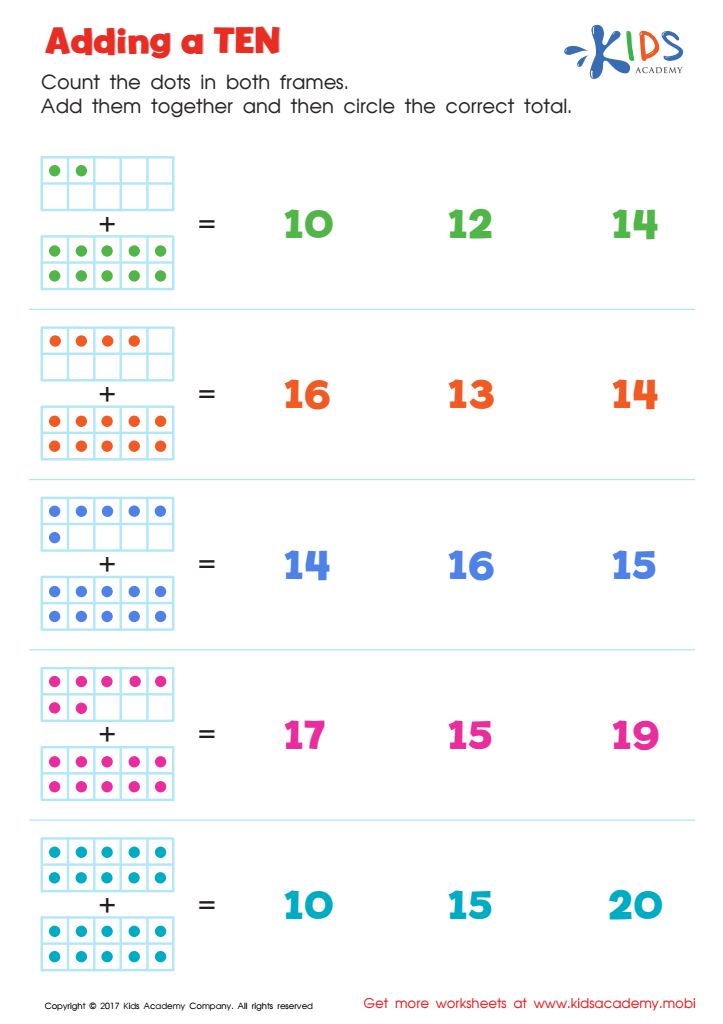
Adding a Ten Worksheet
 Assign to My Students
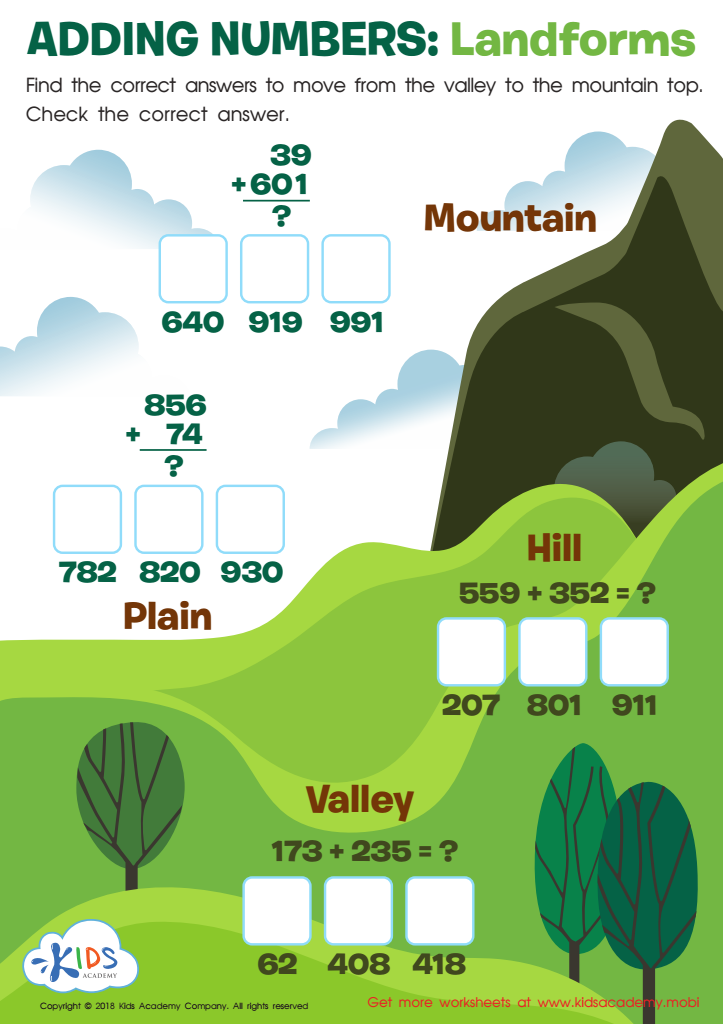
Adding Numbers: Landforms Worksheet
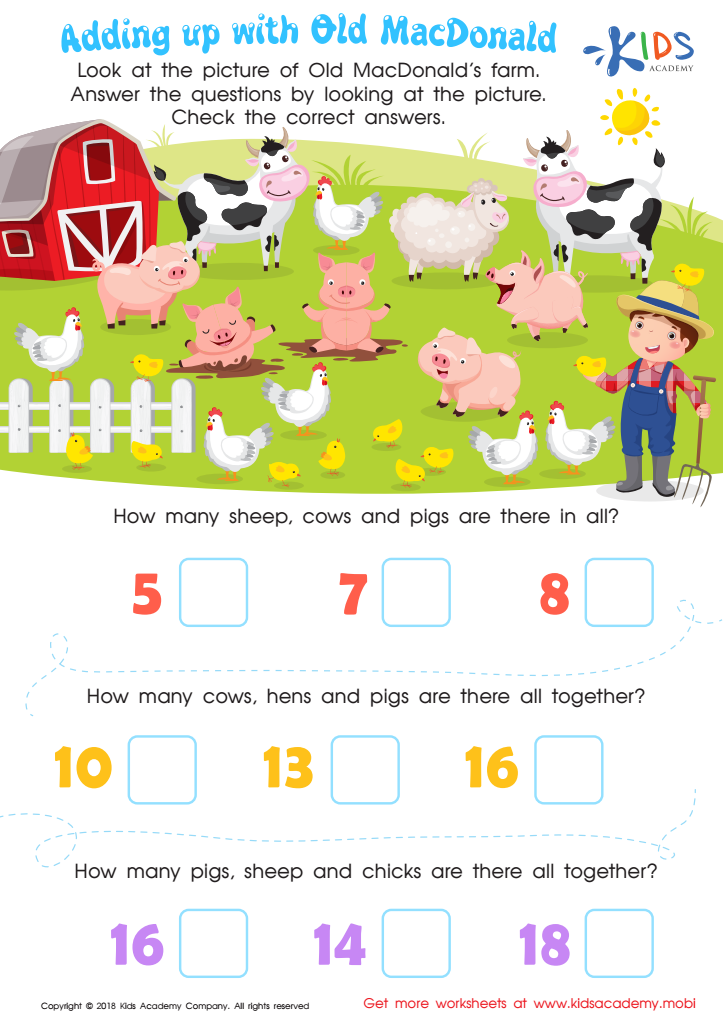
Adding Up with Old MacDonald Worksheet








Mental math practice, particularly with easy addition and subtraction, plays a crucial role in a child's early cognitive and mathematical development. For children aged 4-9, this foundational skill nurtures a range of benefits that parents and teachers should be keen to support.
Firstly, mental math enhances a child’s number sense, enabling them to understand quantities and numerical relationships intuitively. These early experiences with numbers build a strong base, making more complex arithmetic and mathematical concepts easier to grasp in later years.
Moreover, practicing easy addition and subtraction helps improve concentration and memory. Children learn to hold numbers in their minds, perform calculations, and recall results, which bolsters their working memory and attention span.
Mental math also fosters problem-solving skills and confidence. As children become proficient, they gain confidence in their ability to tackle math problems, which can positively affect their overall attitude towards learning and academic challenges.
Lastly, engaging in routine mental math exercises provides brain stimulation, promoting cognitive development beyond mathematics alone. It encourages logical thinking and enhances mental agility, crucial for learning various subjects and for tasks requiring rapid decision-making.
In essence, regular mental math practice in young children nurtures a well-rounded intellectual growth, equipping them with skills that extend far beyond the realm of mathematics.








