
Basic arithmetic practice Easy Worksheets for Ages 6-9
4 filtered results
Difficulty Level
Grade
Age
-
From - To
Subject
Activity
Standards
Boost your child's arithmetic skills with our Basic Arithmetic Practice Easy Worksheets for Ages 6-9! Designed to make learning fun and engaging, these worksheets cover fundamental concepts such as addition, subtraction, multiplication, and division. Perfect for young learners, each worksheet offers a mix of captivating exercises and colorful illustrations to keep kids motivated. Our curated activities help children develop a strong mathematical foundation, improve problem-solving skills, and build confidence. Ideal for at-home practice or in-class reinforcement, these resources are the perfect companion for your child's educational journey. Join us today and watch your young mathematician thrive!
Favorites
With answer key
Interactive
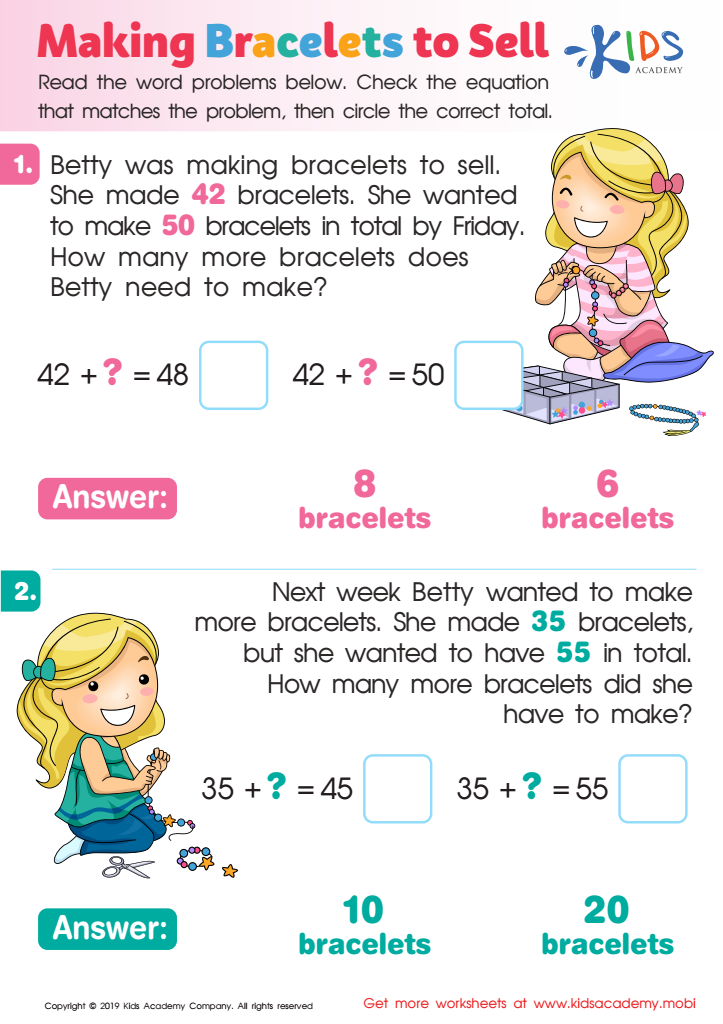
Making Bracelets to Sell Worksheet
Got kids who love crafting? This worksheet will be right up their alley! Let them use their creative and problem-solving skills to check equations and decide the correct total. It's just like making beads into a bracelet but on paper! Print out this downloadable PDF and get ready for a fun craft session.
 Assign to My Students
Making Bracelets to Sell Worksheet
Worksheet
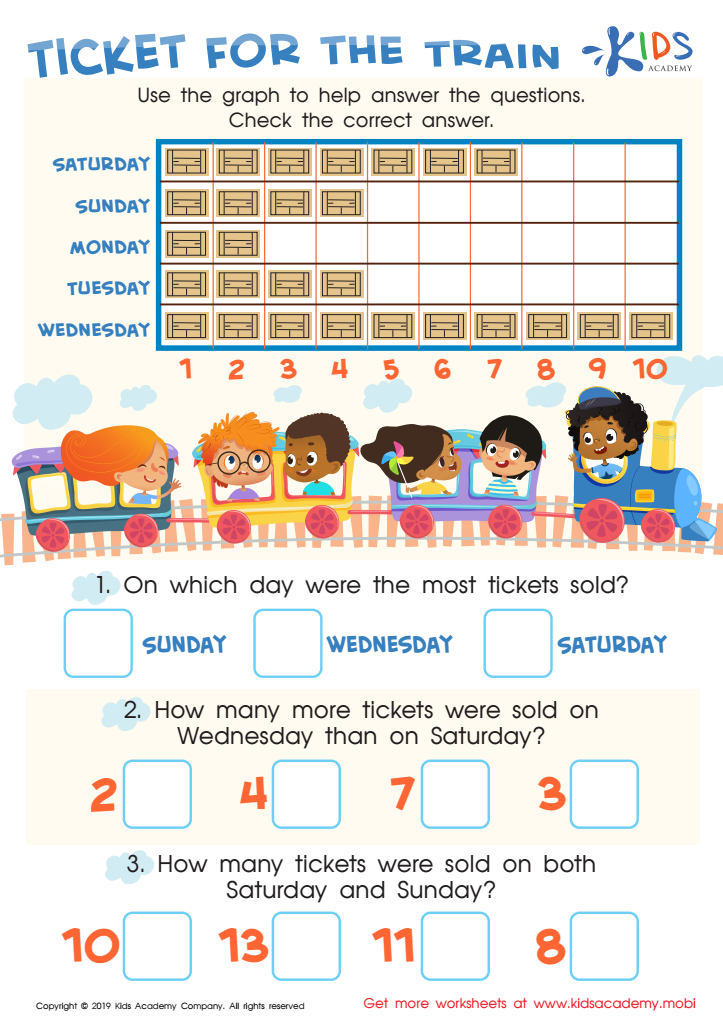
Ticket for the Train Worksheet
It's important to use fun scenarios with familiar objects when teaching kids. Try discussing train rides and the accompanying picture graph. Ask questions about it, then help kids check the correct answers. Let them enjoy the learning process!
Ticket for the Train Worksheet
Worksheet
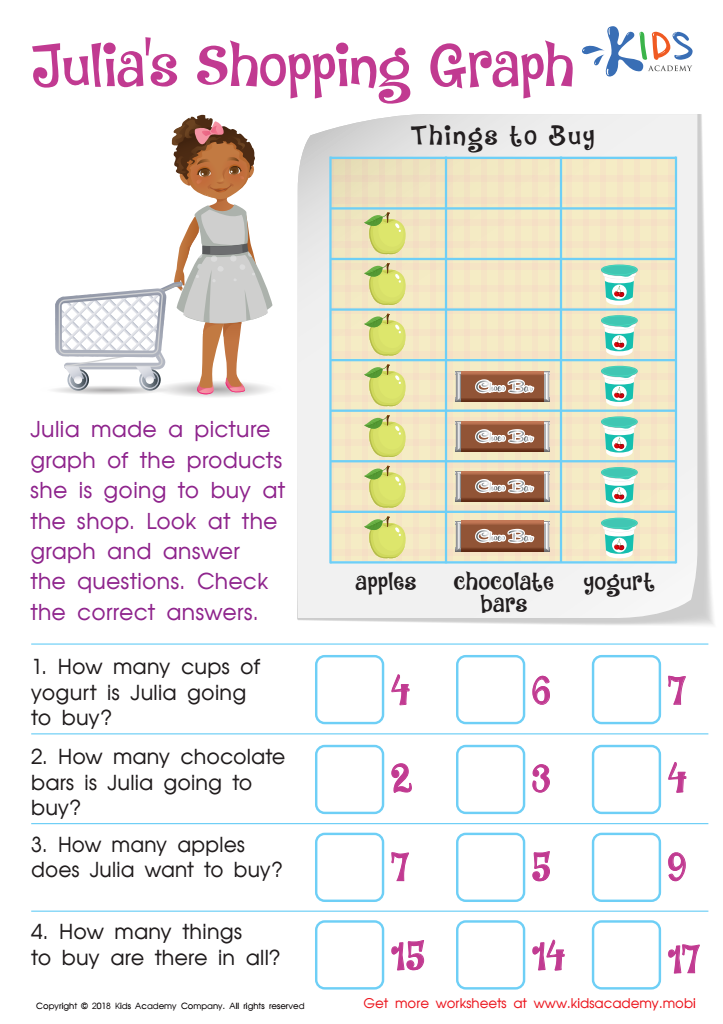
Julia's Shopping Graph Worksheet
This fun PDF worksheet provides little mathematicians with practice using pictographs. They will answer questions about Julia's graph, helping to assess their understanding of reading and interpreting data. Counting and choosing the correct answer is sure to be an enjoyable experience!
Julia's Shopping Graph Worksheet
Worksheet
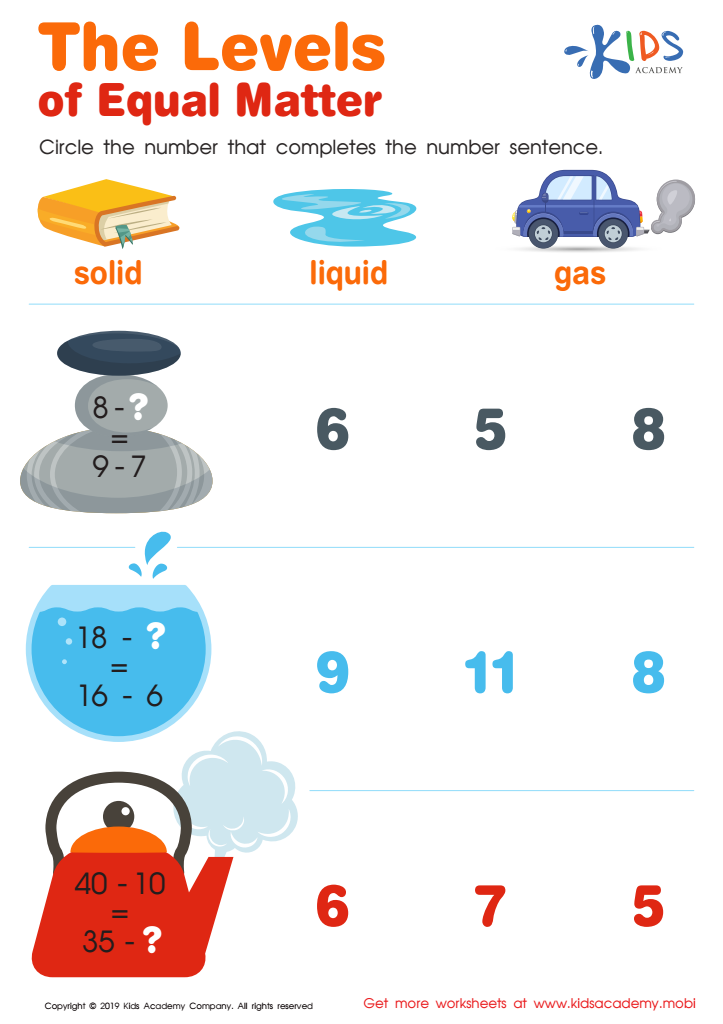
The Levels of Equal Matter Worksheet
Matter is anything that has weight and occupies space. Common examples include people, animals, objects and liquids. Have your kids understand this concept by looking at the levels of matter in this worksheet and completing the number sentence mathematical problems beneath.
The Levels of Equal Matter Worksheet
Worksheet
Join Kids Academy for Free
Who is primarily going to use this learning content?





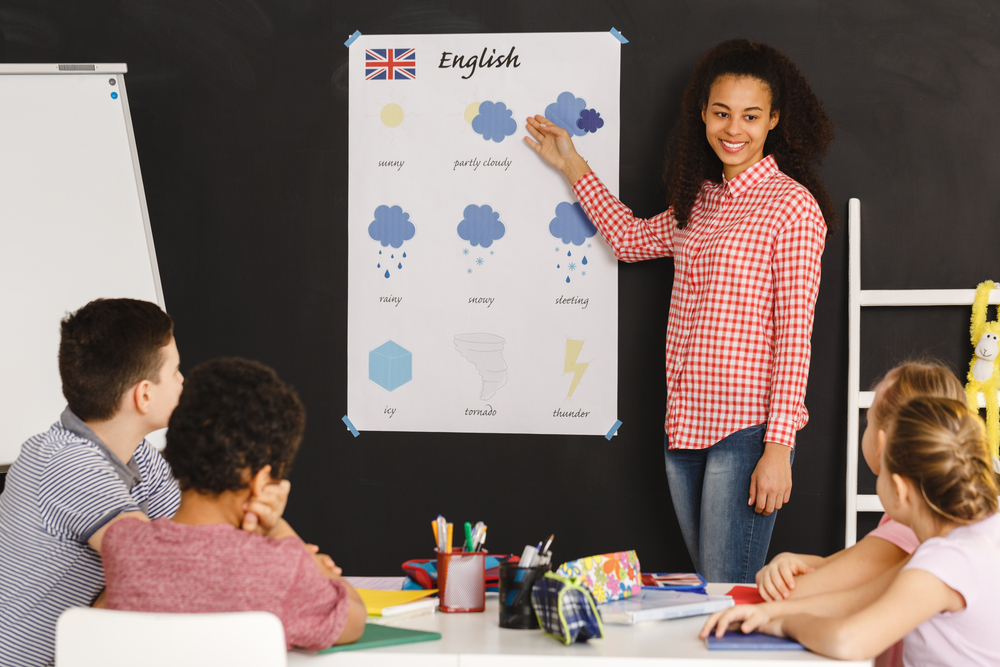


Parents and teachers should prioritize basic arithmetic practice for children ages 6-9 because these foundational skills are critical for their academic development and future success. At this age, children are in a crucial phase of cognitive development where learning mathematical concepts can significantly impact their logical thinking and problem-solving abilities.
Basic arithmetic—such as addition, subtraction, multiplication, and division—forms the bedrock of more advanced mathematical learning. By practicing these skills, children develop numerical fluency, which is essential for tackling more complex math problems in higher grades. It enhances their ability to perform calculations quickly and accurately, making math less intimidating and more enjoyable as they progress in their education.
Moreover, mastering basic arithmetic fosters a child’s confidence in their academic abilities. Confidence can lead to greater participation and engagement in the classroom, promoting a positive attitude toward learning in general. This foundational competence also aids in everyday activities, such as handling money, understanding time, and measuring quantities—practical skills that are useful throughout life.
Therefore, consistent and enjoyable arithmetic practice in the early years sets the stage for academic success, nurtures critical reasoning skills, and prepares children for real-life challenges, making it a vital component of early education.








