Basic geometry understanding Extra Challenge Geometry Worksheets for Ages 3-8
3 filtered results
Difficulty Level
Grade
Age
-
From - To
Subject
Activity
Standards
Discover our “Basic Geometry Understanding Extra Challenge Worksheets” designed for children ages 3-8! These engaging worksheets provide an excellent opportunity for young learners to explore fundamental geometric concepts in a fun and interactive way. With a variety of activities such as shape identification, pattern recognition, and basic measurement exercises, kids will strengthen their spatial awareness and problem-solving skills. Our worksheets are crafted to challenge and inspire young minds while enhancing their understanding of basic geometry. Ideal for home or classroom use, these resources makes learning geometry enjoyable and effective. Get started today and watch your child’s confidence soar!
Favorites
With answer key
Interactive
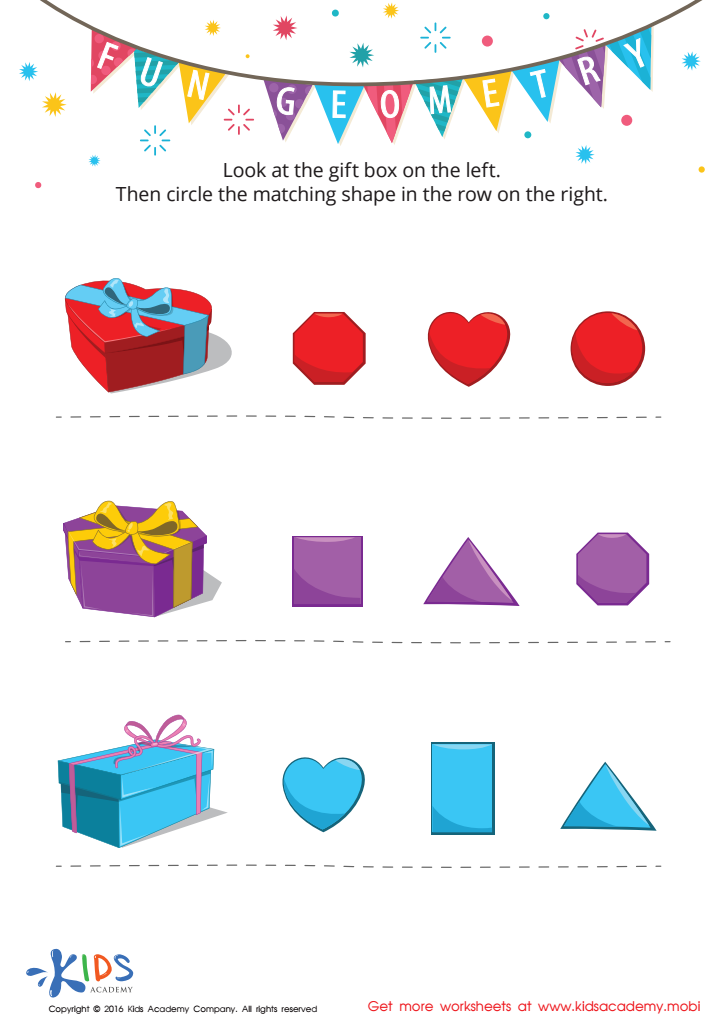
Fun Geometry Worksheet
Give your child the gift of learning with this fun and educational geometry matching worksheet! It'll help them develop essential matching and problem-solving skills while having fun. Vibrant pictures will excite them to complete it and get a better grasp of the world around them.
 Assign to My Students
Fun Geometry Worksheet
Worksheet











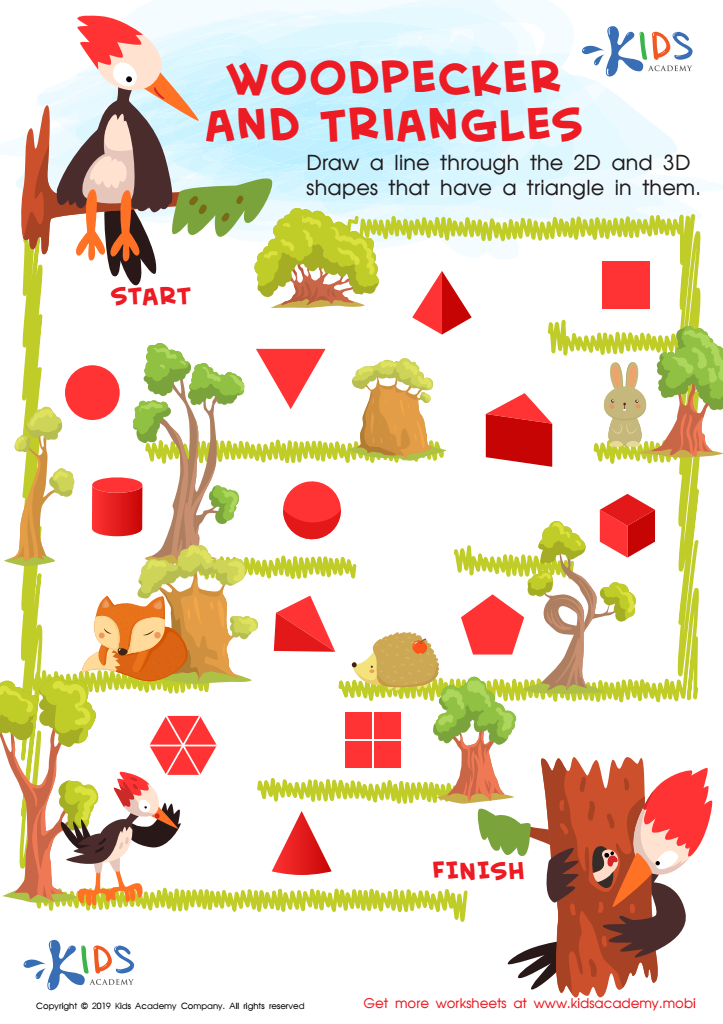
Woodpecker and Triangles Worksheet
Woodpeckers peck wood, and this printout helps kids learn about triangles. Ask your kindergartners to draw a triangle, then draw a line through the shapes that have a triangle in them to help the woodpecker get out of the maze.
Woodpecker and Triangles Worksheet
Worksheet
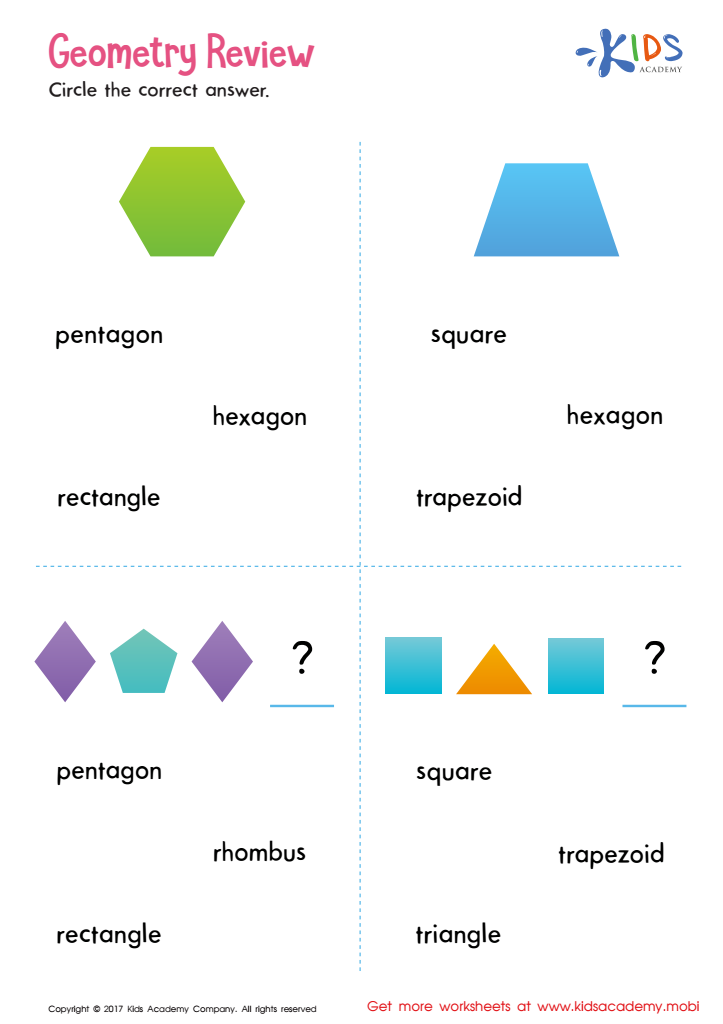
Geometry Review Printable
Repetition is key to success; give your child the practice they need with this geometry worksheet.
Geometry Review Printable
Worksheet
Join Kids Academy for Free
Who is primarily going to use this learning content?








Parents and teachers should prioritize basic geometry understanding, particularly through programs like Extra Challenge Geometry for Ages 3-8, because early spatial skills have a profound impact on a child's cognitive development. Mastery of geometric concepts helps children develop critical thinking and problem-solving abilities which are essential in various life domains. Understanding shapes, sizes, and spatial relations lays a foundation for more complex mathematical concepts encountered later, such as algebra and calculus.
Engaging children with geometry at a young age nurtures their curiosity and fosters a positive attitude towards learning. Programs like Extra Challenge Geometry introduce these concepts through fun, interactive activities that can captivate young minds—making learning enjoyable rather than daunting.
Moreover, spatial awareness plays a crucial role in everyday life. Children who grasp basic geometry are better equipped to navigate their environments, understand maps, and visualize problems. This skill set is relevant not only in academics but also in fields such as engineering, architecture, and design.
By encouraging geometric understanding early on, parents and teachers equip children with essential skills, inspiring their future success in both academics and practical life situations. Ultimately, fostering geometry skills confers a lifelong advantage in a technical and visually-oriented world.