
Money counting skills Extra Challenge Worksheets for Ages 6-7
3 filtered results
Difficulty Level
Grade
Age
-
From - To
Subject
Activity
Standards
Boost your child's financial literacy with our "Money Counting Skills Extra Challenge Worksheets for Ages 6-7". These engaging worksheets are designed to enhance money counting skills through fun and educational activities. Created specifically for young learners, they include a variety of exercises that teach children to recognize coins, add up different denominations, and solve real-world money problems. Perfect for extra practice at home or in the classroom, these worksheets will help your child gain confidence in managing money, laying the foundation for future financial success. Download now and watch your young learner master money counting with ease!
Favorites
With answer key
Interactive
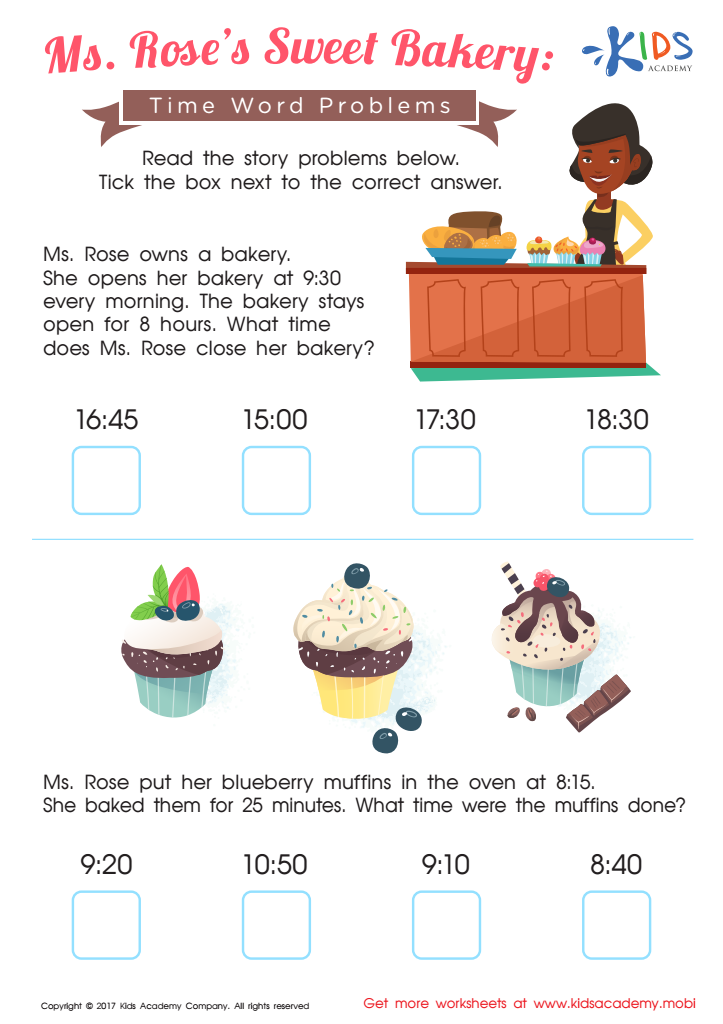
Ms. Roseв's Sweet Bakery Time Worksheet
Help your child understand the 24-hour clock using this fascinating telling time word problems worksheet: Sweet Bakery! Widely known as "military time", this skill isn't taught in school but is important for your kid to master.
 Assign to My Students
Ms. Roseв's Sweet Bakery Time Worksheet
Worksheet
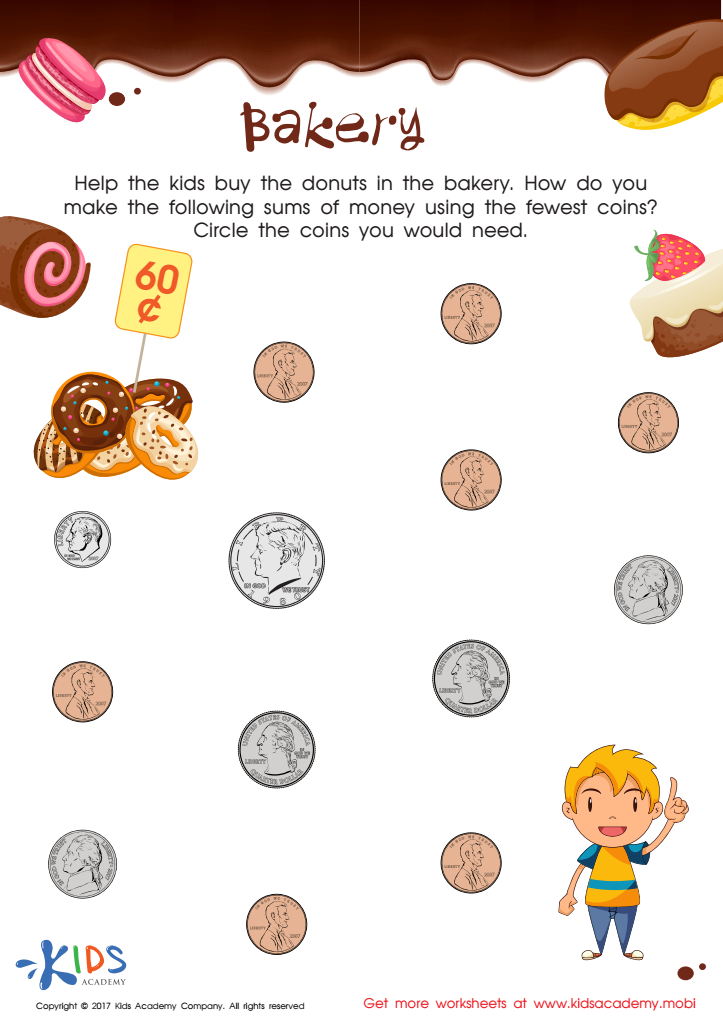
Counting Coins Worksheet
It will challenge them to spend a given amount using the least coins possible. Perfect for 2nd grade.
Help your child learn to count coins with this fun bakery-themed worksheet. It's perfect for 2nd graders and will challenge them to use the least coins possible to spend a set amount. Develop a valuable life skill and have fun while doing it!
Counting Coins Worksheet
Worksheet
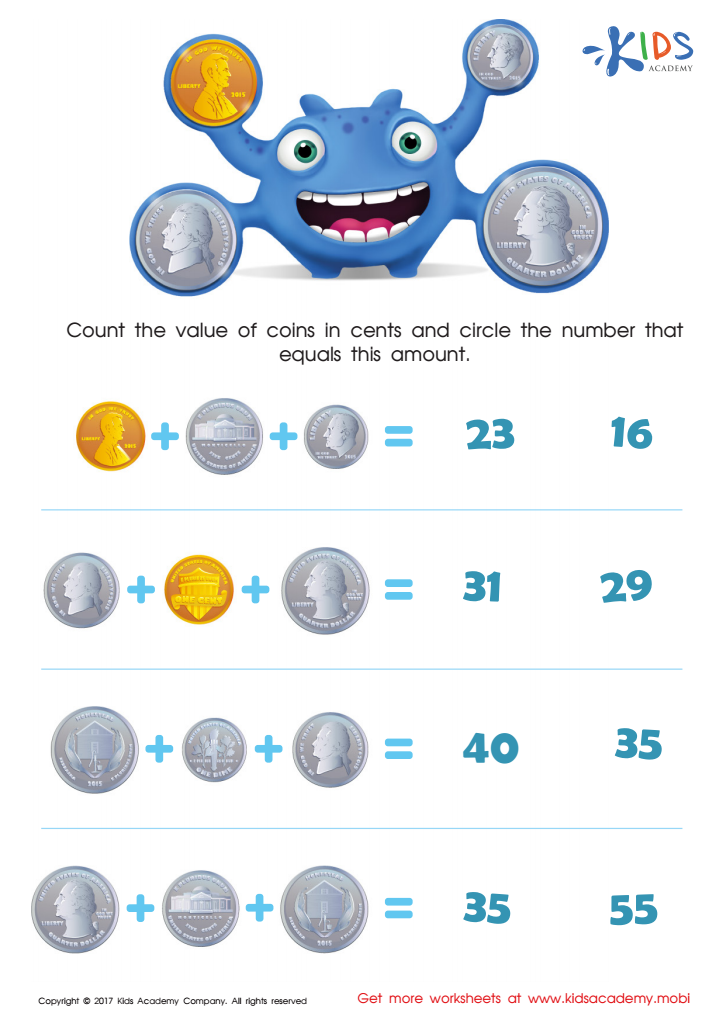
Counting the Coins Money Worksheet
Count coins quickly and work out sums in cents. Remember the value of each coin!
Counting the Coins Money Worksheet
Worksheet
Join Kids Academy for Free
Who is primarily going to use this learning content?








Developing money counting skills in children aged 6-7 holds significant importance for both parents and teachers as it fosters essential life skills early on. At this stage, children are beginning to grasp basic arithmetic concepts, and integrating money counting into their learning routine enhances their numerical comprehension and problem-solving abilities.
Money counting exercises extend beyond simple addition and subtraction, requiring kids to recognize the value of different coins and bills, and to make accurate calculations in transactions. By familiarizing them with monetary concepts, it prepares them for real-life situations, promoting financial literacy from a young age. This foundational knowledge instills confidence, allowing children to handle money responsibly and understand its value.
Furthermore, money counting activities can sharpen attention to detail, improve memory, and encourage patience. Engaging in these tasks fosters a sense of accomplishment and independence, essential traits for personal development.
Incorporating money counting into learning can be interactive and fun, utilizing play-based techniques that make the experience enjoyable. This approach not only solidifies mathematical skills but also keeps children motivated and excited about learning.
Ultimately, prioritizing money counting skills at a young age equips children with a critical, lifelong toolset, making it a pivotal educational objective for both parents and teachers.








