
Understanding fact families Extra Challenge Worksheets for Ages 7-9
3 filtered results
Difficulty Level
Grade
Age
-
From - To
Subject
Activity
Standards
Boost your child's math skills with our "Understanding Fact Families Extra Challenge Worksheets for Ages 7-9." These worksheets are designed to deepen comprehension of fact families, reinforcing addition and subtraction relationships in a fun, engaging manner. Suitable for advanced learners or students seeking extra practice, these exercises challenge young minds while solidifying foundational math concepts. Easy to download and print, our worksheets offer structured practice, promoting problem-solving abilities and boosting confidence. Explore now to support your child's journey in mastering fact families with exciting, additional math practice tailored specifically for ages 7 to 9.
Favorites
With answer key
Interactive
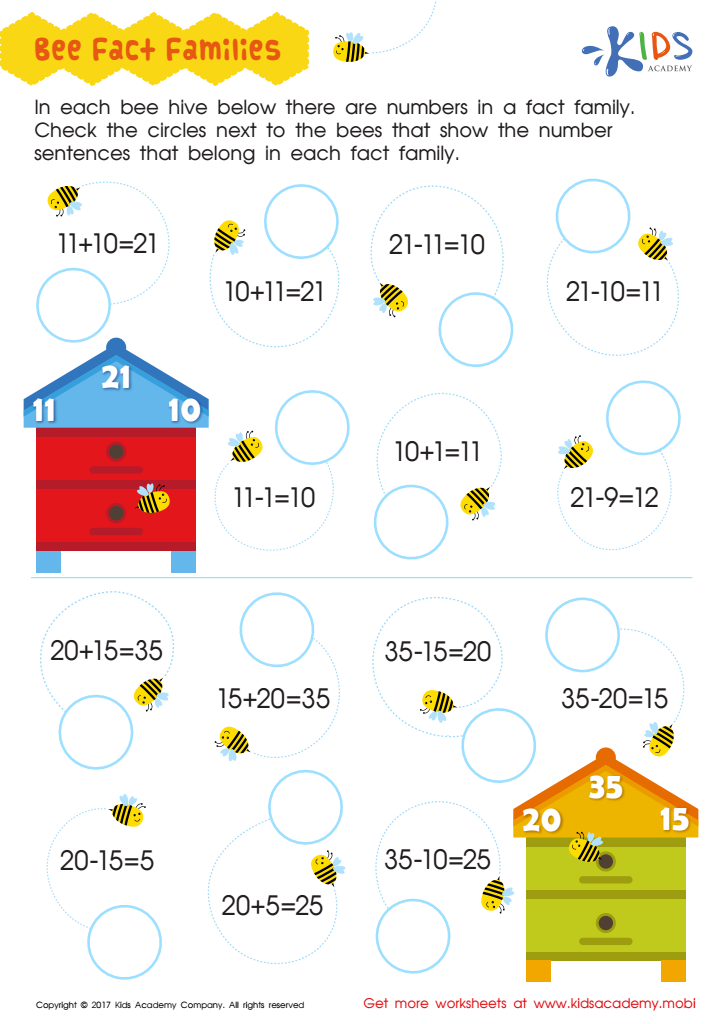
Fact Families Worksheet
Your 2nd grader will love this engaging activity.
Kids will buzz about fact families with this fun worksheet! Images of bees and their hives make learning numeracy enjoyable. Engaging and entertaining, your 2nd grader will love this activity.
 Assign to My Students
Fact Families Worksheet
Worksheet
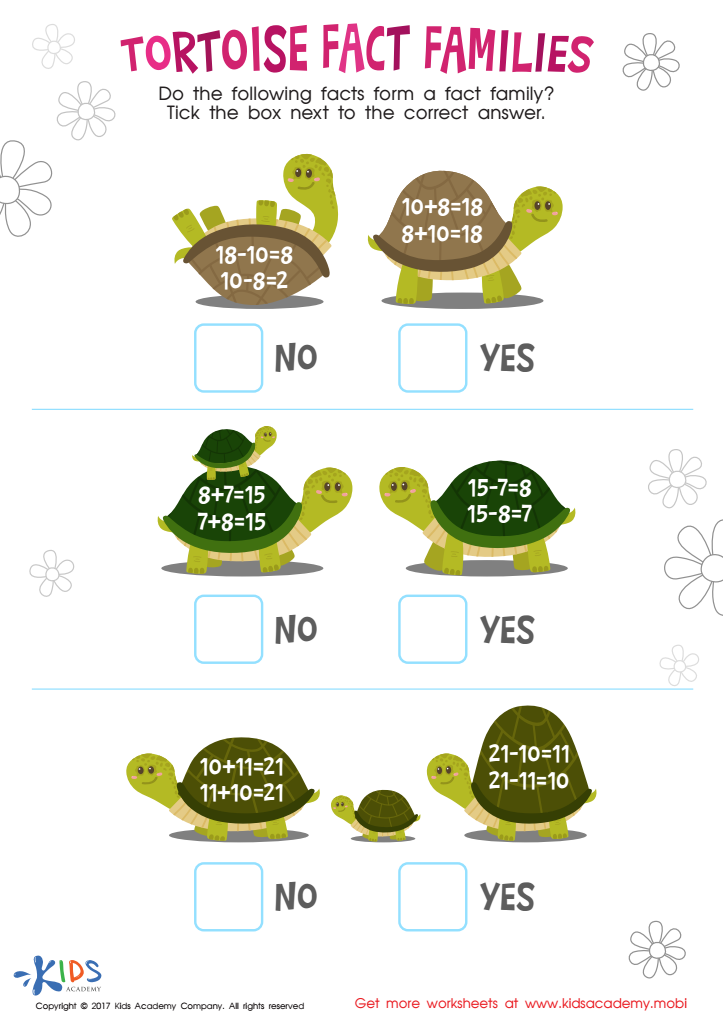
Tortoise Fact Families Printable
With 1st grade add & subtract tortoises, kids can improve their math understanding and skills. Enjoy fun, hands-on practice with fact families and strengthen logical reasoning and critical thinking!
Tortoise Fact Families Printable
Worksheet
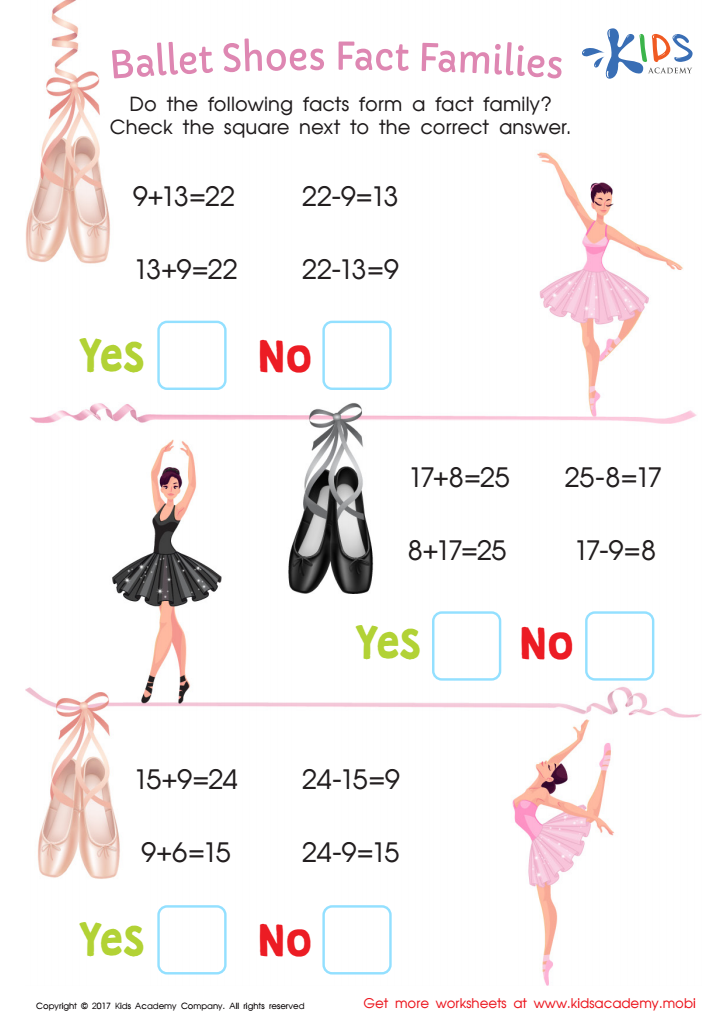
Ballet Shoes Fact Family Printable
Have them observe the equations and determine which groupings are fact families for a delightful learning experience. It encourages critical thinking, showing how addition and subtraction are related.
Ballet Shoes Fact Family Printable
Worksheet
Join Kids Academy for Free
Who is primarily going to use this learning content?





Understanding fact families is essential for children ages 7-9 because it lays a strong foundation for their arithmetic skills and mathematical reasoning. Fact families, which consist of related addition and subtraction or multiplication and division facts, help children recognize the relationships between numbers. This comprehension allows them to solve problems more efficiently.
For parents and teachers, emphasizing fact families aids in reinforcing the concept of inverse operations. For example, by understanding that if 3 + 4 = 7, then 7 - 3 = 4, children can approach problems from multiple angles, boosting their confidence and problem-solving abilities.
Moreover, grasping fact families helps in memorizing basic math facts, leading to quicker recall and less reliance on counting methods, which smooths the transition to more complex mathematics. This foundational skill also supports their learning in other subjects that require quantitative reasoning.
Fostering early competence in fact families encourages a positive attitude towards mathematics. Children feel more confident and capable, reducing anxiety and increasing overall academic engagement. An extra challenge in understanding fact families can help gifted students deepen their knowledge and stay engaged.
Therefore, by caring about fact families, parents and teachers can ensure children develop the essential numeracy skills they need for academic success and everyday problem-solving.








