
Number Recognition Subtraction Worksheets
12 filtered results
Difficulty Level
Grade
Age
-
From - To
Subject
Activity
Standards
Enhance your child's math skills with our engaging Number Recognition Subtraction Worksheets! Designed for early learners, these printable resources combine number recognition with subtraction practice to foster a solid understanding of essential math concepts. Each worksheet features vibrant visuals and fun scenarios that make learning subtraction enjoyable. Students will develop the ability to identify numbers while solving subtraction problems, reinforcing their skills in a practical context. Our worksheets also promote critical thinking and improve number literacy, ensuring a comprehensive math foundation. Perfect for classroom use or at-home learning, these worksheets are an invaluable tool for young mathematicians ready to excel!
Favorites
With answer key
Interactive
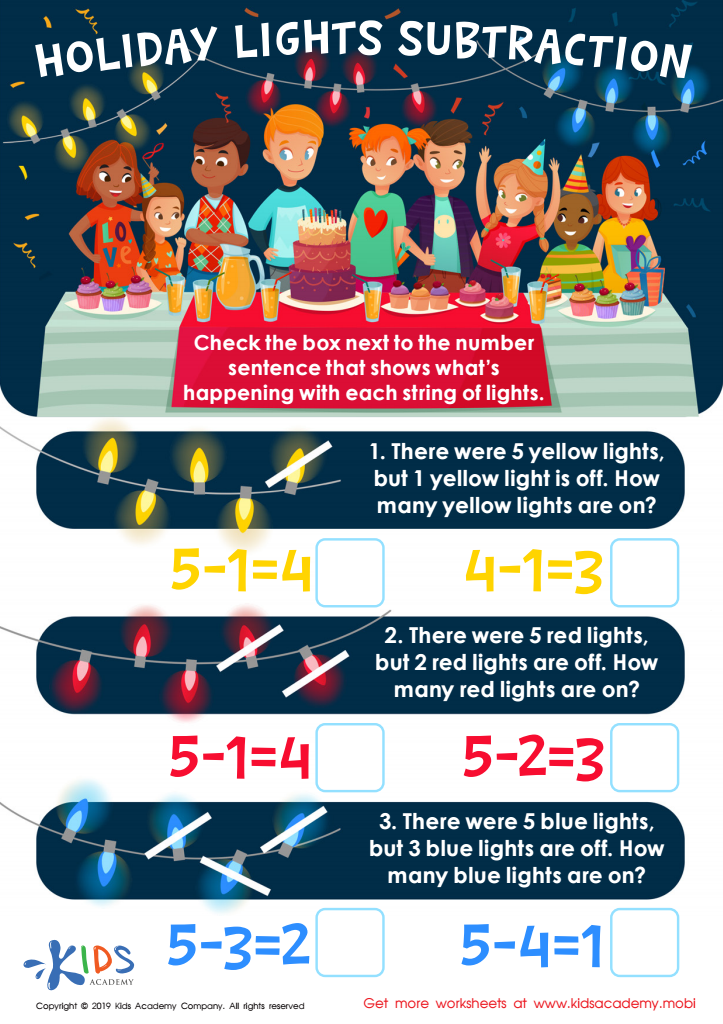
Holiday Lights Subtraction Worksheet
Before tackling the math problem, get your kids ready by asking them to share their favorite holiday and why. Then, look at the picture on the worksheet with them. Help them examine the numbers and problems, and select the number sentence that shows what's happening with each string of light. 80 words.
 Assign to My Students
Holiday Lights Subtraction Worksheet
Worksheet
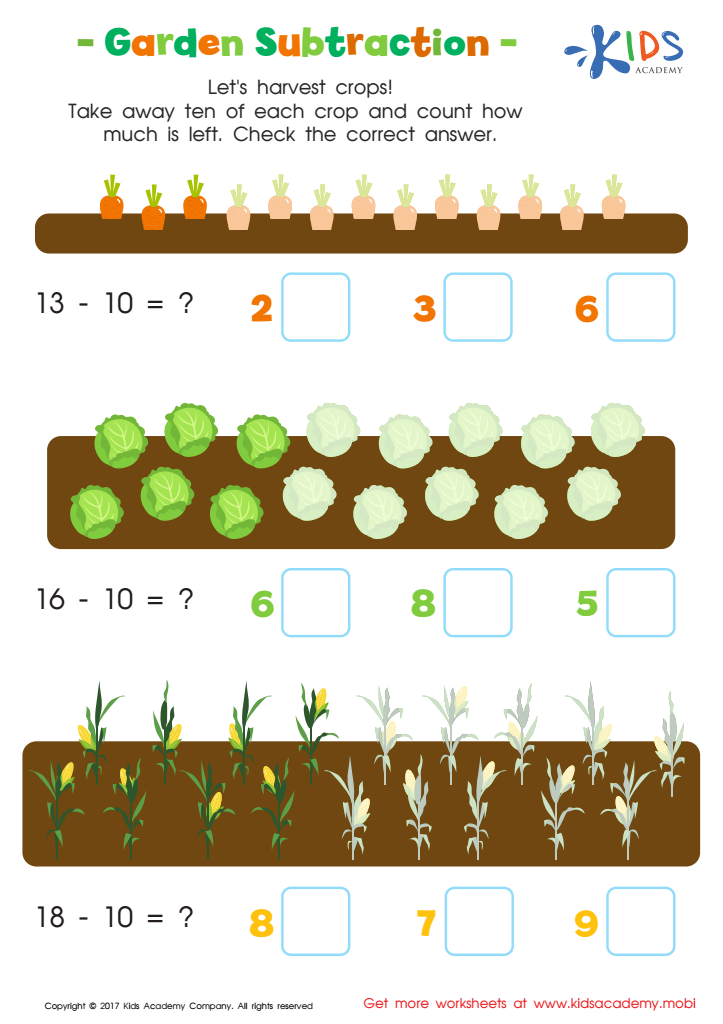
Garden Subtraction Worksheet
Help your kids understand math with this fun, garden-themed subtraction worksheet! Have them read the number sentences and count the veggies in each row. Then, subtract 10 from each row to find the answer. They'll love counting the colorful veggies and solving the problems!
Garden Subtraction Worksheet
Worksheet
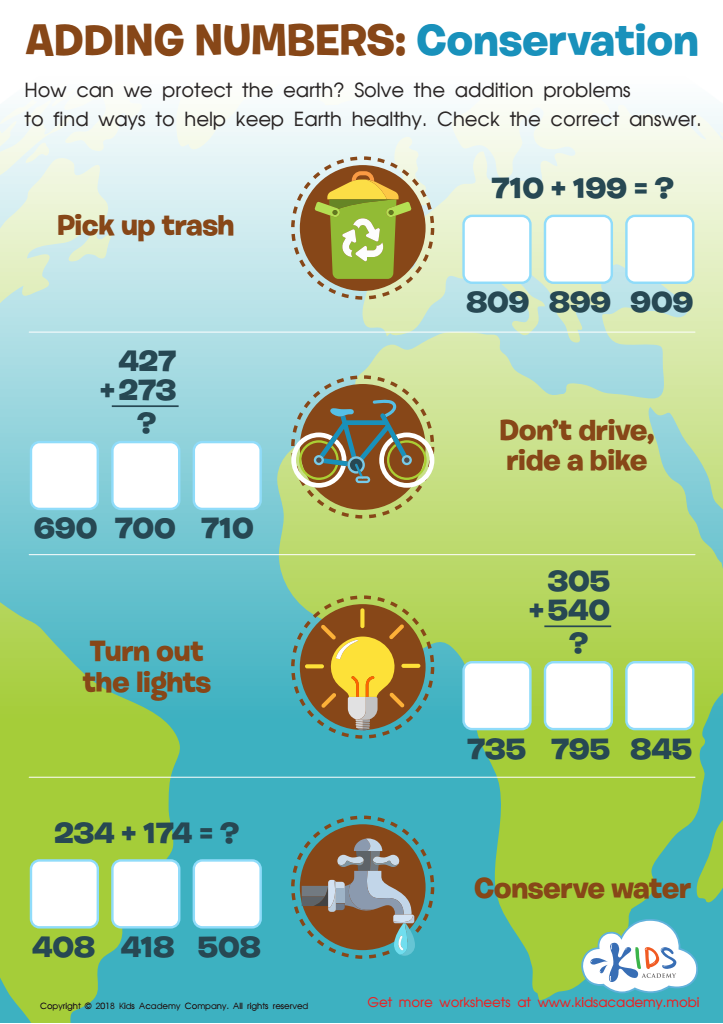
Adding Numbers: Conservation Worksheet
We all live on the Earth, which provides us with the vital necessities for survival. Unfortunately, we too often take advantage of this, causing pollution, water wastage and global warming. Help teach your kids how we can protect our planet - ask them to come up with good ideas and work together to find solutions. Challenge them to solve the subtraction problems to see what they can do to help keep the Earth healthy.
Adding Numbers: Conservation Worksheet
Worksheet
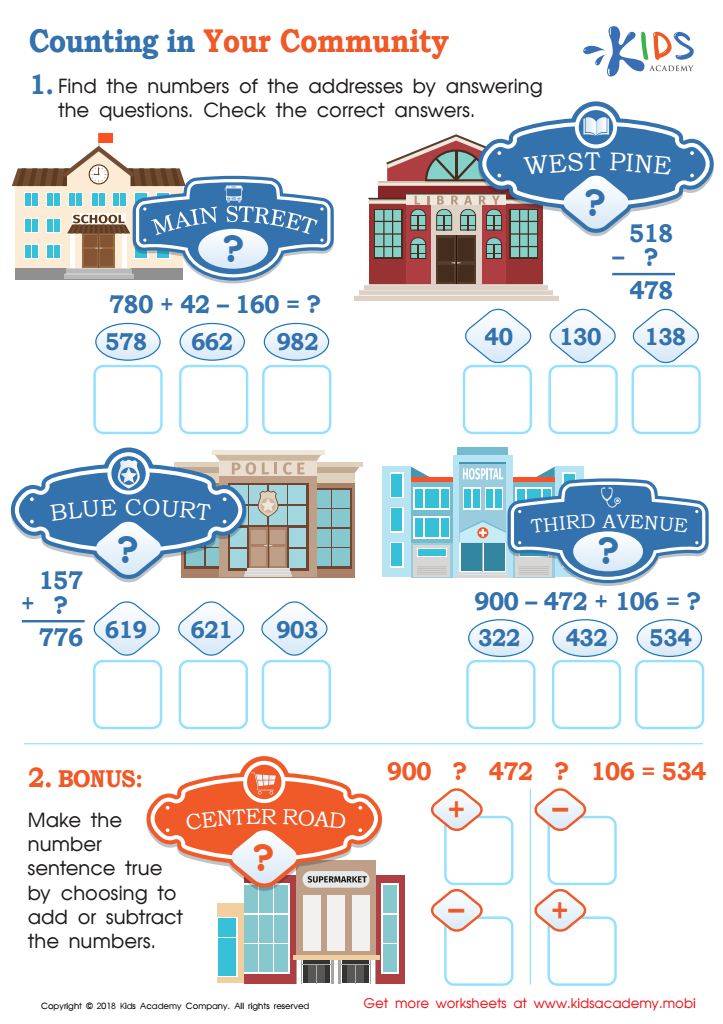
Counting in Your Community Worksheet
Introduce your kids to the idea of a community, where different people and buildings co-exist, each playing their part for the community's progress. Ask them to name the buildings they see in their community. Then work through this worksheet to find the numbers of the addresses by answering the questions. Check the answers once they've solved the equations.
Counting in Your Community Worksheet
Worksheet
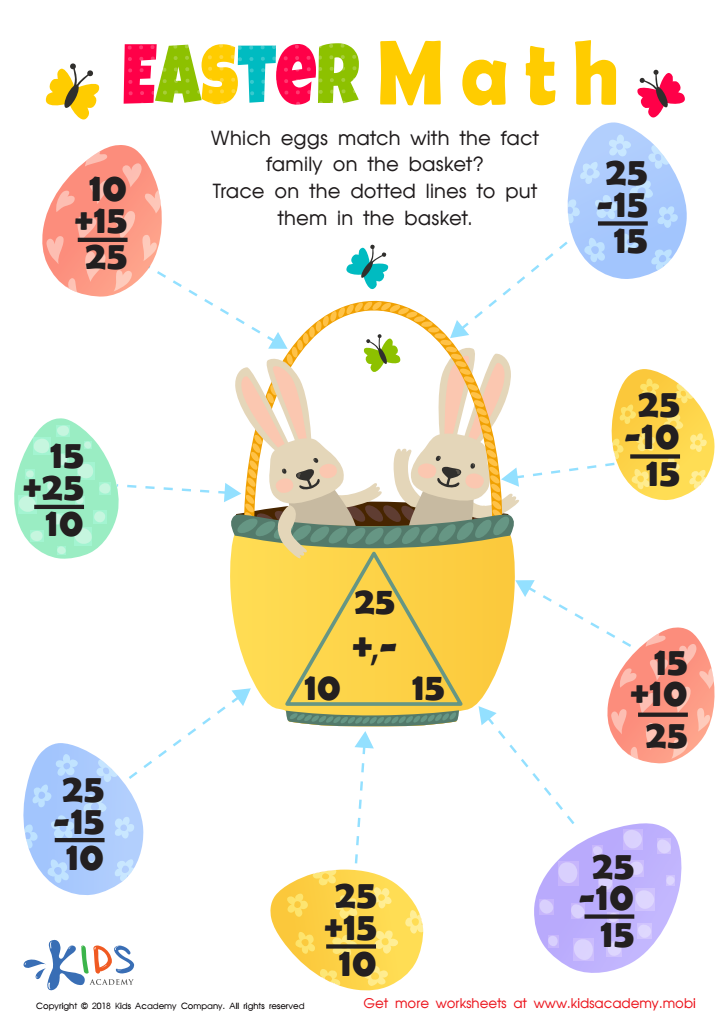
Fact Families: Easter Math Worksheet
Kids will love this vibrant PDF packed with Easter math fun! Match facts with the colorful eggs, add and subtract multiples of five to boost automaticity, and have a blast with the bunny friends!
Fact Families: Easter Math Worksheet
Worksheet
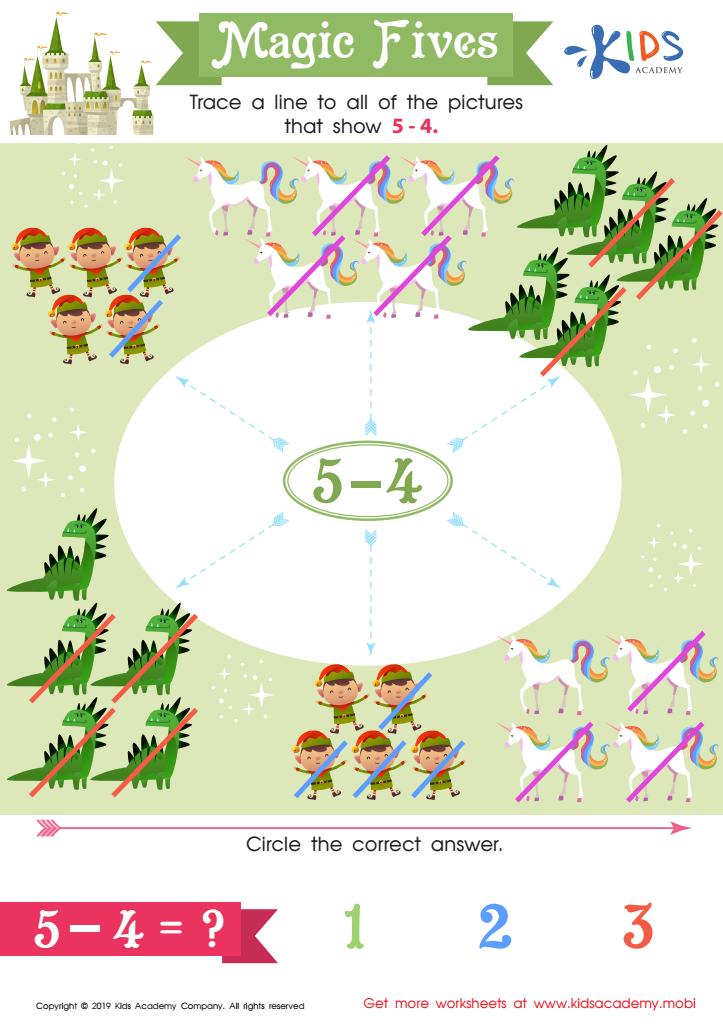
Magic Fives Worksheet
Help your students identify the objects & people in the worksheet. Point to the equation 5 -4 in the center, then get them to count the items and trace a line connecting those that add up to 5 - 4.
Magic Fives Worksheet
Worksheet
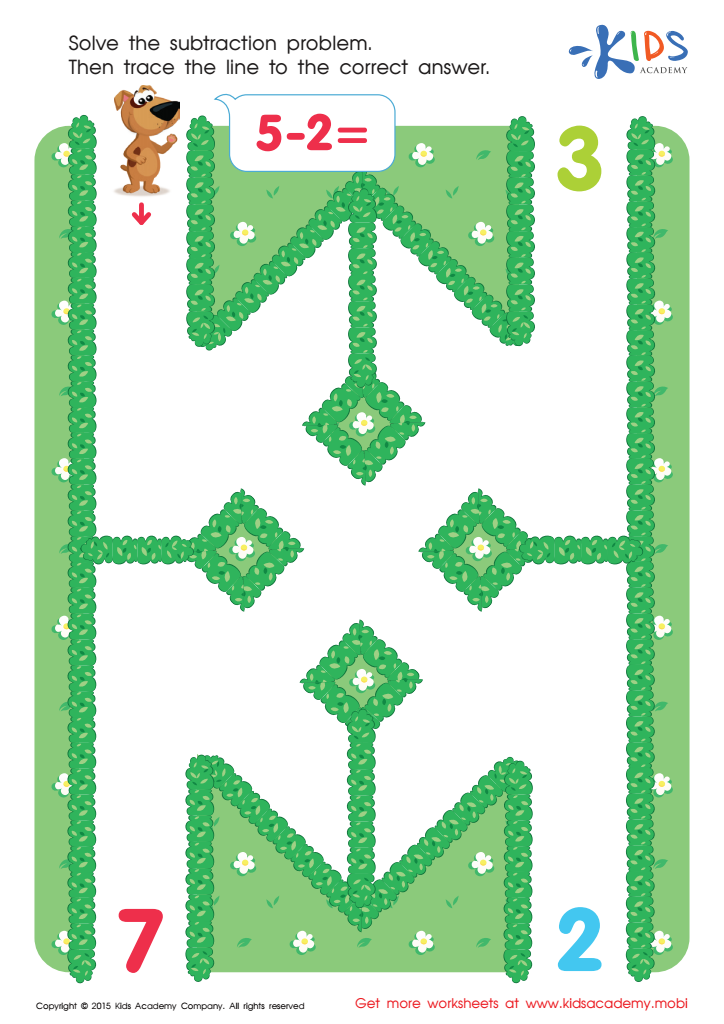
Five Minus Two Worksheet
Help the dog find its way by practising subtraction - trace the path and make sure to have fun!
Five Minus Two Worksheet
Worksheet
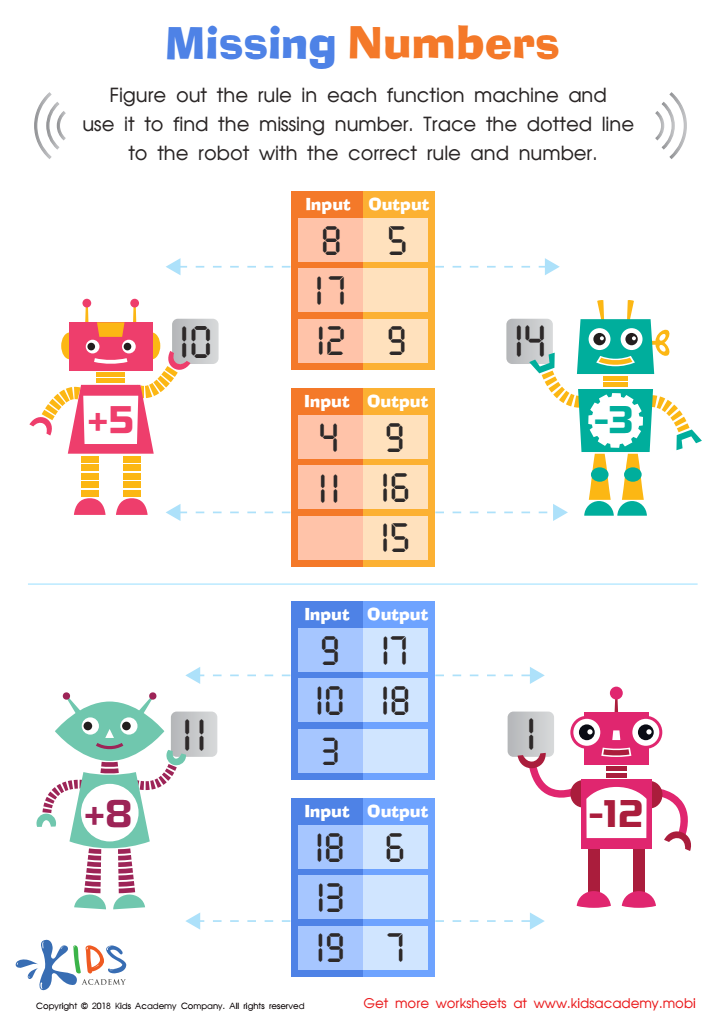
Missing Numbers Worksheet
Elementary students can learn the important pre-algebra skill of solving for missing numbers! Our robots guide them along with number-filled bellies and missing answers in their hands. Kids can examine the other numbers in each graph, use the rule to solve the missing number, and check their work with the missing number to ensure correctness.
Missing Numbers Worksheet
Worksheet
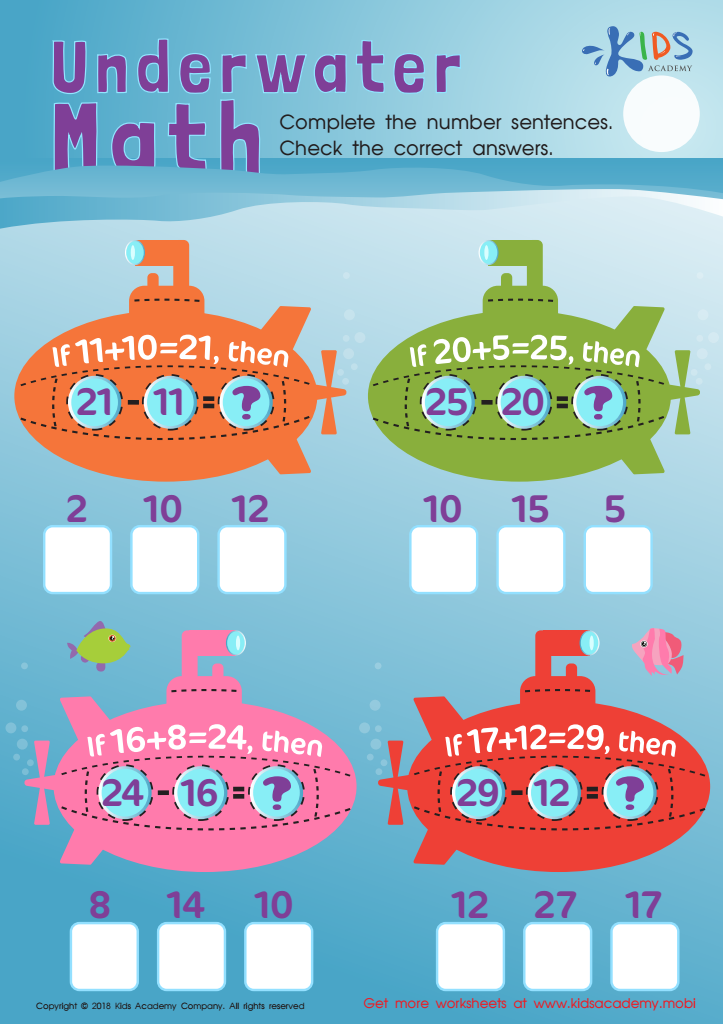
Addition and Subtraction: Underwater Math Worksheet
Take your little mathematicians on an undersea adventure as they work to solve number sentences. With fun worksheets, they'll analyze numbers, orders of operation and use if/then statements. They'll learn addition and subtraction are opposites, helping them solve more problems!
Addition and Subtraction: Underwater Math Worksheet
Worksheet
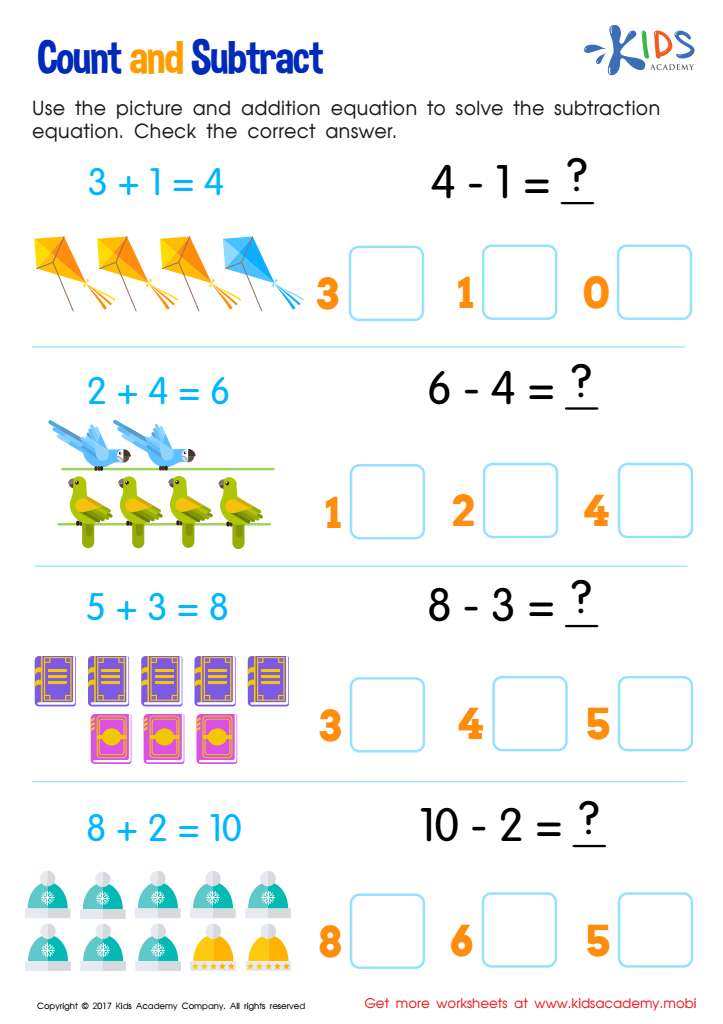
Count and Subtract Worksheet
This worksheet helps your child learn math via colorful pictures and equations. Count the items together, adding and subtracting as necessary. Your child will be challenged to get the correct total, thereby developing their math skills.
Count and Subtract Worksheet
Worksheet
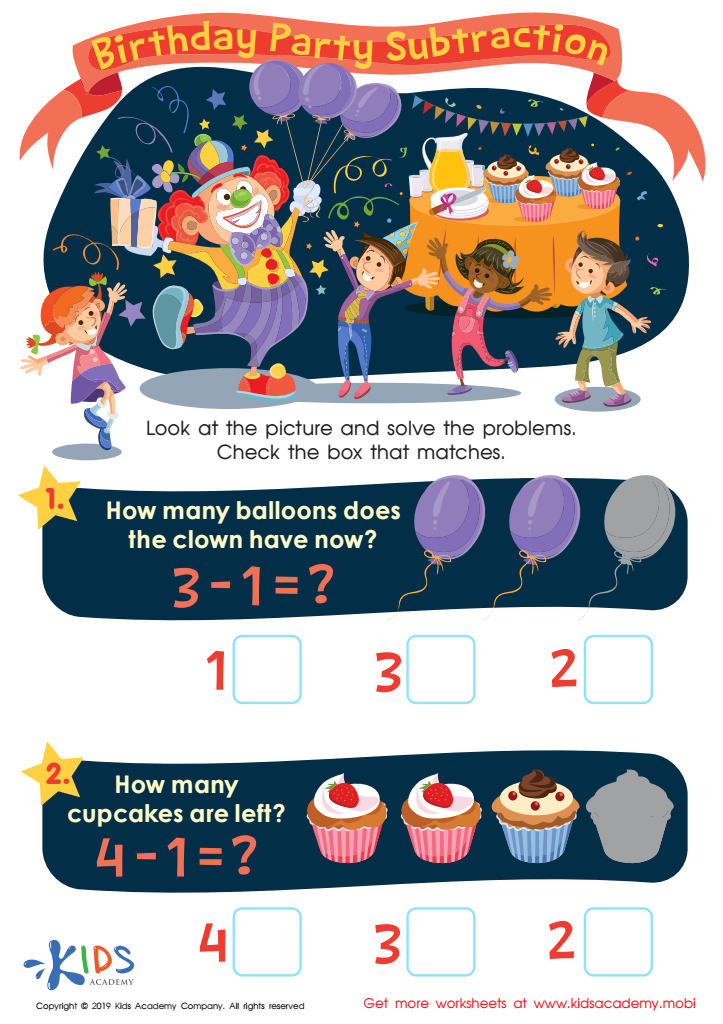
Birthday Party Subtraction Worksheet
Kids love birthday parties, with fun activities and yummy treats. Make math fun with this worksheet! It has pictures of a party, and your kids should solve the problems and check the matching box. They'll get to learn math, and have fun too!
Birthday Party Subtraction Worksheet
Worksheet
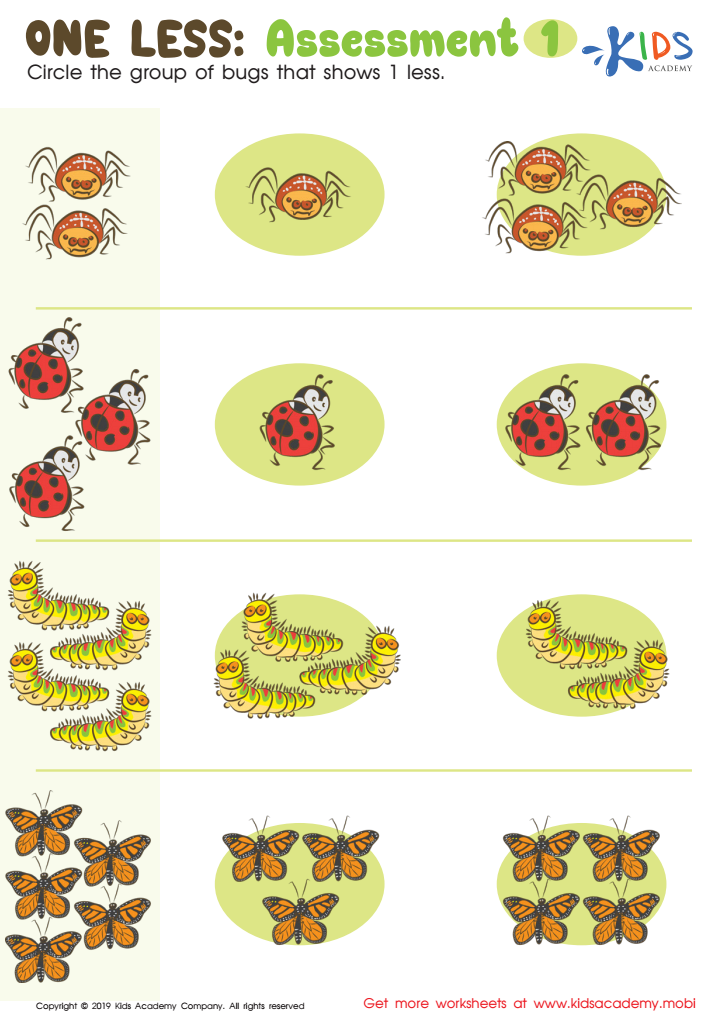
One Less: Assessment 1 Worksheet
Help your kids with counting using this worksheet that has pictures of bugs! There are four different bugs and insects. Show them each one and ask them to count, then circle the group that has 1 less than the previous group. Don't worry if your kids don't like bugs - it's just a picture!
One Less: Assessment 1 Worksheet
Worksheet
Join Kids Academy for Free
Who is primarily going to use this learning content?








Number recognition and subtraction are critical foundational skills in early mathematics that both parents and teachers should prioritize. Understanding numbers helps children identify quantities, which is essential for everyday tasks and future math concepts. Mastering number recognition fosters confidence, enabling children to engage with math in a meaningful way.
Subtraction, on the other hand, builds on this foundation by teaching students how to manipulate quantities and solve problems. It is one of the basic operations that children encounter daily—such as sharing items or taking away objects from a larger set. Encouraging subtraction skills helps students understand the relationship between adding and subtracting, enhancing their overall mathematical fluency.
Furthermore, these skills are linked to overall cognitive development; they encourage critical thinking, problem-solving, and logical reasoning. By promoting number recognition and subtraction, parents and teachers are not just teaching mathematics but also providing essential life skills. Children who master these concepts gain an early advantage in academics, boosting their self-esteem and curiosity.
Thus, an emphasis on these skills sets the groundwork for future learning, empowering children to approach more complex math with confidence and enthusiasm. Parents and teachers play a key role in fostering a positive learning environment through engaging activities that make these concepts fun and accessible.








