
Time reading skills Normal Math Worksheets for Ages 3-8
3 filtered results
Difficulty Level
Grade
Age
-
From - To
Subject
Activity
Standards
Enhance your child's time reading skills with our engaging math worksheets designed specifically for ages 3-8. These printable resources provide a fun and interactive way to introduce young learners to the concept of time. Through colorful illustrations and age-appropriate activities, children will learn to recognize clock faces, read different times, and understand essential time-related vocabulary. Our worksheets promote critical thinking and problem-solving abilities while reinforcing fundamental math concepts. Ideal for homeschooling or classroom use, these normal math worksheets are an excellent tool for fostering early numeracy skills and building confidence in your child's mathematical journey. Start exploring the world of time today!
Favorites
With answer key
Interactive
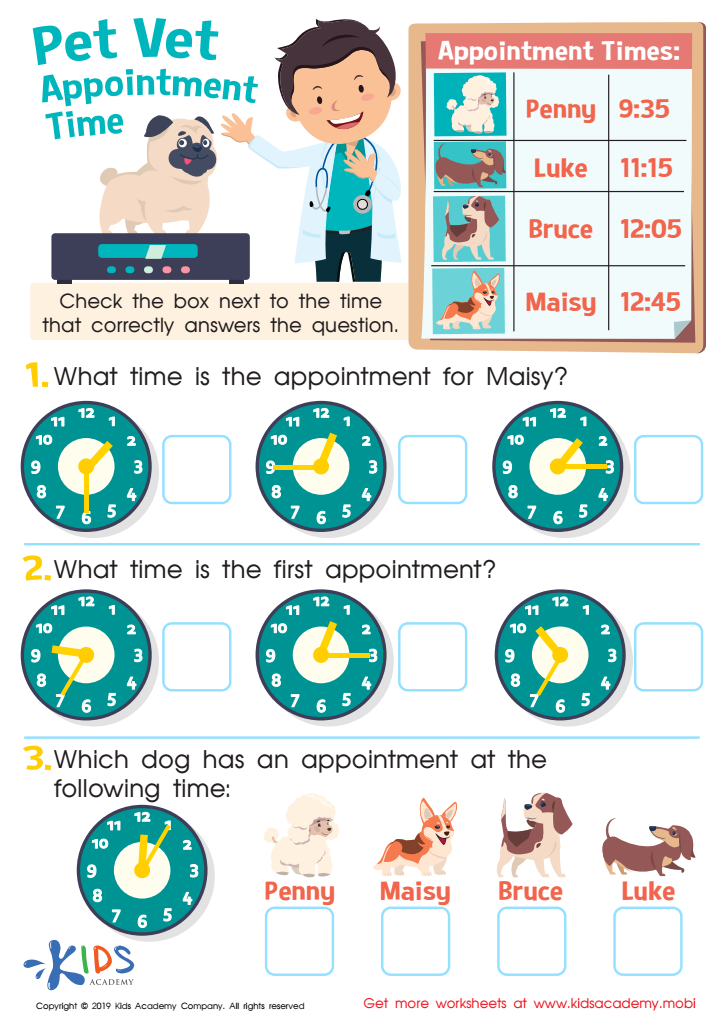
Pet Vet Appointment Time Worksheet
Teach your child how to read the time early, so they can master it. Explain the importance of being able to tell the time. Use this worksheet to have your child practice. Have them look at the clocks and check the box of the time that correctly answers the three questions.
 Assign to My Students
Pet Vet Appointment Time Worksheet
Worksheet
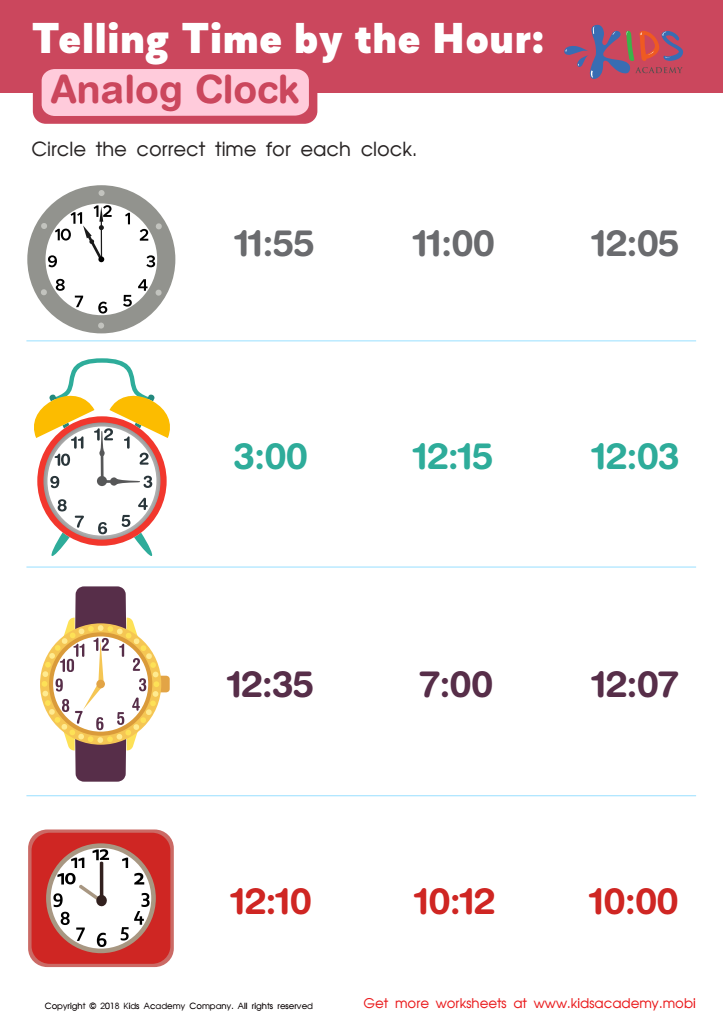
Telling Time by the Hour: Analog Clock Worksheet
Are your kids skilled at telling time? Find out with this worksheet featuring four clocks. Ask your child to identify the type of clock, then circle the correct time from the options. Help your child if needed and get the answers you need.
Telling Time by the Hour: Analog Clock Worksheet
Worksheet
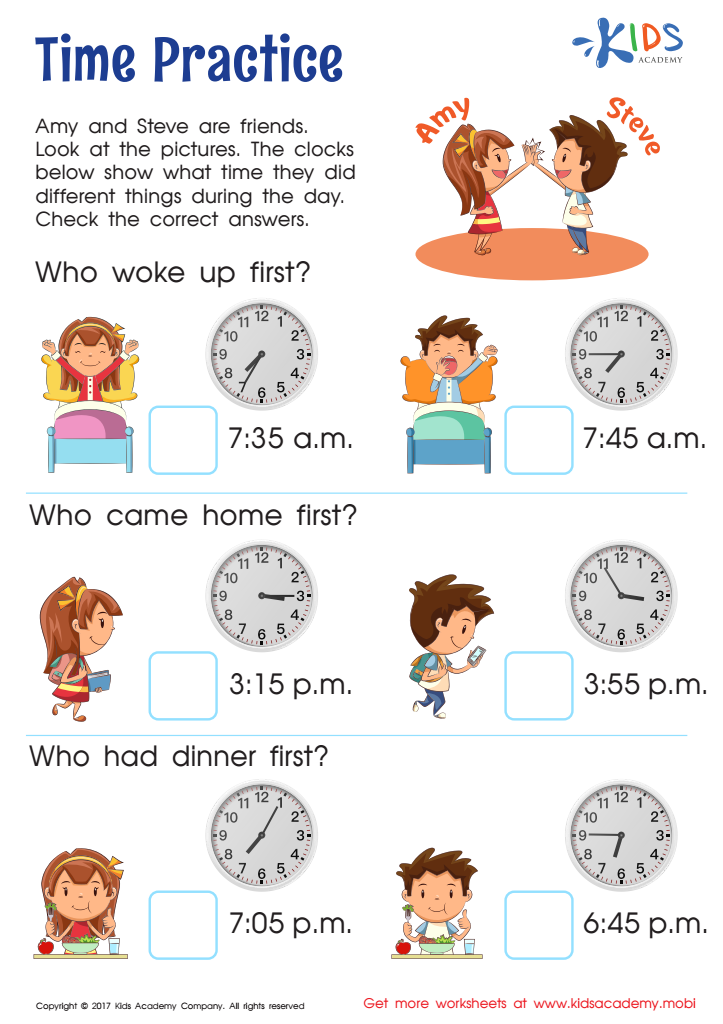
Time Practice Worksheet
It's perfect for 2nd graders as they gain a better understanding of time. Get them to tell the time on analog clocks, improve their math skills, and boost their confidence!
Second graders can brush up on timekeeping with our time practice worksheets. They'll learn to read minutes on analog clocks, honing math and confidence. Perfect for mastering this tricky concept!
Time Practice Worksheet
Worksheet
Join Kids Academy for Free
Who is primarily going to use this learning content?








Reading and math skills are foundational for children aged 3-8, setting the stage for lifelong learning. Parents and teachers should prioritize developing these skills during this crucial developmental period for several reasons.
Firstly, early reading skills enhance children's vocabulary, comprehension, and communication abilities, making it easier for them to express their thoughts and engage with peers. When children read regularly, they become familiar with different genres, stimulating imagination and creativity.
Similarly, normal math skills like counting, basic operations, and understanding patterns help children develop critical thinking and problem-solving abilities. Early exposure to math concepts fosters a sense of confidence and competence, laying the groundwork for more complex mathematics in later grades.
Furthermore, proficiency in reading and math significantly contributes to academic success. Children who struggle in these areas often face challenges in their overall education and social interactions, which can lead to decreased motivation and self-esteem.
Overall, promoting early reading and math skills equips children with essential tools for learning, igniting a passion for knowledge that will empower them for years to come. By nurturing these abilities, adults play a pivotal role in helping young learners reach their full potential.








