
Understanding moon phases Normal Worksheets for Ages 5-8
4 filtered results
Difficulty Level
Grade
Age
-
From - To
Subject
Activity
Standards
Discover engaging worksheets tailored for young learners ages 5-8 that simplify understanding moon phases. Our colorful, age-appropriate activities provide visual aids and hands-on practice to help children grasp the concept of the lunar cycle effortlessly. These worksheets not only enhance scientific curiosity but also bolster learning skills like observation and critical thinking. Ideal for both classroom and home settings, our moon phases worksheets foster a fun and interactive learning environment. Parents and educators can download these printable resources to inspire a deeper appreciation for our celestial neighbor and boost early science education. Start exploring moon phases with your child today!
Favorites
With answer key
Interactive
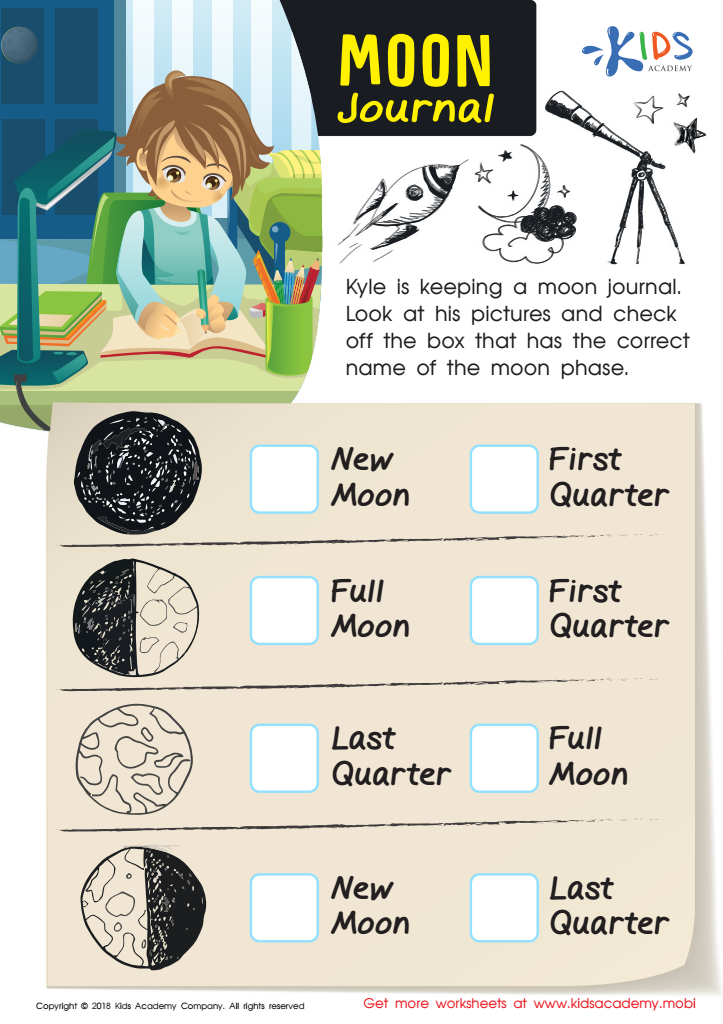
Moon Journal Worksheet
Observe the moon and its 8 phases with your child by downloading this free PDF worksheet from Kids Academy! Review the moon phases with them then help them label Kyle's moon journal. Select the right moon phase for each picture to complete the page!
 Assign to My Students
Moon Journal Worksheet
Worksheet
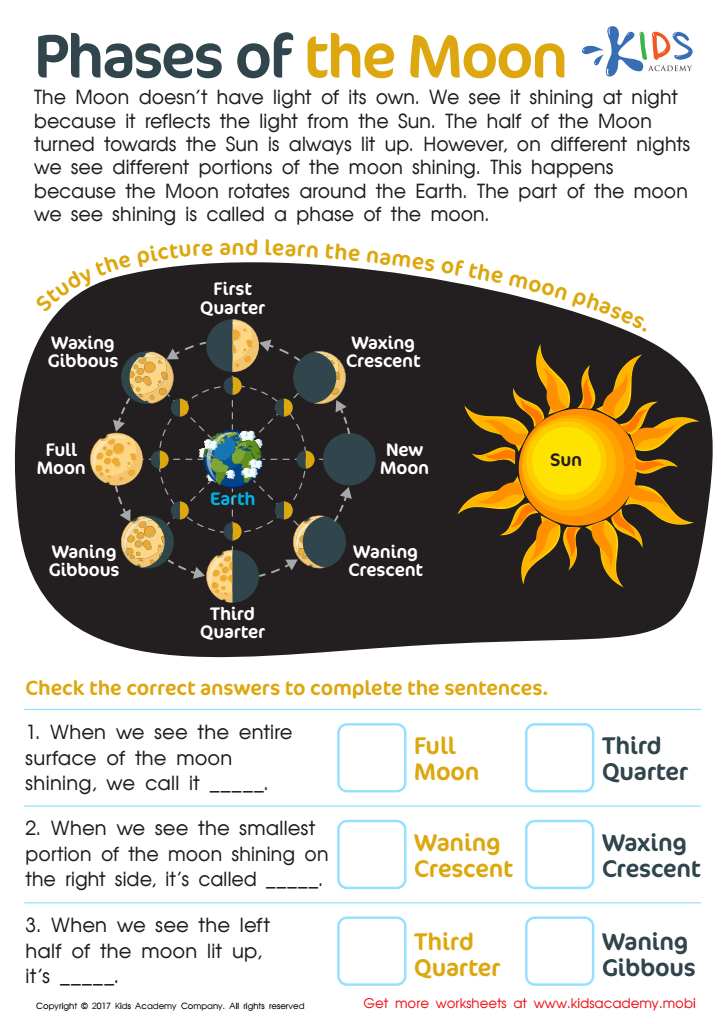
Phases of The Moon Worksheet
It'll show kids the fascinating phases and journey the moon takes around Earth. They'll be amazed to learn it's not always shining!
Phases of The Moon Worksheet
Worksheet
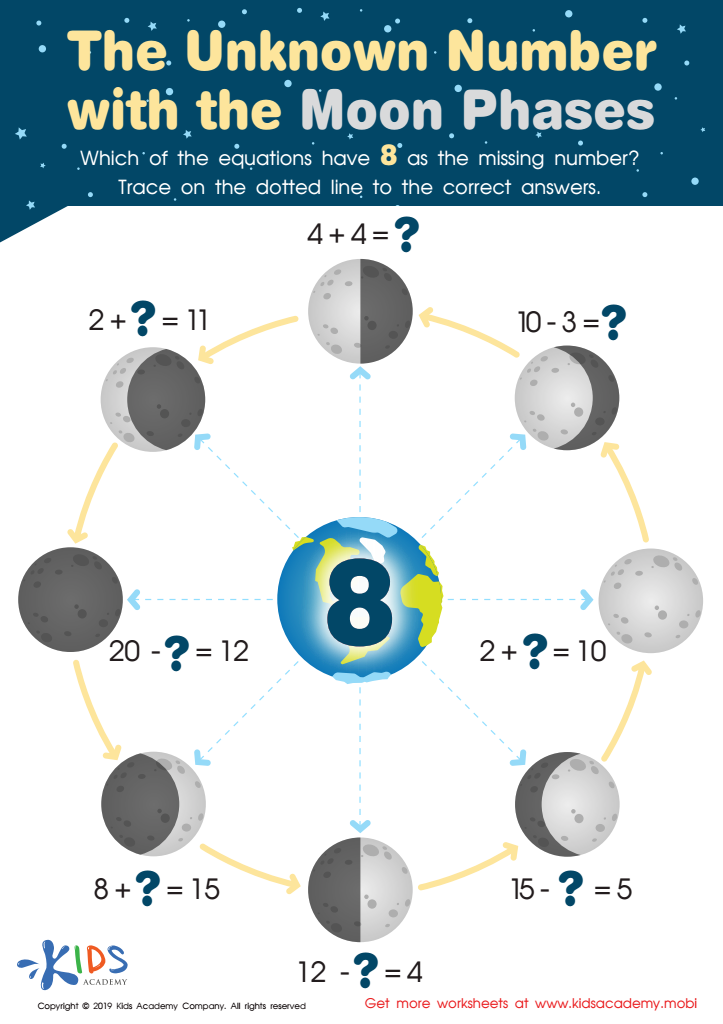
The Unknown Number with the Moon Phases Worksheet
Show your kids the moon one night! Explain why its shape changes during the month with a worksheet. Then, help them to solve math equations and trace the answer, where the missing number is '8'.
The Unknown Number with the Moon Phases Worksheet
Worksheet
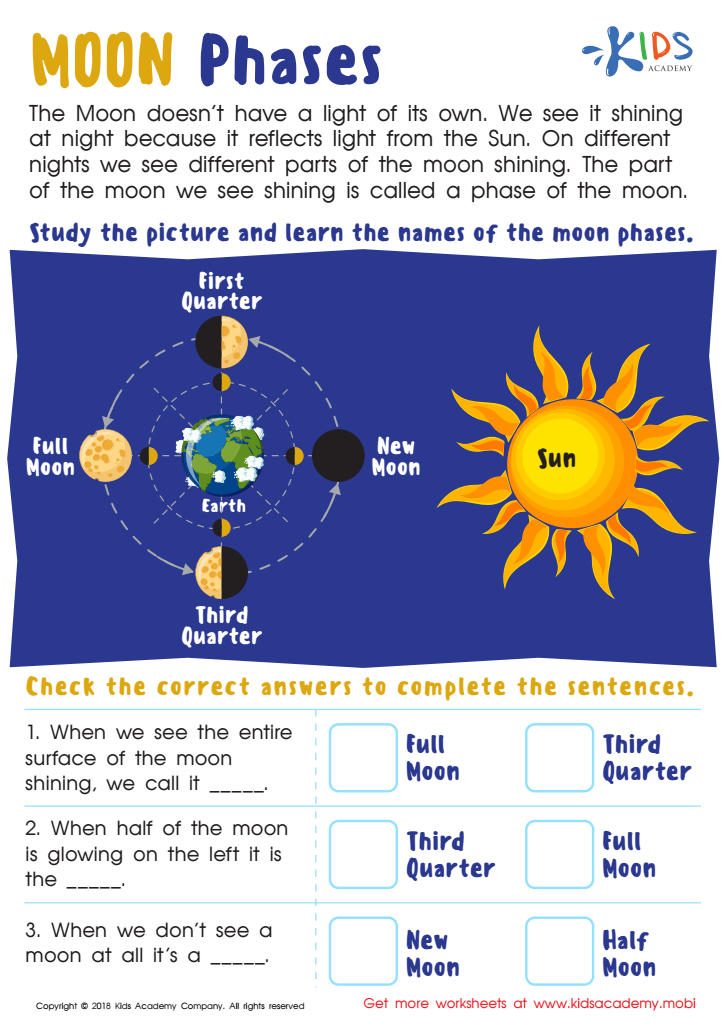
Moon Phases Worksheet
Gaze up at the night sky and the moon's appearance may change from night to night. Encourage your child to learn more about the sun, the moon, and space with this science worksheet. Have them read the text then study the picture. Finally, read the sentences and check the answers to identify the moon's phases.
Moon Phases Worksheet
Worksheet
Join Kids Academy for Free
Who is primarily going to use this learning content?






Understanding moon phases is a valuable aspect of children's early education, particularly for ages 5-8, fostering curiosity and promoting foundational scientific thinking. Moon phases offer a concrete way to introduce natural cycles and patterns in the environment, which is essential for developing observational and analytical skills. By learning about the moon’s phases, young students can grasp the concepts of time, change, and the way our universe is interconnected.
Incorporating moon phases into education also enriches vocabulary, introducing terms like "waxing," "waning," "crescent," and "gibbous." This enhances their descriptive language skills. Beyond language and science, learning about the moon can spark broader interests in astronomy and space, encouraging a lifelong passion for science.
Furthermore, understanding moon phases can bridge cultural learning. Many cultures have legends, holidays, and traditions linked to lunar phases, providing a pathway to celebrate and respect global diversity.
Parents and teachers should care about moon phases because it integrates STEM learning in an engaging, hands-on manner. Activities like moon observation journals, documenting changes, and crafting moon phase charts make learning interactive and fun. This holistic development—scientific reasoning, vocabulary enhancement, cultural appreciation, and engagement—places students on solid educational ground, kindling curiosity to explore the world beyond immediate understanding.








