
Understanding subtraction Normal Worksheets for Ages 5-8
10 filtered results
Difficulty Level
Grade
Age
-
From - To
Subject
Activity
Standards
Our "Understanding Subtraction" worksheets are designed for children ages 5-8 to build a strong foundation in early math skills. These engaging worksheets use a variety of visual aids and hands-on activities to make subtraction fun and approachable. Each worksheet is carefully crafted to cater to different learning styles, helping kids better grasp the concept of 'taking away' in a supportive and encouraging environment. Ideal for both classroom and at-home learning, these worksheets pave the way for confident young mathematicians, ensuring they understand subtraction through interactive exercises that challenge and inspire them. Get your free printable worksheets now!
Favorites
With answer key
Interactive
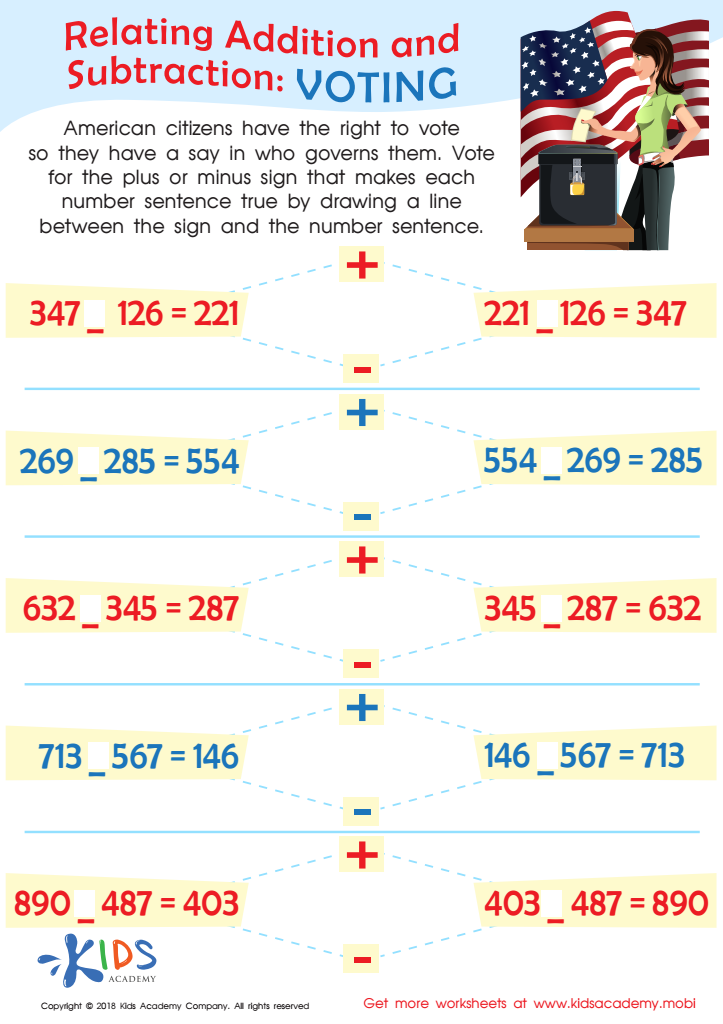
Voting Worksheet
This worksheet combines Social Studies and Math, teaching kids the democratic concept of voting. Guide learners to observe the problem, and decide if it needs a plus or minus. They "vote" for the correct answer by drawing a line from the problem to the correct operation symbol. Tally up the votes to check the answers!
 Assign to My Students
Voting Worksheet
Worksheet
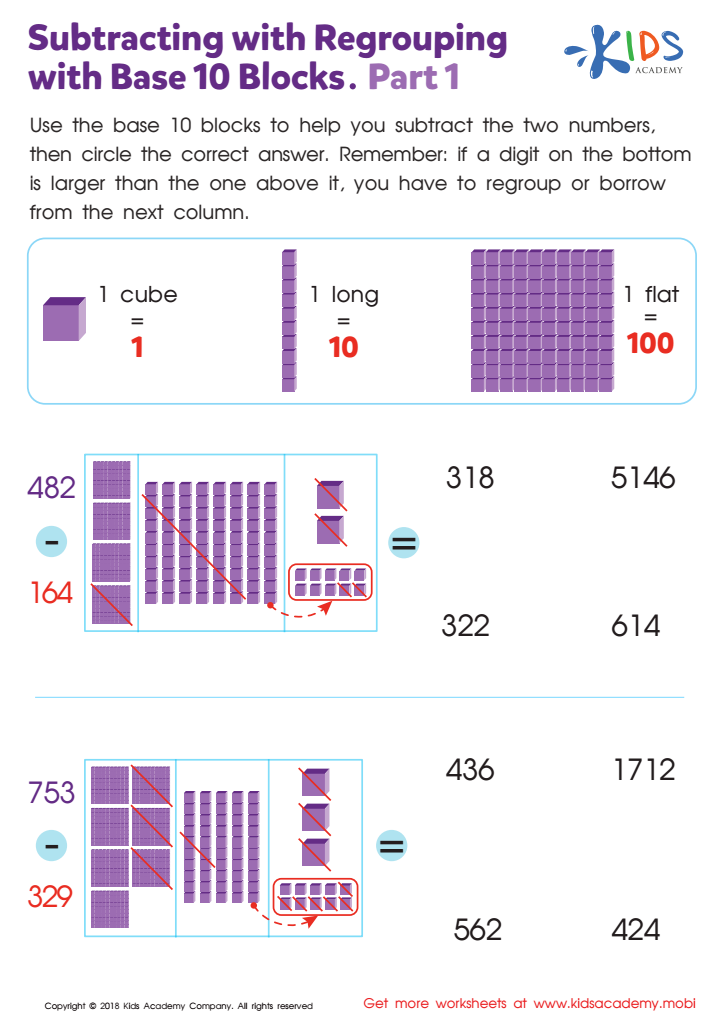
Subtracting with Regrouping with Base 10 Blocks. Part1 Worksheet
Subtracting with regrouping can be tough, but visuals make it easier! This worksheet uses colorful base ten blocks to help kids understand regrouping. Go over each problem starting at the ones, and review regrouping with a picture when needed. Finish by circling the correct answer.
Subtracting with Regrouping with Base 10 Blocks. Part1 Worksheet
Worksheet
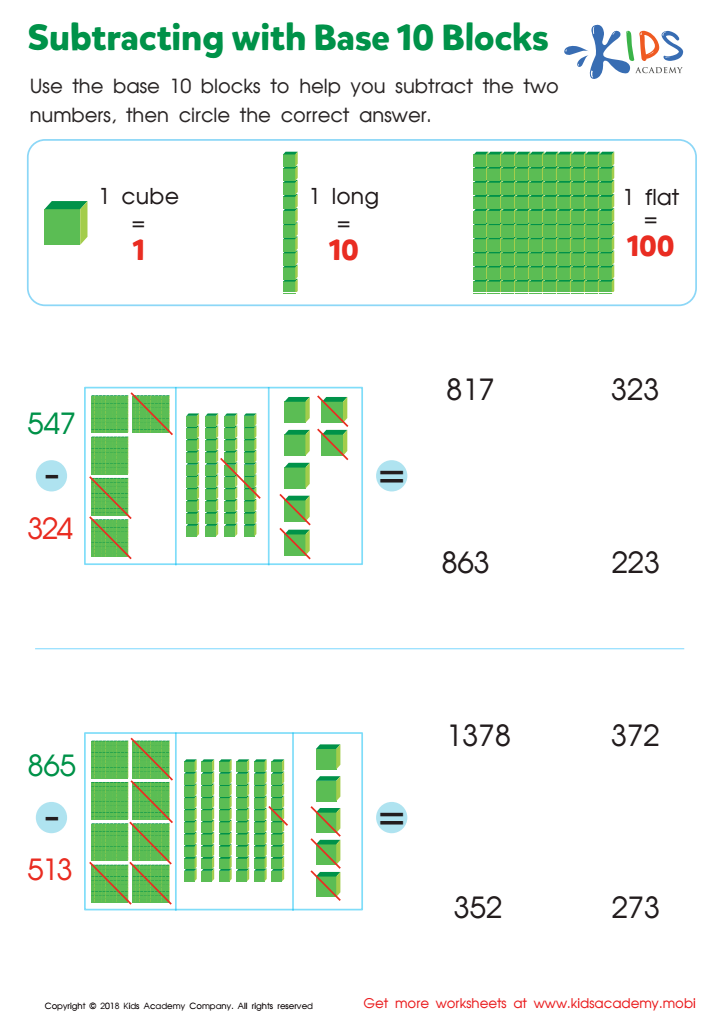
Subtracting with Base 10 Blocks Worksheet
Is your child having difficulty with 3-digit subtraction? They're not alone! Show your kid the idea behind subtracting with the help of Kids Academy's PDF worksheet. Colorful green base blocks are used to visualize the concept. Starting from the tens column, subtract each number and use the images for guidance. Allow your child to circle the correct answer for a comprehensive math lesson.
Subtracting with Base 10 Blocks Worksheet
Worksheet
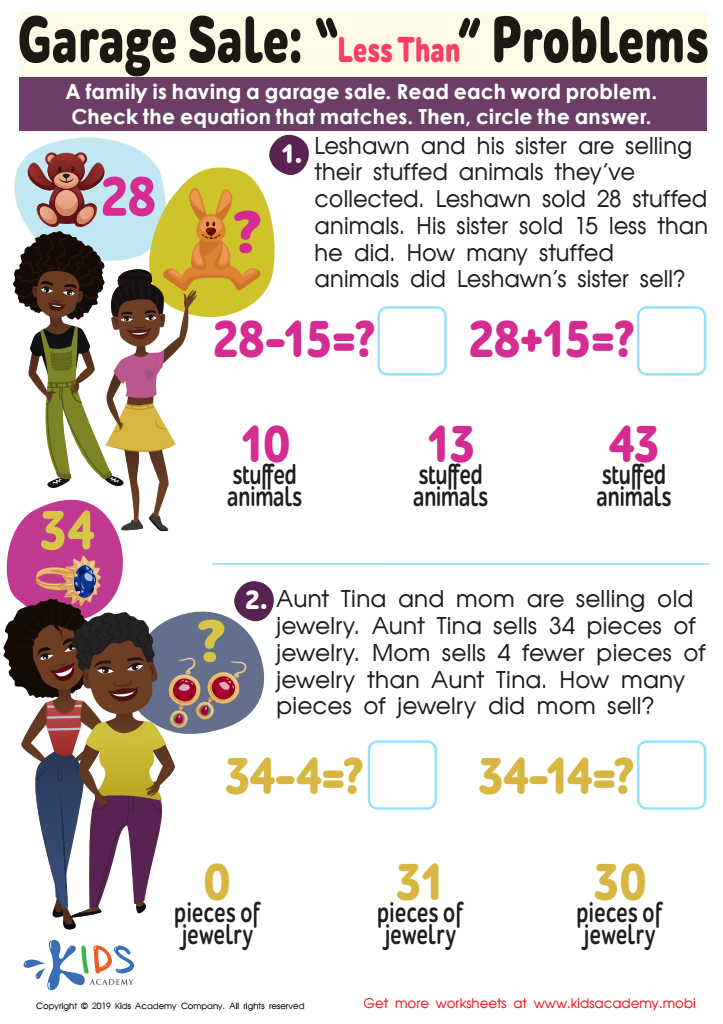
Garage Sale Less Than Worksheet
Kids often struggle with math word problems. This worksheet offers practice, using a real-world situation: friends having a garage sale. Students read each problem, extract the relevant information, match it with the correct equation and solve. Great for honing those essential problem-solving skills!
Garage Sale Less Than Worksheet
Worksheet
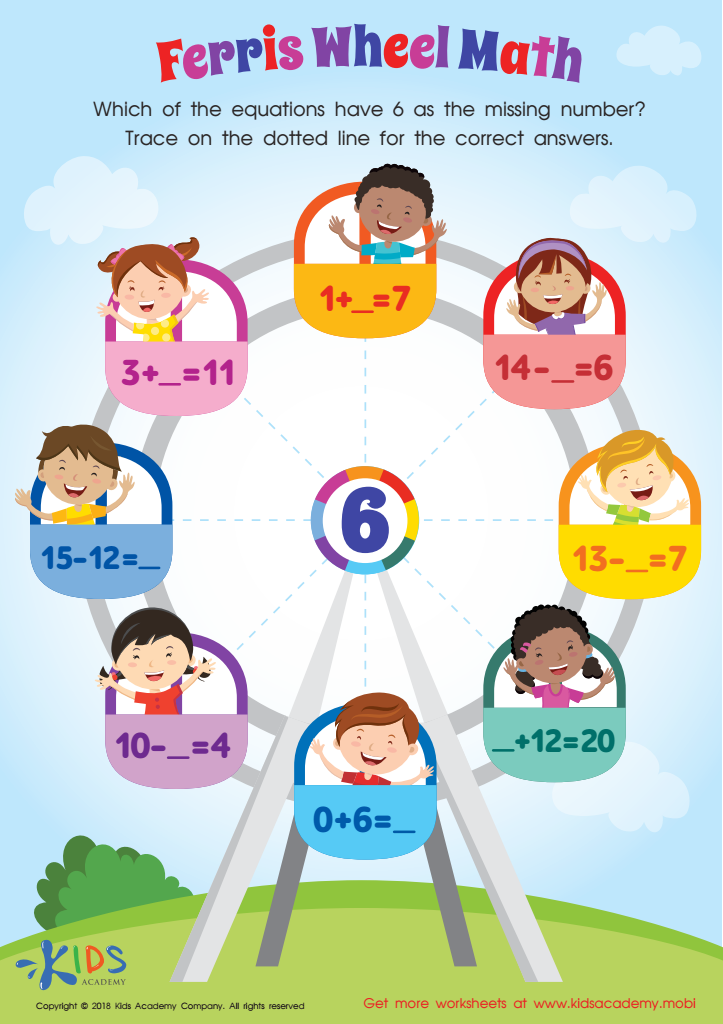
Missing Number: Ferris Wheel Math Worksheet
Hop on the Ferris wheel and solve the equations in the baskets! If the missing number is 6, draw a line from the basket to the middle of the wheel. Kids Academy's addition worksheet will not only help practice pre-algebra but also keep kids entertained with its vibrant illustrations. So, go round and round and have fun with math!
Missing Number: Ferris Wheel Math Worksheet
Worksheet
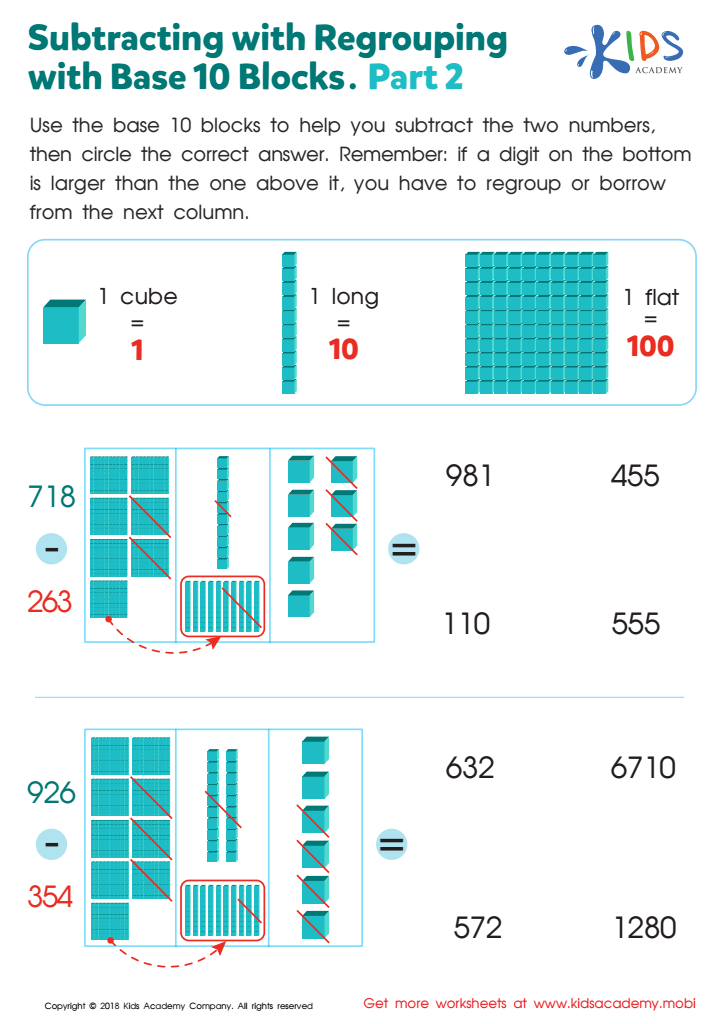
Subtracting with Regrouping with Base 10 Blocks. Part 2 Worksheet
Give your kids the practice they need to master subtracting with regrouping with Kids Academy's printable worksheet. It contains two 3-digit problems for kids to solve, plus colorful blocks to help them understand the concept more easily. Help your kids succeed!
Subtracting with Regrouping with Base 10 Blocks. Part 2 Worksheet
Worksheet
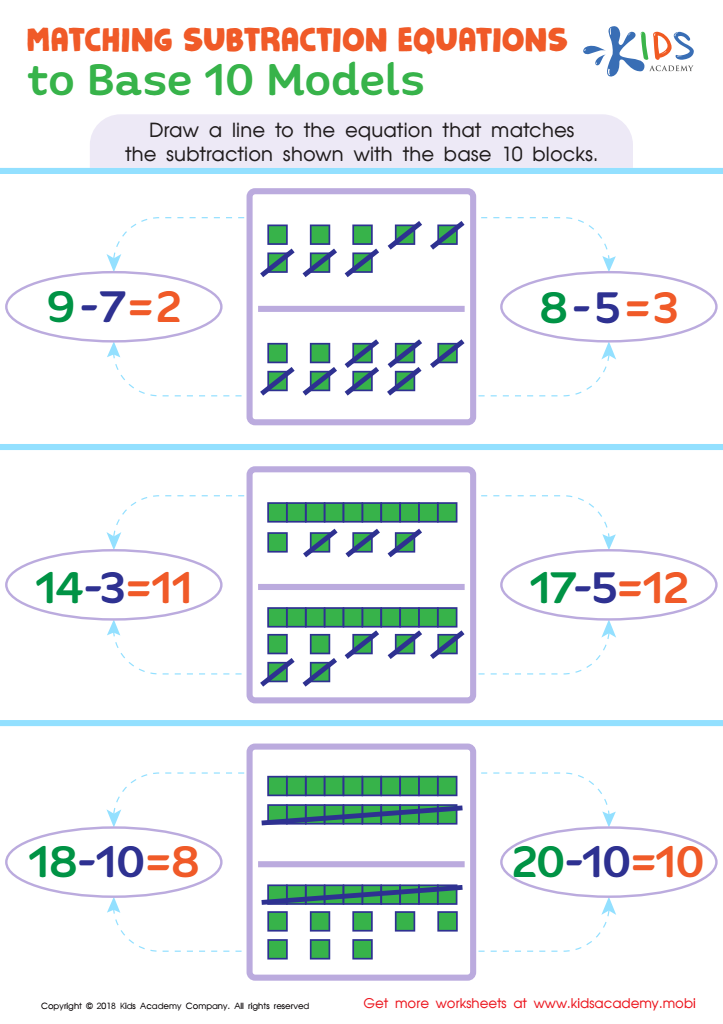
Matching Subtraction Equations To Base 10 Models Worksheet
Help your student draw a line to the equation that matches the subtraction shown with the base 10 blocks. Guide them through the task, ensuring they have good subtraction, counting and problem-solving skills. This tracing sheet is easy enough to complete with your support; the three mathematical problems here should be straightforward.
Matching Subtraction Equations To Base 10 Models Worksheet
Worksheet
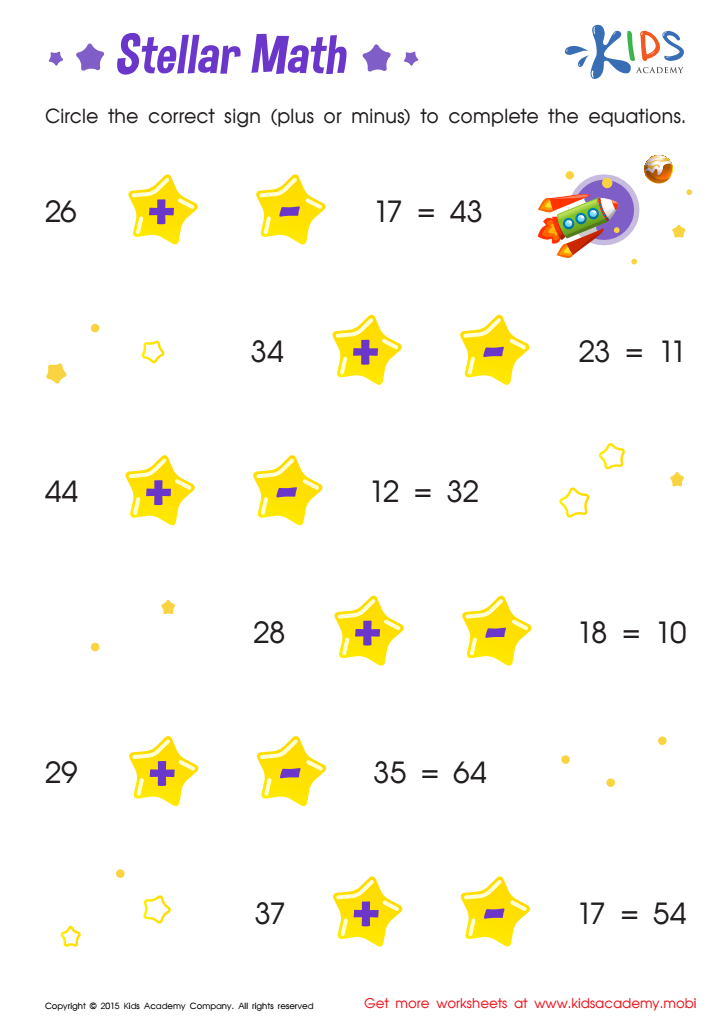
Stellar Math Substraction Worksheet
This worksheet offers more than just subtraction- your little learner can practice addition too! It will help them use number sense and mental math, as well as logical reasoning strategies, to complete the equations. With this worksheet, they'll use higher level thinking skills to determine which sign (plus or minus) is needed. Plus, they'll improve their cognitive skills too! Check out our rich collection of math worksheets for a fun and exciting math experience.
Stellar Math Substraction Worksheet
Worksheet
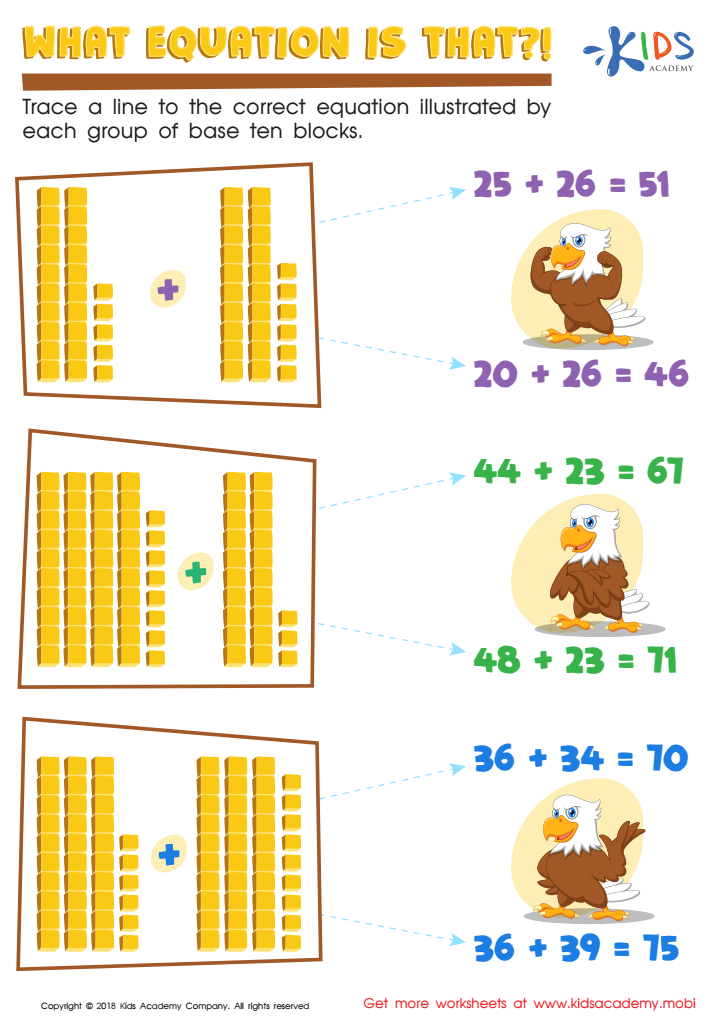
What Equation Is That? Worksheet
Have your students practice counting with base ten blocks. This will help them with math struggles. Homework and worksheets will help them improve; ask them to trace lines to the correct equation on a tracing sheet. Guide them as they count the blocks and trace the lines.
What Equation Is That? Worksheet
Worksheet
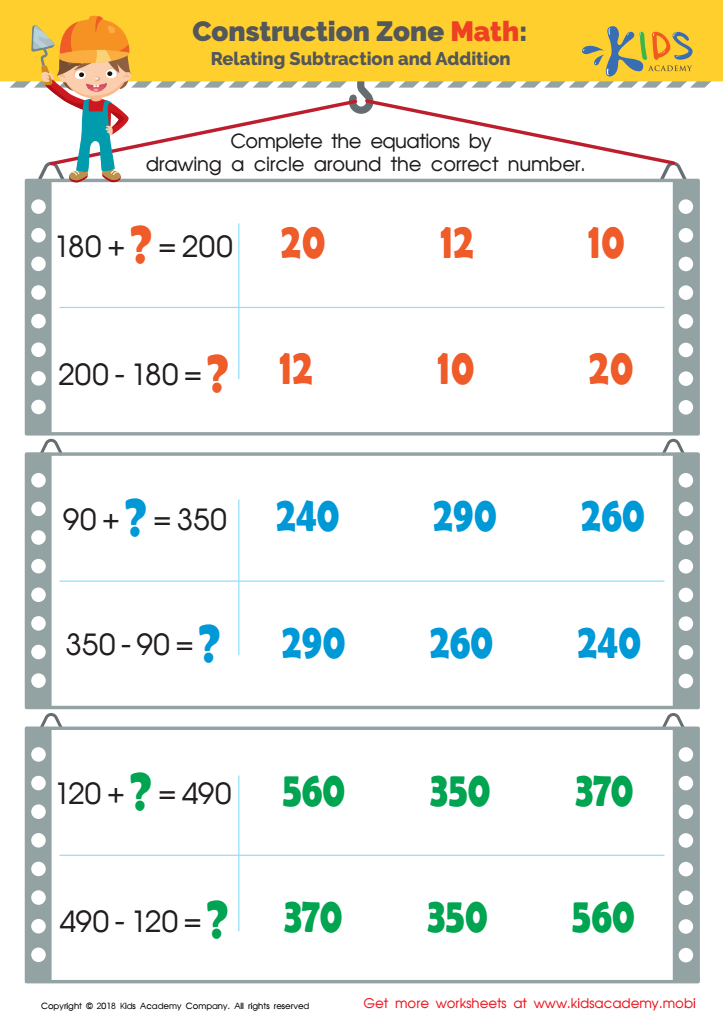
Construction Zone Math: Relating Subtraction and Addition Worksheet
Help kids master the concept of solving for missing numbers with subtraction. Use this cute worksheet featuring construction elements and colorful equations. Show them how to subtract to find the missing number, then circle the answer. It'll help them increase their number sense and get ready for algebra.
Construction Zone Math: Relating Subtraction and Addition Worksheet
Worksheet
Join Kids Academy for Free
Who is primarily going to use this learning content?








Understanding subtraction is crucial for children aged 5-8 as it sets the foundation for their mathematical development and critical thinking skills. At this age, children are like sponges, absorbing fundamental concepts that will be built upon throughout their education. Subtraction is more than just taking one number away from another; it teaches problem-solving, logical reasoning, and the ability to compare and understand quantities and differences.
For parents and teachers, fostering a strong grasp of subtraction helps ensure future academic success in mathematics and related subjects, particularly since subtraction is a precursor to more complex arithmetic operations such as multiplication and division. Moreover, mastering subtraction aids in everyday problem-solving tasks, from understanding time and money to dividing snacks or toys equally.
Engaging children in subtraction through practical, real-world situations helps reinforce these concepts in a meaningful way, making learning fun and relevant. Activities such as counting down days, cooking measurements, or even playing board games that require subtraction can effectively illustrate its importance and application.
Ensuring that children comprehend subtraction not only enhances their mathematical capabilities but also boosts their confidence and enjoyment in learning, paving the way for a positive, lifelong relationship with math. Parents and teachers play a critical role in nurturing this understanding, laying the groundwork for both academic and practical life skills.








