Number Recognition Normal Subtraction Worksheets for Ages 6-9
4 filtered results
-
From - To
Enhance your child's subtraction skills with our "Number Recognition Normal Subtraction Worksheets for Ages 6-9." Designed by education experts, these engaging worksheets help young learners identify numbers and understand subtraction concepts effortlessly. With vibrant illustrations and straightforward tasks, children can practice subtracting within a range of numbers suitable for their age. Perfect for both classroom and at-home learning, these worksheets ensure a fun and educational experience. Parents and teachers can track progress, making learning interactive and rewarding. Equip your kids with the essential subtraction skills they need for mathematical success today!
Adding Numbers: Conservation Worksheet
 Assign to My Students
Counting in Your Community Worksheet
Fact Families: Easter Math Worksheet
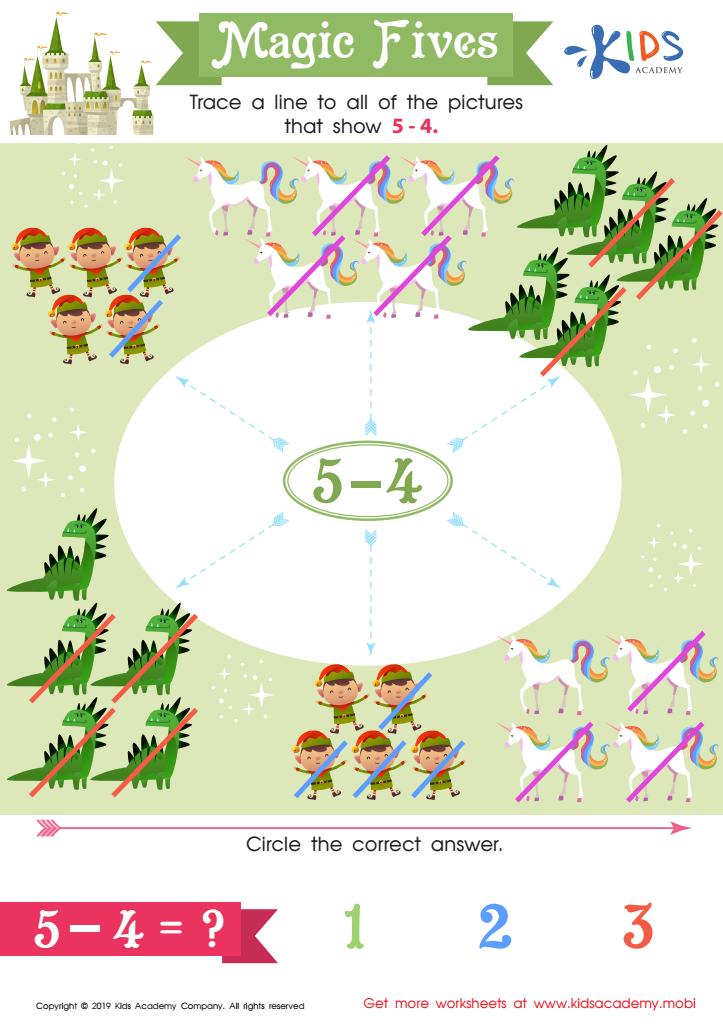
Magic Fives Worksheet



.jpg)




Number recognition and normal subtraction are fundamental skills that form the backbone of mathematical learning for children ages 6-9. At this stage, kids are still developing their understanding of numbers and basic arithmetic operations, which are critical for their future academic success and day-to-day problem-solving abilities.
Firstly, number recognition allows children to identify and understand numerical symbols, which is crucial for their ability to follow instructions, solve problems, and engage in mathematical activities. It sets the stage for higher-level math concepts by enabling them to feel comfortable and confident with numbers.
Normal subtraction comes into play by helping children grasp the concept of taking away and understanding how numbers relate to each other in practical scenarios. Subtraction is not only a core mathematical skill but also an essential life skill which aids in managing time, making financial decisions, and planning (e.g., understanding how much time is left or how many flowers need to be removed to make a bouquet).
Furthermore, both skills enhance cognitive development by fostering logical thinking, improving memory, and boosting problem-solving skills. Children who struggle with basic number skills and subtraction can face difficulties in more advanced mathematical topics later on, leading to academic frustration and diminished self-esteem. Therefore, parents and teachers should prioritize and actively engage children in learning and practicing these essential skills through interactive and enjoyable methods.