
Easy Tracing worksheets activities for 9-Year-Olds
1 filtered results
Difficulty Level
Grade
Age
-
From - To
Subject
Activity
Standards
Introducing our Easy Tracing Worksheets Activities, designed to provide endless fun while enhancing fine motor skills. Perfect for young learners, these activities offer a delightful way for children to practice their handwriting and drawing skills. Our carefully crafted worksheets include a variety of shapes, letters, and numbers, ensuring a comprehensive learning experience. Each activity is structured to build confidence in tracing, steadily progressing in complexity to accommodate growing skills. Ideal for both classroom use and home practice, our Easy Tracing Worksheets Activities are the go-to resource for parents and teachers looking to engage children in meaningful, educational play. Unlock the joy of learning with each stroke!
Favorites
With answer key
Interactive
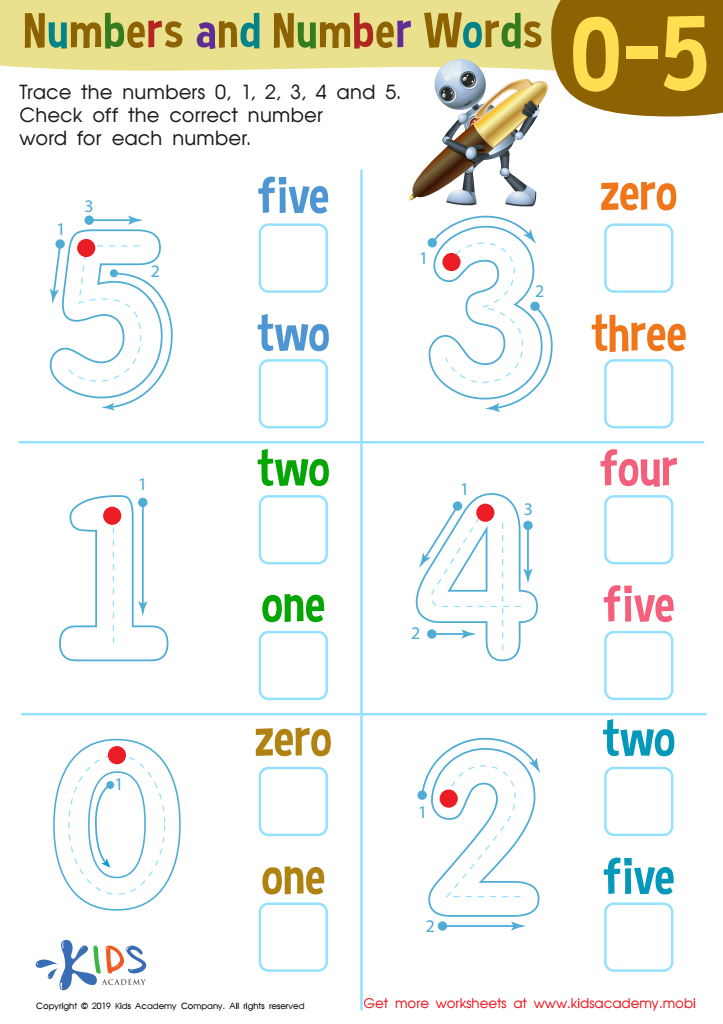
Numbers and Number Words Worksheet
Preschoolers can practice counting and recognizing numbers with this worksheet. Students trace the numbers zero through five and check the boxes next to each number to show the correct number word. Ideal for young kids, this printable helps them learn early math and number words.
 Assign to My Students
Numbers and Number Words Worksheet
Worksheet
Join Kids Academy for Free
Who is primarily going to use this learning content?








Easy tracing worksheets activities are incredibly beneficial for both children and adults embarking on the journey of learning various skills. These activities, structured around simple tracing tasks, are designed to cultivate a myriad of essential abilities that contribute significantly to personal development and educational growth.
First and foremost, easy tracing worksheets activities serve as an excellent tool for improving fine motor skills. The act of tracing lines, shapes, and letters requires control, precision, and coordination of small muscle movements, particularly in the hands and fingers. For young learners, these activities lay the groundwork for future skills such as writing, drawing, and even performing daily tasks that require dexterity.
Beyond motor skills, these tracing activities are instrumental in enhancing cognitive abilities. They teach children how to follow directions, focus on the task at hand, and understand spatial awareness. By engaging in tracing exercises, learners develop the ability to recognize patterns, shapes, and letters, which are fundamental skills in reading and mathematics.
Moreover, easy tracing worksheets activities are designed to be accessible and enjoyable, making learning less intimidating and more engaging for early learners. The simplicity of tracing exercises allows children to gain confidence as they successfully complete each task, fostering a positive relationship with learning from the outset.
In addition, these activities are incredibly versatile and can be tailored to suit a wide range of learning objectives and skill levels. Whether it's mastering the alphabet, numbers, or even more complex geometric shapes, easy tracing worksheets can be adapted to meet the educational needs of any learner.
In conclusion, easy tracing worksheets activities are a cornerstone of foundational learning. They play a crucial role in developing fine motor skills, cognitive abilities, and a positive attitude towards learning. These simple, yet effective exercises offer a stepping stone to more complex skills, making them an invaluable tool for learners of all ages.








