Normal Elementary Phonics worksheets activities for Ages 3-5
1 filtered results
-
From - To
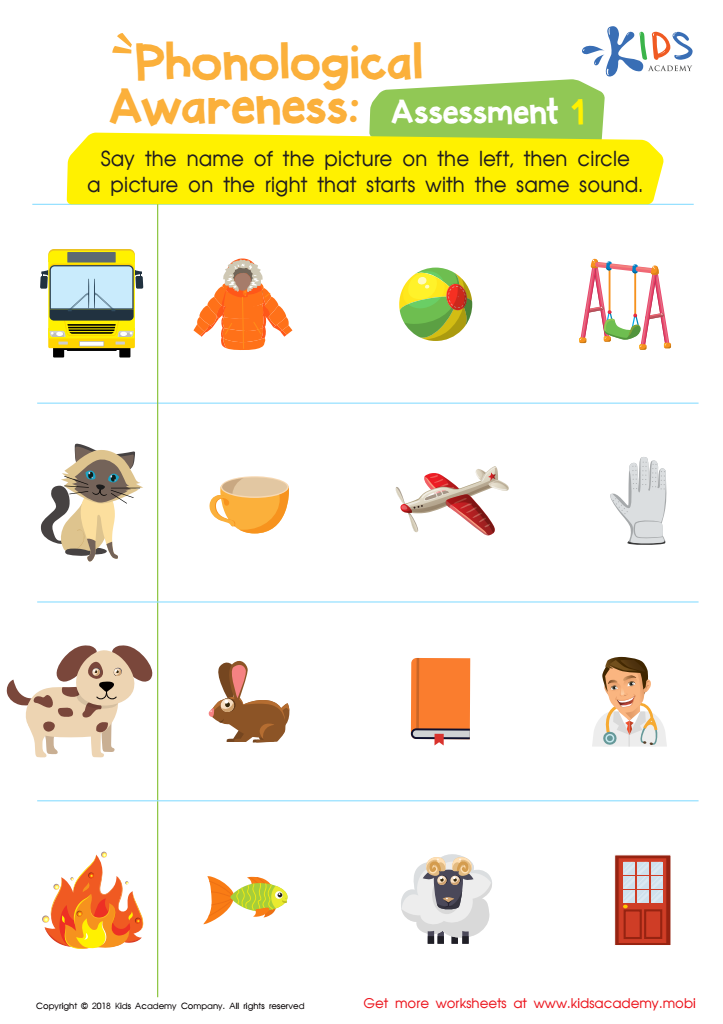
Phonological Awareness: Assessment 1 Worksheet
 Assign to My Students







Normal Elementary Phonics worksheets activities play a crucial role in the foundational development of young learners' reading and writing skills. These structured activities are designed specifically to make the process of understanding phonics—the relationship between letters and sounds—both engaging and effective for elementary students. There are several reasons why these worksheets are invaluable in an educational setting.
Firstly, Normal Elementary Phonics worksheets activities cater to a variety of learning styles. Whether a child is a visual, auditory, or kinesthetic learner, phonics worksheets can be adapted to suit their preferred method of learning. This flexibility ensures that every student has the opportunity to grasp the basics of phonics at their own pace, in a way that makes the most sense to them.
Secondly, these activities provide systematic and sequential learning. Phonics is a subject that builds upon itself, and Normal Elementary Phonics worksheets are structured in a way that gradually introduces new concepts while reinforcing previously learned skills. This systematic approach helps to solidify the foundational knowledge that is necessary for successful reading and spelling.
Moreover, the repetitive nature of these worksheets activities reinforces learning. Repetition is a key element in the learning process, especially for young learners. Through repeated exposure to phonics rules and patterns, students are more likely to retain the information and apply it when reading or writing.
Furthermore, Normal Elementary Phonics worksheets activities foster independent learning. As students become familiar with the format of the worksheets, they gain the confidence to complete them independently. This independence not only boosts their self-esteem but also encourages a love for learning and reading.
Lastly, these activities provide immediate feedback to both students and teachers. As students work through the worksheets, they can quickly see the results of their understanding, allowing for immediate correction and learning. For teachers, completed worksheets offer insight into each student's grasp of the material, enabling targeted instruction where needed.
In summary, Normal Elementary Phonics worksheets activities are a fundamental tool in teaching phonics to young learners. They offer a structured, adaptable, and effective method for teaching the crucial relationship between letters and sounds, paving the way for successful reading and writing.








