
Normal Phonics worksheets activities for Ages 7-9
5 filtered results
Difficulty Level
Grade
Age
-
From - To
Subject
Activity
Standards
Discover engaging Normal Phonics worksheets designed specifically for children aged 7-9! Our curated activities focus on enhancing phonics skills through interactive and fun exercises tailored to various learning styles. Each worksheet promotes reading fluency, decoding, and comprehension, making learning to read both enjoyable and effective. With a variety of games and challenges, these worksheets support skill development while keeping learners motivated. Perfect for classroom use or at-home learning, our phonics resources equip young readers with the essential tools to succeed. Explore our collection today and watch your child’s confidence and academic abilities soar!
Favorites
With answer key
Interactive
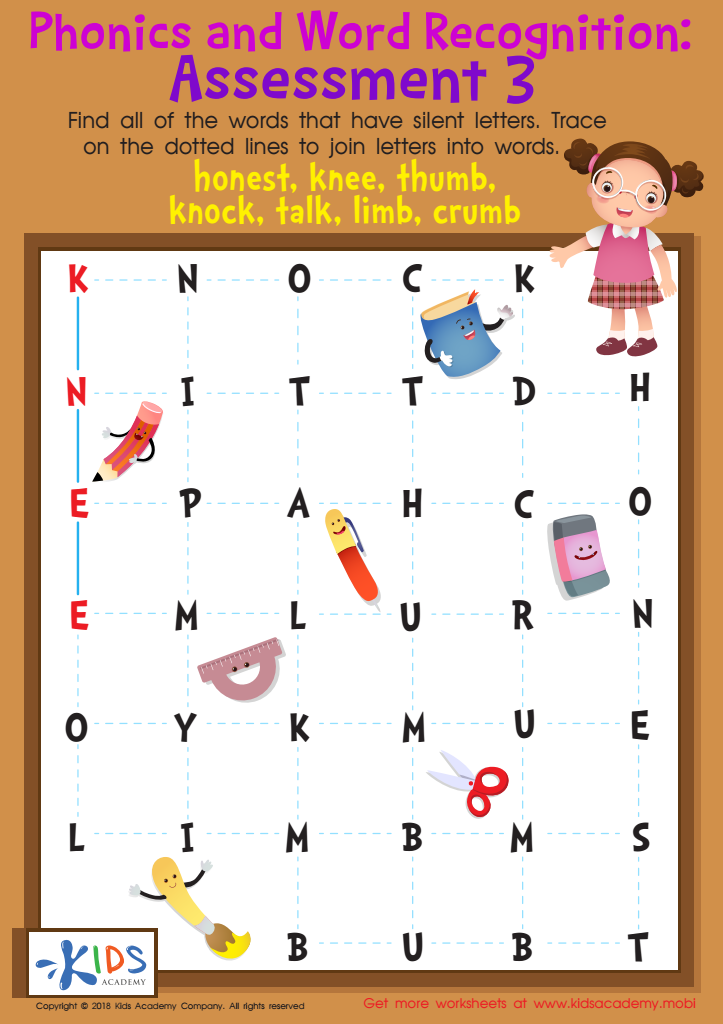
Phonics and Word Recognition: Assessment 3 Worksheet
Silent letters can be tricky for kids learning to read and write. Show them how they work with words like 'knee' and 'dumb'. Then, challenge them to come up with their own. Give them a worksheet with silent letters and trace the lines to join the letters into words.
 Assign to My Students
Phonics and Word Recognition: Assessment 3 Worksheet
Worksheet
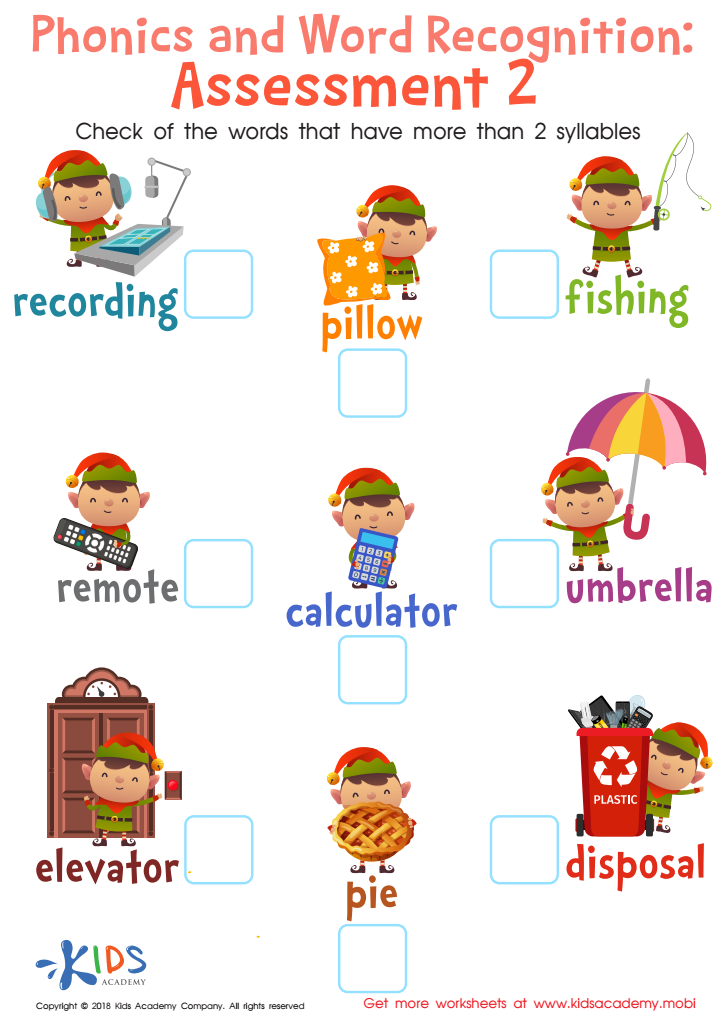
Phonics and Word Recognition: Assessment 2 Worksheet
Help your kids learn proper pronunciation by counting syllables. Most words they'll encounter have 1-3 syllables, making them simple to say. Have them repeat the words in your worksheet after you. Focus on longer words with more than two syllables.
Phonics and Word Recognition: Assessment 2 Worksheet
Worksheet
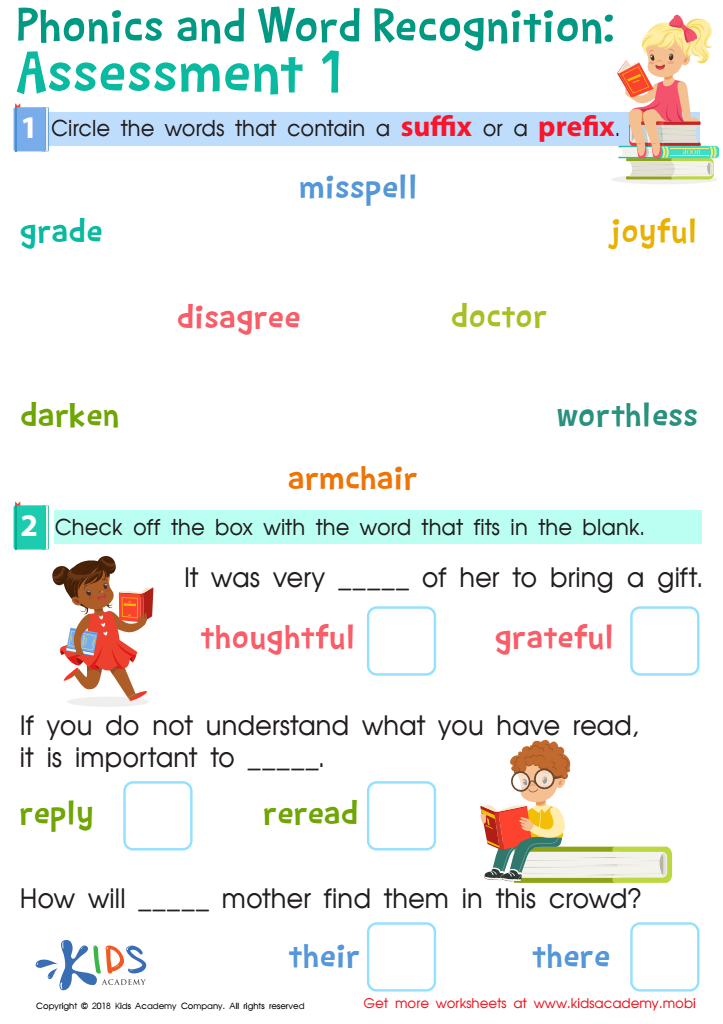
Phonics and Word Recognition: Assessment 1 Worksheet
Explain prefixes (words added to start of another word to give it a new meaning) and suffixes (added to end of word to change its meaning) to your kids with examples like 'unhappy' (prefix) and 'forgetful' (suffix). Now, help your child complete this worksheet, including circling words and checking boxes.
Phonics and Word Recognition: Assessment 1 Worksheet
Worksheet
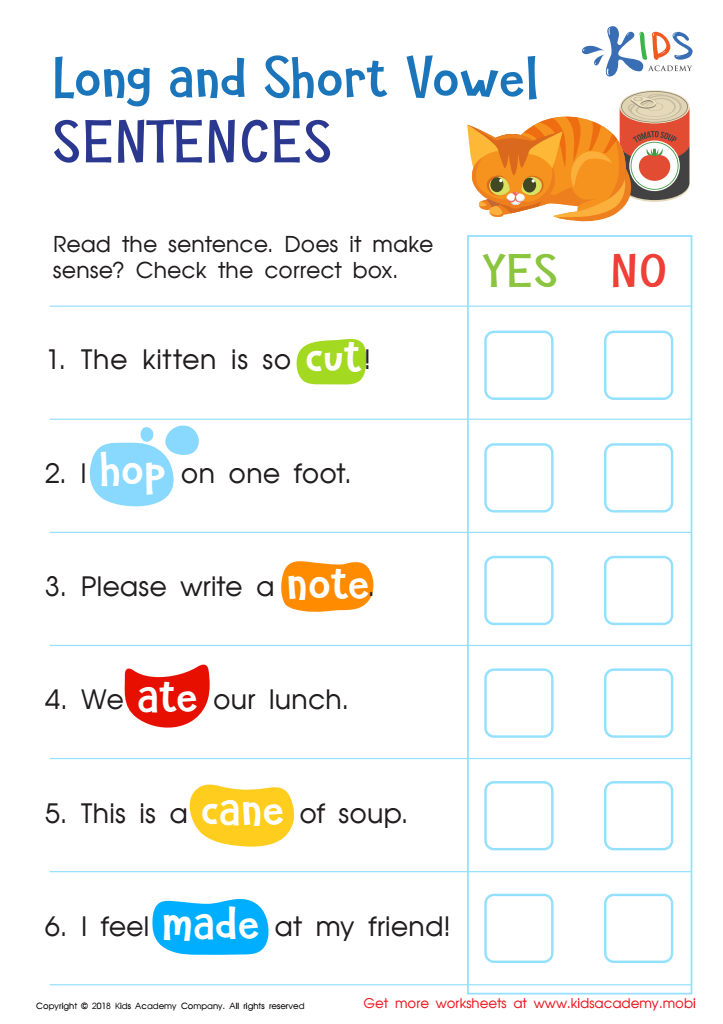
Long and Short Vowel Sentences: Assessment Worksheet
This printable worksheet helps kids practice differentiating between short and long vowel sounds. They'll use context clues to figure out which words make sense in simple sentences. A great way to build reading and writing skills!
Long and Short Vowel Sentences: Assessment Worksheet
Worksheet
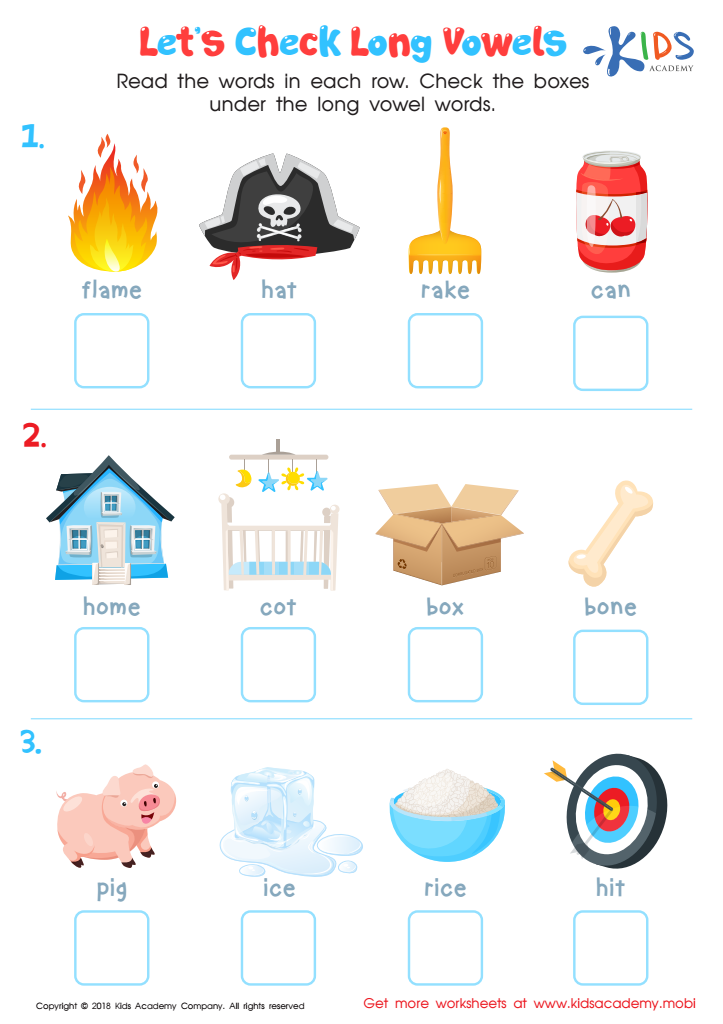
Let's Check Long Vowels: Assessment Worksheet
This worksheet helps your child identify objects and learn long vowel sounds. Ask them to say the names of the four objects in each row. Then, help them check the boxes to confirm they know the long vowel sounds. This will help them develop their reading skills.
Let's Check Long Vowels: Assessment Worksheet
Worksheet
Join Kids Academy for Free
Who is primarily going to use this learning content?








Normal Phonics activities for ages 7-9 are vital for several reasons, particularly in enhancing literacy development. During this stage, children begin to read and write independently, making a solid grasp of phonics essential. Phonics teaches the relationship between letters and sounds, helping children decode new words and improve their reading fluency.
For parents and teachers, engaging students in phonics activities fosters essential reading skills, which are foundational for all academic achievement. This is the time when students shift from learning to read to reading to learn, so a strong phonetic grounding empowers them to tackle increasingly complex texts. Additionally, regular phonics practice helps to build confidence. When children can decode words effectively, they are more likely to enjoy reading and participate willingly in discussions about books.
Furthermore, phonics activities support spelling and writing abilities, leading to overall literacy development. It creates a positive feedback loop: better reading skills enhance writing, and improved writing skills boost reading.
By incorporating Normal Phonics activities into learning routines, both parents and teachers can help ensure students develop robust literacy competencies essential for their future success in school and beyond. Advocating for systematic phonics instruction is a crucial investment in children's educational journey.








