
Normal Phonics worksheets activities for 9-Year-Olds
3 filtered results
Difficulty Level
Grade
Age
-
From - To
Subject
Activity
Standards
Dive into the world of reading and writing with our Normal Phonics worksheets activities, designed to boost your child's phonetic skills in an engaging and interactive way. Our meticulously crafted worksheets cater to learners of all levels, ensuring a solid foundation in phonics. From understanding basic sounds to blending them into words, our activities cover a wide range of phonetic exercises. Each worksheet is carefully structured to provide a step-by-step learning experience, making it easy for children to grasp and apply phonetic principles. With our Normal Phonics worksheets activities, watch your child's reading confidence soar, paving the way for academic success.
Favorites
With answer key
Interactive
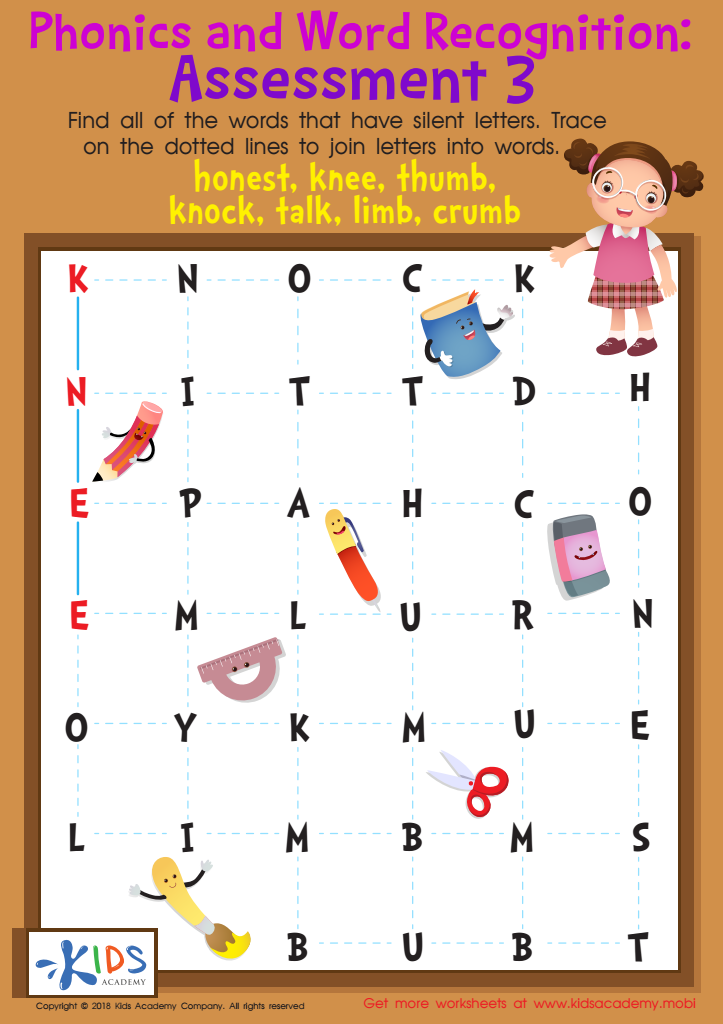
Phonics and Word Recognition: Assessment 3 Worksheet
Silent letters can be tricky for kids learning to read and write. Show them how they work with words like 'knee' and 'dumb'. Then, challenge them to come up with their own. Give them a worksheet with silent letters and trace the lines to join the letters into words.
 Assign to My Students
Phonics and Word Recognition: Assessment 3 Worksheet
Worksheet
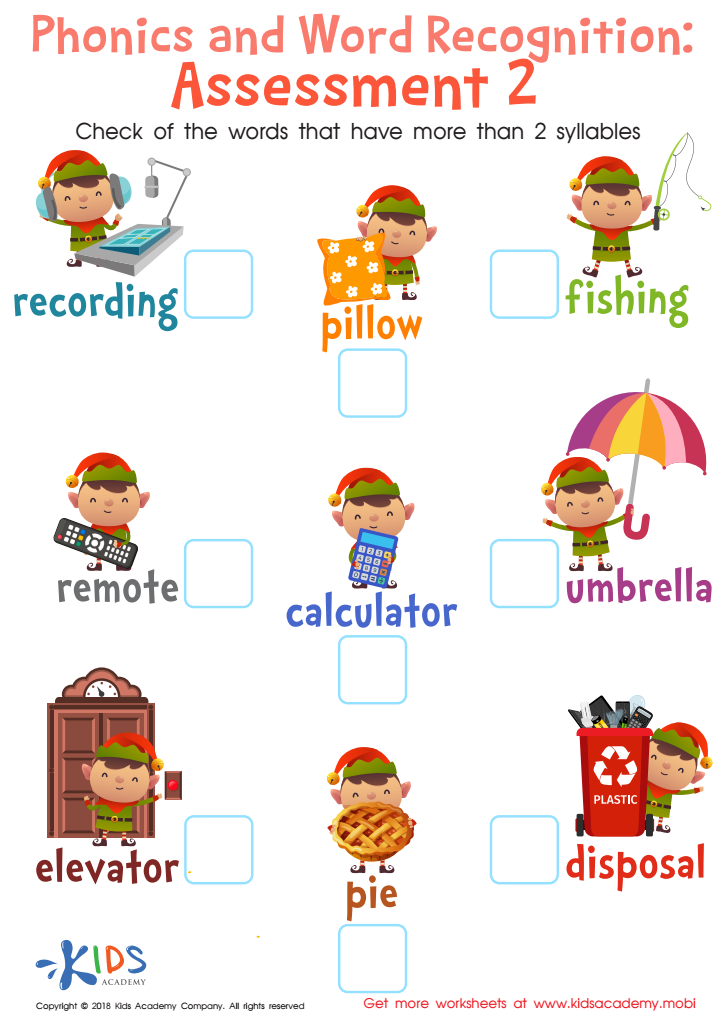
Phonics and Word Recognition: Assessment 2 Worksheet
Help your kids learn proper pronunciation by counting syllables. Most words they'll encounter have 1-3 syllables, making them simple to say. Have them repeat the words in your worksheet after you. Focus on longer words with more than two syllables.
Phonics and Word Recognition: Assessment 2 Worksheet
Worksheet
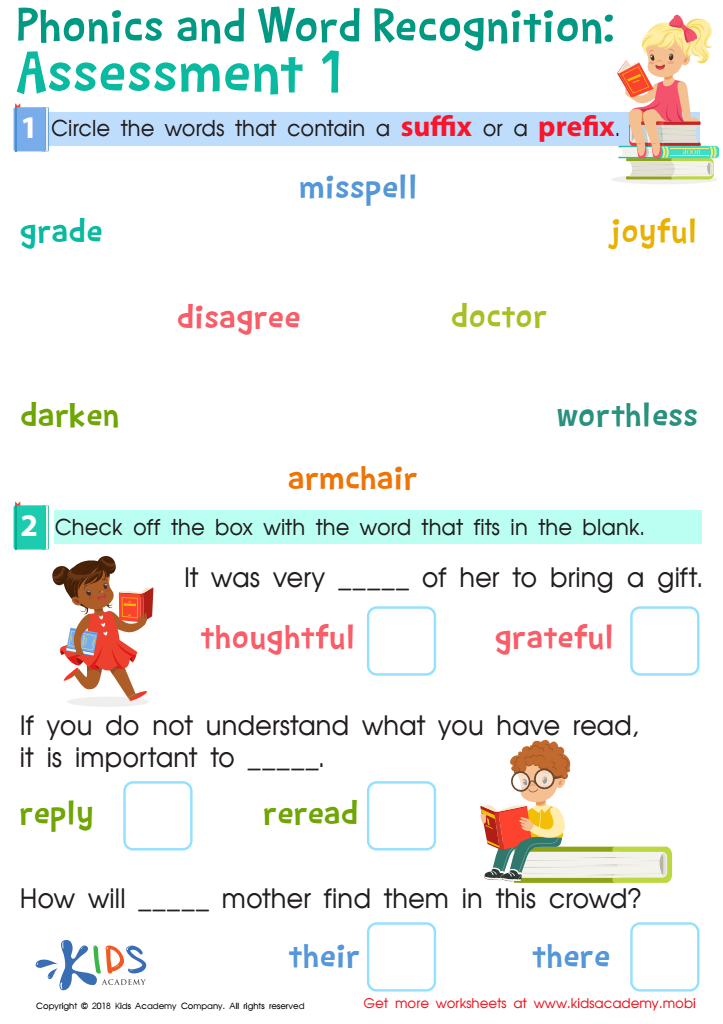
Phonics and Word Recognition: Assessment 1 Worksheet
Explain prefixes (words added to start of another word to give it a new meaning) and suffixes (added to end of word to change its meaning) to your kids with examples like 'unhappy' (prefix) and 'forgetful' (suffix). Now, help your child complete this worksheet, including circling words and checking boxes.
Phonics and Word Recognition: Assessment 1 Worksheet
Worksheet
Join Kids Academy for Free
Who is primarily going to use this learning content?







In the journey of learning to read and write, Normal Phonics worksheets activities stand out as an invaluable tool for students. These activities, carefully designed to enhance phonetic understanding, are not just another task for learners but a critical step towards literacy. Engaging with Normal Phonics worksheets activities offers a myriad of benefits that cater to different learning styles and paces, making them an indispensable part of any educational setting.
Firstly, these activities provide a structured approach to learning sounds and their correspondence with letters, which is fundamental in laying the groundwork for reading and spelling. Through repetitive practice, students can internalize the relationship between letters and sounds, a core aspect of phonics that supports the development of decoding skills. Decoding, in turn, is essential for reading fluency and comprehension, allowing learners to tackle new words with confidence.
Moreover, Normal Phonics worksheets activities are designed to progressively increase in complexity, ensuring that learners are constantly challenged and engaged. This scaffolding approach reinforces learning and aids in the retention of phonetic rules, gradually building a robust vocabulary and an understanding of language structure. For educators, the sequential nature of these worksheets makes it easier to track and assess individual student progress, providing insights into areas that may require additional focus.
Furthermore, the variety of exercises available in phonics worksheets—ranging from matching activities and fill-in-the-blanks to word puzzles and sentence formation—caters to diverse learning preferences. This variety ensures that learning remains exciting and interactive, promoting active participation and sustained interest among students. For visual and kinesthetic learners especially, the hands-on aspect of completing worksheets can make abstract phonetic concepts more concrete and understandable.
In conclusion, Normal Phonics worksheets activities are a fundamental resource in the literacy toolkit. By offering a systematic, engaging, and comprehensive approach to phonics instruction, these activities not only enhance phonetic knowledge but also foster a love for reading and writing, laying a solid foundation for academic success.








