Normal Coins Worksheets for Ages 5-6
1 filtered results
-
From - To
Introducing our "Normal Coins for Ages 5-6" worksheets, specifically crafted to introduce young learners to the fascinating world of currency! Engage your child with vibrant, interactive activities designed to promote recognition and understanding of everyday coins. These worksheets are meticulously tailored for children ages 5-6, offering a perfect blend of fun and education. Through a series of carefully structured tasks, your child will explore the value, history, and usage of normal coins, laying the foundation for financial literacy in a playful and engaging manner. Unlock the world of money with our captivating worksheets and watch your child's curiosity and knowledge grow!
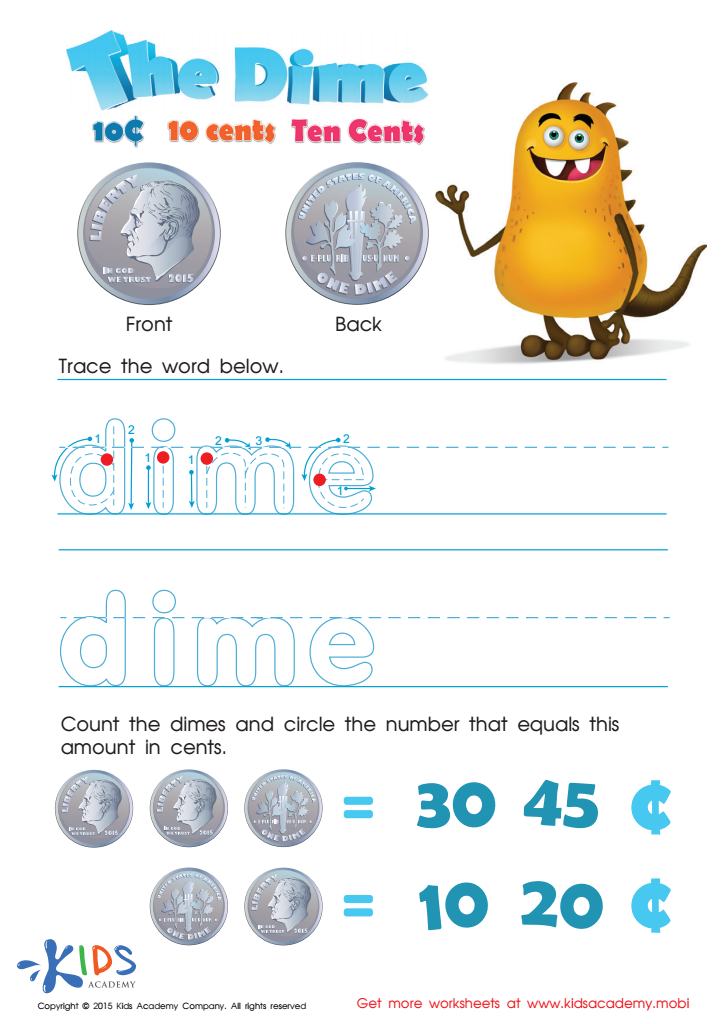
Ten Cents or the Dime Money Worksheet
 Assign to My Students








Normal worksheets on Coins for Ages 5-6 are an essential educational tool that serves a foundational role in the financial literacy journey of young learners. At this pivotal age, children are just beginning to understand the concept of money, its value, and its everyday use. By introducing Normal Coins worksheets specifically designed for 5 to 6-year-olds, educators and parents provide a platform that blends learning with fun, ensuring that the concepts of counting, identifying, and understanding the value of different coins are absorbed effectively.
These worksheets are created with the cognitive and motor skills of 5 to 6-year-olds in mind, featuring engaging activities that not only hold their attention but are also suitable for their developmental stage. Through sorting, matching, and even simple addition activities, children learn to recognize and differentiate between various coins, a skill that is crucial in everyday life.
Moreover, Normal Coins worksheets for Ages 5-6 lay down a vital foundation for future math skills. They introduce basic arithmetic in a relatable context, making the transition to more complex mathematical concepts smoother as children grow. In essence, these worksheets equip young minds with the ability to handle real-world situations involving money, making them an indispensable part of early childhood education.








