
Normal Arrays Worksheets for Ages 6-7
3 filtered results
Difficulty Level
Grade
Age
-
From - To
Subject
Activity
Standards
Introducing our engaging Normal Arrays Worksheets for ages 6-7 from Kids Academy! Designed specifically for young learners, these fun and educational worksheets help children grasp the concept of arrays, a fundamental building block for understanding multiplication and division. Each worksheet features vibrant illustrations and real-world scenarios, making learning enjoyable and relatable. Perfect for both classroom and home use, our downloadable and printable worksheets align with common core standards, reinforcing essential math skills. Watch your young mathematicians build confidence and excel in their studies with our well-crafted Normal Arrays Worksheets. Start exploring today!
Favorites
With answer key
Interactive
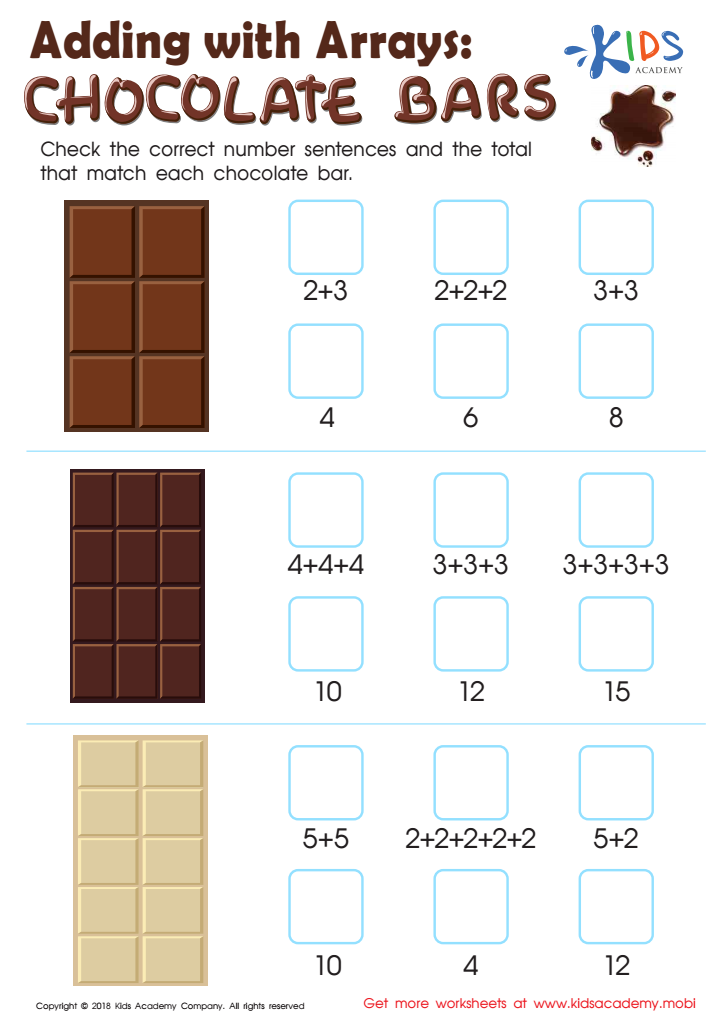
Adding with Arrays: Chocolate Bars Worksheet
Kids love chocolates! Gauge how enthused your kids get when you mention them. This worksheet is a fun exercise about chocolates - get your kids to check the correct number sentences and totals for each chocolate bar. Reward their hard work with some chocolates - extra incentive for a job well done!
 Assign to My Students
Adding with Arrays: Chocolate Bars Worksheet
Worksheet
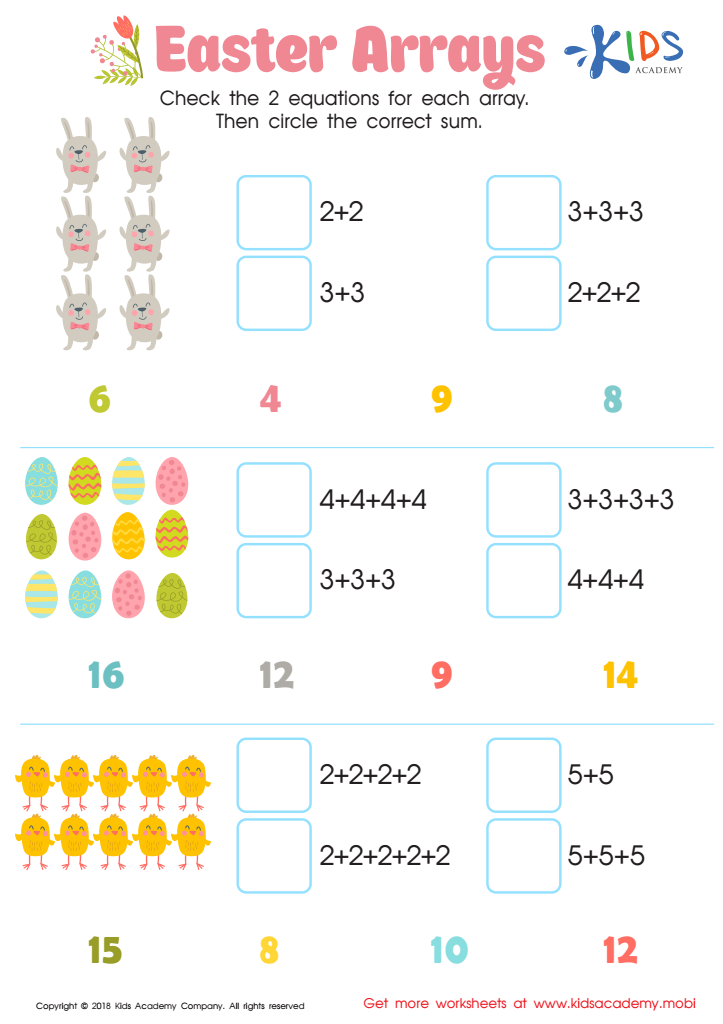
Easter Arrays Worksheet
Does your child love Easter? Do they adore the Easter bunny and egg hunts? Help them have fun with this worksheet! Go through it with them and check the equations for each array. Then, have them circle the correct sum. It's a great way to make the holiday extra exciting!
Easter Arrays Worksheet
Worksheet
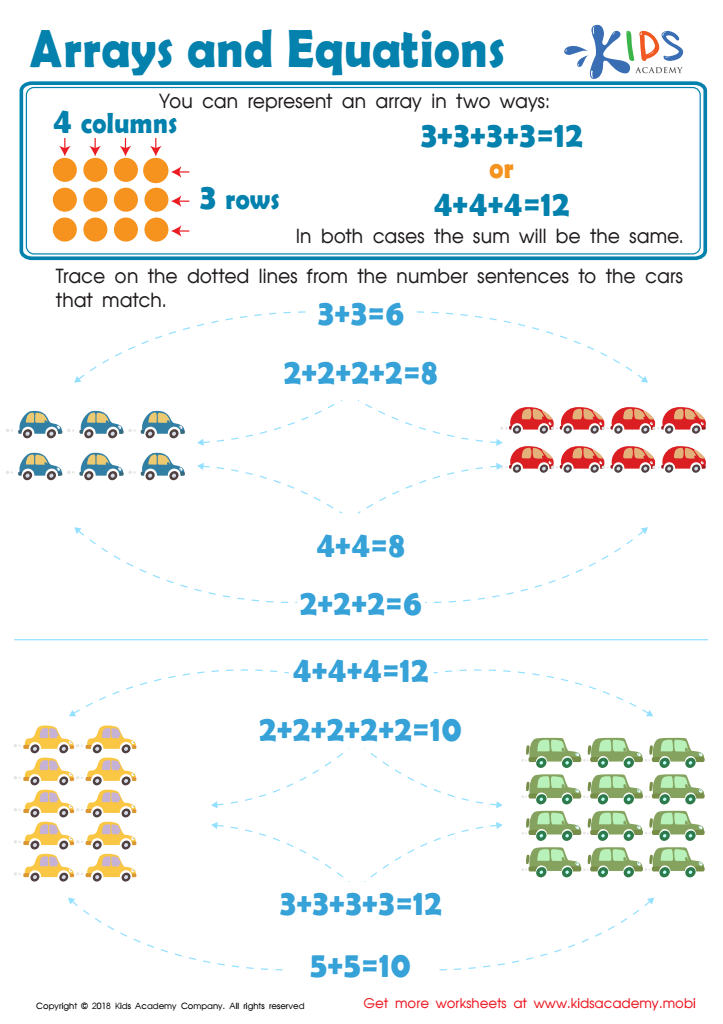
Arrays and Equations Worksheet
An array is objects, pix, or numbers organized in rows and columns. Show kids two ways to interpret this: 3 rows in 4 places = 12 and 4 columns in 3 places = 12. Help your child trace the number sentences to the matching cars. All equations always add up to the same amount.
Arrays and Equations Worksheet
Worksheet
Join Kids Academy for Free
Who is primarily going to use this learning content?








Normal arrays, or organized rows and columns of objects or numbers, are incredibly beneficial for children ages 6-7 because they help develop foundational math skills. At this age, children are beginning to understand concepts such as addition, subtraction, multiplication, and patterns. Using normal arrays makes these abstract concepts more concrete.
Firstly, arrays provide a visual representation of mathematical operations. For instance, if a teacher needs to demonstrate 3 rows of 4 apples for a multiplication problem (3x4), an array helps students clearly see and count the total number of apples. This visual aid builds a stronger conceptual understanding of what multiplication actually represents.
Moreover, arrays are instrumental in teaching the basics of grouping, which is pivotal for understanding multiplication as repeated addition. By arranging objects into groups, children can easily practice counting, grouping, and adding, which strengthens their number sense.
Additionally, working with arrays helps children recognize patterns and improves their spatial reasoning. Both these skills are essential not only in math but also in fields like science, technology, and engineering.
For parents and teachers, incorporating arrays into learning activities fosters a hands-on, interactive environment that can enhance a child’s engagement and motivation in learning math. By caring about normal arrays, educators and parents lay down a strong mathematical foundation, paving the way for more advanced problem-solving skills in the future.








