Map reading skills Science Worksheets
1 filtered results
-
From - To
Enhance your child's map reading skills with our engaging Science Worksheets! Designed for early learners, these worksheets provide fun activities that foster essential spatial awareness and critical thinking abilities. Through interactive exercises, students will explore various map components, including legends, symbols, and scales, enabling them to interpret and navigate information effectively. Our thoughtfully crafted materials support classroom learning and home study, making geography an exciting subject. Discover a variety of printable resources that will inspire curiosity and enhance your child's understanding of the world around them. Perfect for teachers and parents alike, our worksheets promote both educational growth and enjoyment!
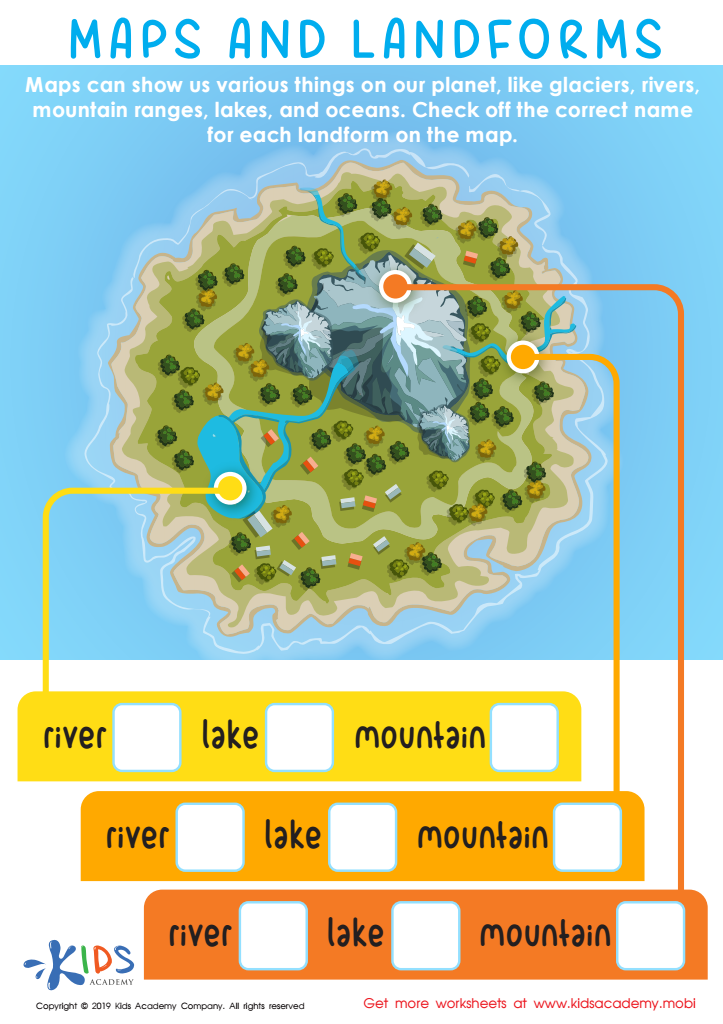
Maps and Landforms Worksheet
 Assign to My Students






Map-reading skills are essential for students as they develop critical thinking, spatial awareness, and problem-solving abilities, all of which are foundational aspects of scientific learning. Parents and teachers should prioritize these skills because they enhance a child's ability to understand and interpret the world around them. In science, students often need to analyze data represented in maps—whether they're studying ecosystems, weather patterns, or geological features.
Furthermore, skilled map reading promotes independence and confidence. Children learn not only to navigate physical spaces but also to grasp abstract concepts like distance, direction, and scale, which are vital in fields like geography, biology, and environmental science. As students engage with maps, they cultivate observational skills and learn to make connections between different data points, fostering a deeper sense of inquiry.
Incorporating map-reading into science lessons can stimulate interest in subjects such as environmental studies, urban planning, and astronomy. By nurturing these skills, parents and teachers lay the groundwork for informed and engaged future citizens who can understand and participate in discussions about societal and environmental issues based on geographic context. Ultimately, investing in map-reading skills enriches a child's educational experience and prepares them for real-world challenges.







