
Map reading skills Our Planet and Environment Worksheets
1 filtered results
Difficulty Level
Grade
Age
-
From - To
Subject
Activity
Standards
Enhance your child's map reading skills with our engaging "Our Planet and Environment" worksheets! Designed for early grade learners, these worksheets introduce essential map literacy, including understanding symbols, scales, and directions. Students will develop critical thinking and spatial awareness while exploring various environments and geographical features. Through interactive activities, they will analyze different types of maps, helping them connect classroom learning to the real world. Perfect for teachers and parents seeking to enrich their child's science and geography education, these worksheets make learning about our planet fun and interactive. Dive into the world of maps today and watch their confidence grow!
Favorites
With answer key
Interactive
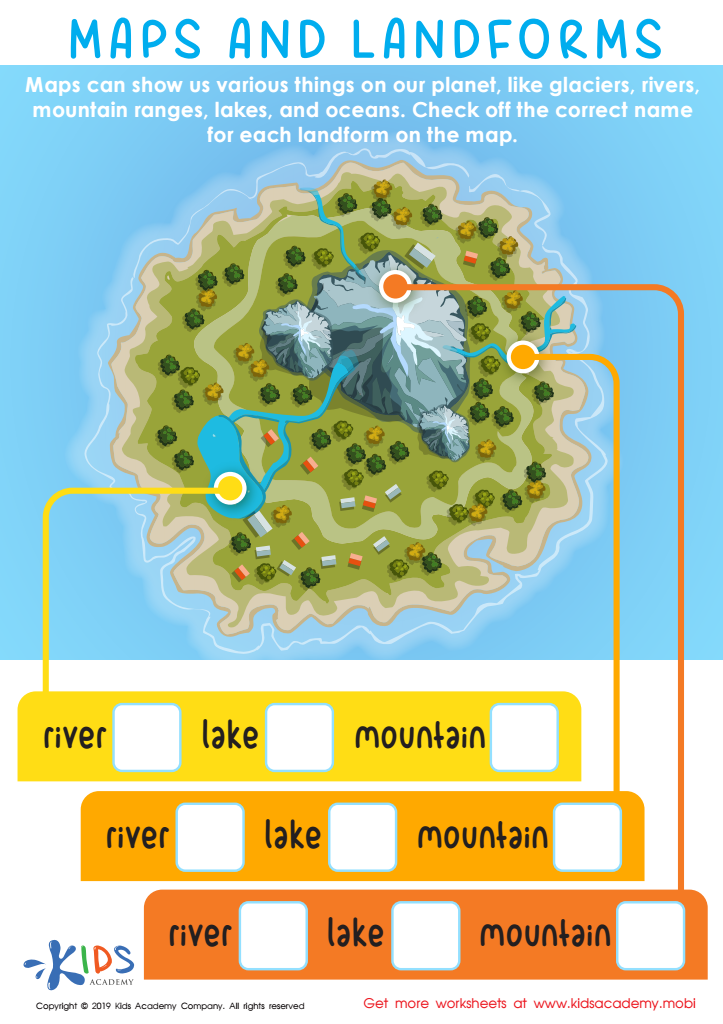
Maps and Landforms Worksheet
We can educate our kids on the world and its landforms by showing them a map. Point out mountains, rivers, and oceans, and help them identify each correctly. With this knowledge, they will better understand our planet.
 Assign to My Students
Maps and Landforms Worksheet
Worksheet
Join Kids Academy for Free
Who is primarily going to use this learning content?




Map reading skills are essential for both parents and teachers to foster in children, especially concerning understanding our planet and environment. Proficiency in map reading helps children develop a sense of spatial awareness, geographical literacy, and critical thinking skills. Engaging with maps allows students to visualize their surroundings, understand locations, distances, and the relationships between various ecosystems.
Furthermore, understanding map reading can instill a sense of responsibility and awareness about environmental issues. For instance, when children can read and interpret maps, they can grasp vital concepts such as land use, urban planning, and conservation efforts. This awareness can inspire them to become stewards of the environment, as they learn how human activities impact their local and global landscapes.
Incorporating map reading into education highlights the significance of environmental protection. Parents and teachers play a crucial role in shaping children’s attitudes toward nature. By teaching children to navigate and understand their environment through maps, they enhance their appreciation for natural resources and the need to protect them. In a world increasingly affected by climate change and urbanization, cultivating map reading skills in young learners can lead to informed, environmentally aware citizens who are conscious of their role in preserving the planet.







