Enhances critical thinking Grade 3 Math Worksheets
3 filtered results
Difficulty Level
Grade
Age
-
From - To
Subject
Activity
Standards
Enhance your third grader's critical thinking skills with our engaging Grade 3 Math Worksheets. Designed to challenge young minds, these worksheets encourage problem-solving through real-world scenarios and critical analyzing of mathematical concepts. Students will explore patterns, devise strategies, and apply mathematical reasoning to a variety of fun activities. Each worksheet promotes collaborative learning, enabling students to work together while developing essential skills needed for advanced math concepts. With colorful visuals and age-appropriate tasks, our worksheets make learning enjoyable and effective. Equip your child with the tools they need to think analytically and approach math challenges with confidence. Explore our collection today!
Favorites
With answer key
Interactive
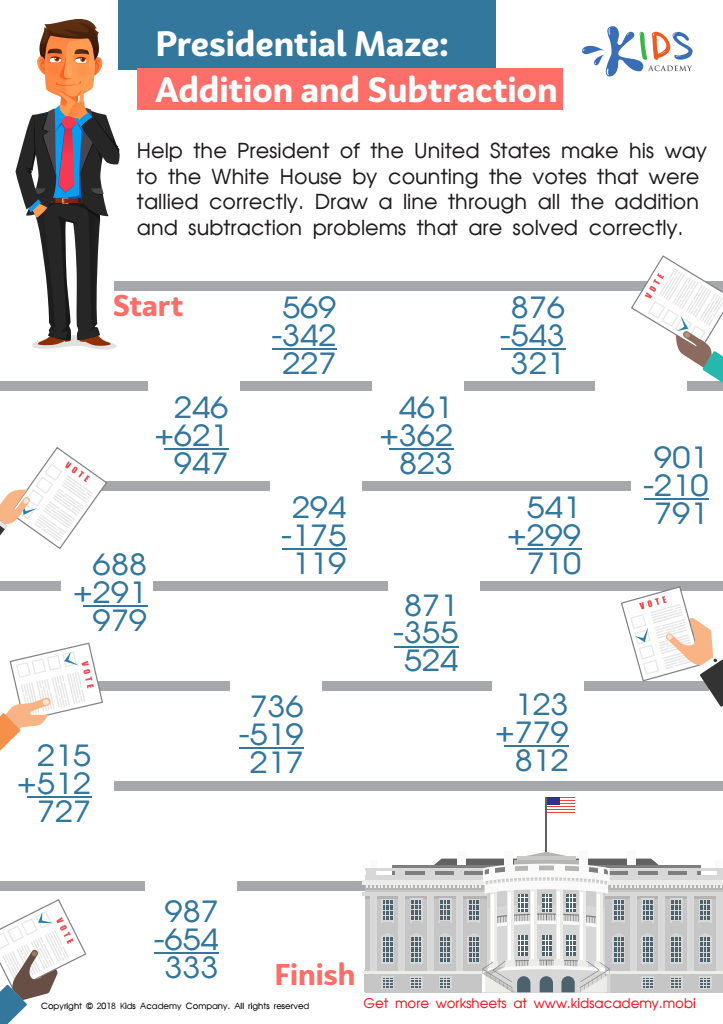
Presidential Maze: Addition and Subtraction Worksheet
Help the President get elected by counting the votes on this fun addition and subtraction worksheet from Kids Academy! Guide learners to go through each problem, drawing a line through any that are completed correctly and leaving incorrect answers alone. Get voting and have a blast!
 Assign to My Students
Presidential Maze: Addition and Subtraction Worksheet
Worksheet
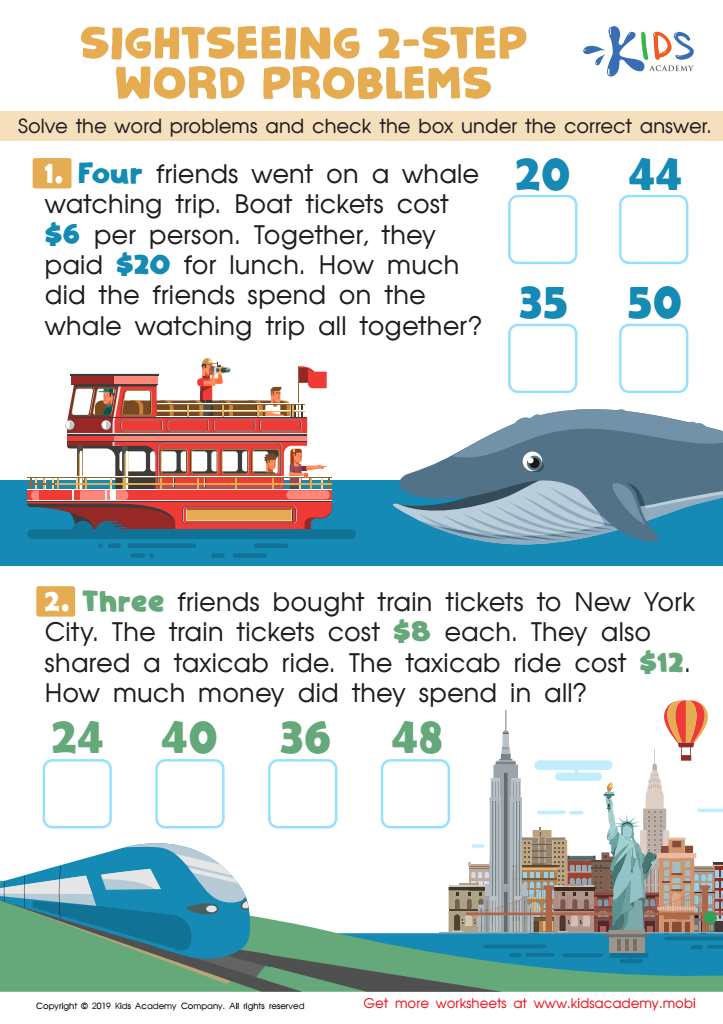
Sightseeing 2-Step Word Problems Worksheet
Help your kids tackle word problems with this PDF! Read aloud two simple problems, have them create equations and solve, then check the box under the right answer. With practice, confusion will be a thing of the past.
Sightseeing 2-Step Word Problems Worksheet
Worksheet
Join Kids Academy for Free
Who is primarily going to use this learning content?








Enhancing critical thinking in Grade 3 math is vital for parents and teachers because it lays the foundation for problem-solving skills and logical reasoning that students will use throughout their academic and personal lives. At this age, children begin to transition from basic arithmetic to more complex concepts, which provides an ideal opportunity to foster analytical thinking. Encouraging critical thinking helps students understand why math works, not just how to compute answers.
When parents and teachers prioritize critical thinking, they empower students to approach problems with a curious mindset rather than simply memorizing processes. This approach nurtures a love for learning and encourages students to explore different ways to arrive at solutions, building resilience in facing challenges and fostering creativity in their thinking.
Moreover, as the global job market increasingly seeks individuals with strong analytical skills, equipping children with these abilities in early grades becomes imperative. Engaged learners are more likely to excel academically, leading to greater self-confidence and motivation. Ultimately, enhancing critical thinking in Grade 3 math helps produce well-rounded individuals capable of tackling complex real-world problems, making it a priority for both parents and teachers.