
Practicing addition Worksheets for Ages 5-8
7 filtered results
Difficulty Level
Grade
Age
-
From - To
Subject
Activity
Standards
Unlock the joy of learning with our engaging Practicing Addition Worksheets, designed specifically for children ages 5-8. These worksheets combine fun and education, suited for early learners eager to enhance their math skills. With a variety of colorful, interactive activities, kids can practice basic addition through relatable themes and visuals that capture their attention. Each worksheet fosters problem-solving abilities and builds a solid foundation in math, making learning enjoyable. Perfect for classroom or home use, these resources cater to different learning styles, ensuring every child can thrive. Download now and watch your child develop confidence in addition!
Favorites
With answer key
Interactive
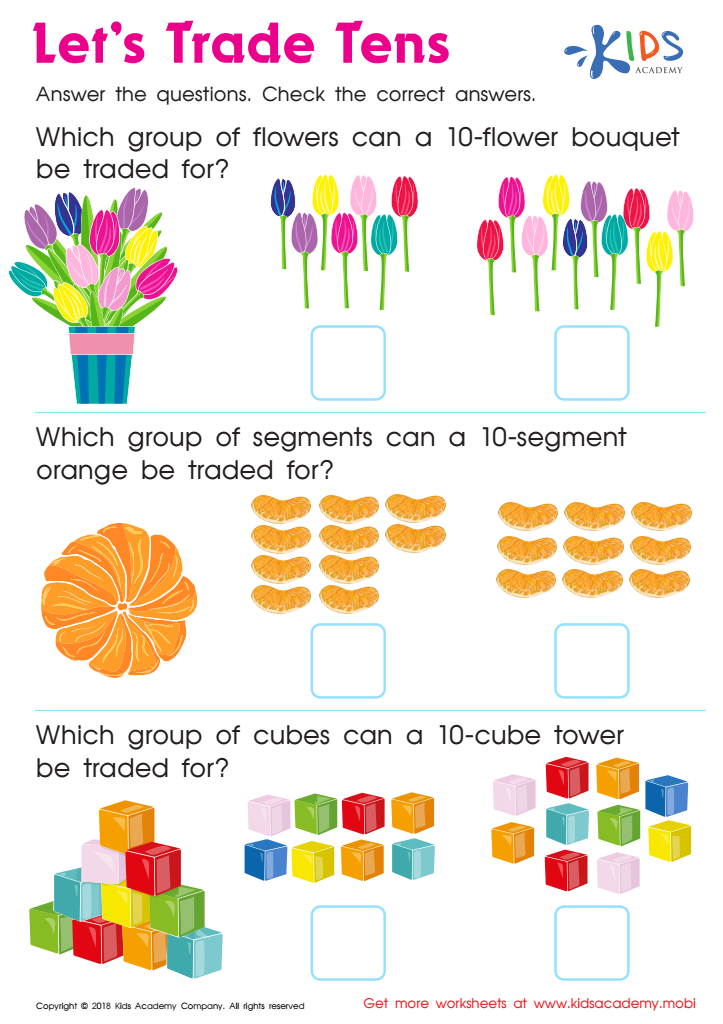
Lets Trade Tens Worksheet
This free worksheet strengthens counting and logic skills. Kids will enjoy exchanging flowers for bouquets, orange slices for a whole fruit, and cube towers for individual cubes. Combining numbers and problem solving is essential for first grade math. Seeing two options helps them understand how 10s look.
 Assign to My Students
Lets Trade Tens Worksheet
Worksheet
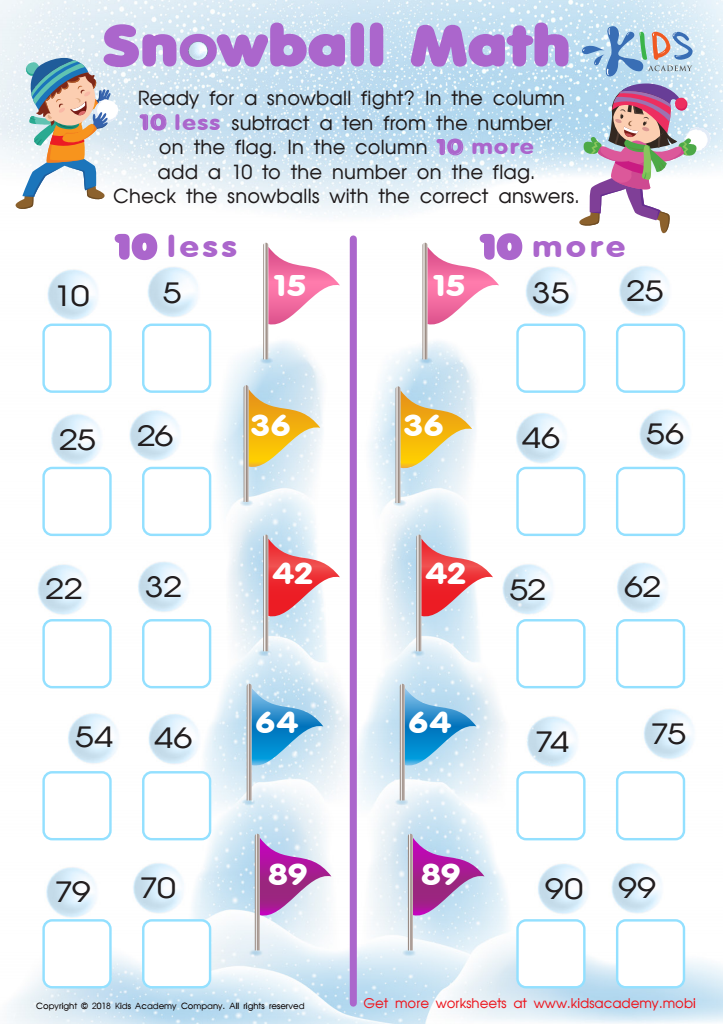
Snowball Math Worksheet
Kids can have a snowball fight and build math skills at the same time with this free worksheet. Kids can use tens to add and subtract for quick math equations and select the correct answers. No need to worry about getting cold either - these snowballs won't chill you!
Snowball Math Worksheet
Worksheet
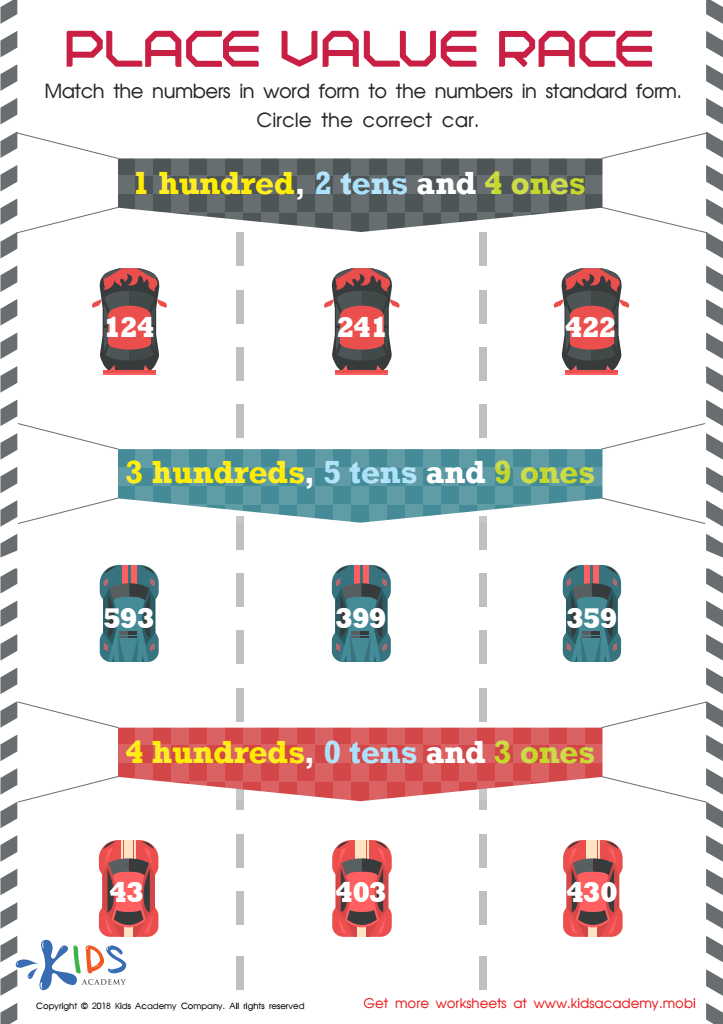
Place Value Race Worksheet
Teach your child to count, then write numbers in word form and back to standard form. In this worksheet, they'll match the numbers written in word form to their standard form and circle the correct car with the correct answer.
Place Value Race Worksheet
Worksheet
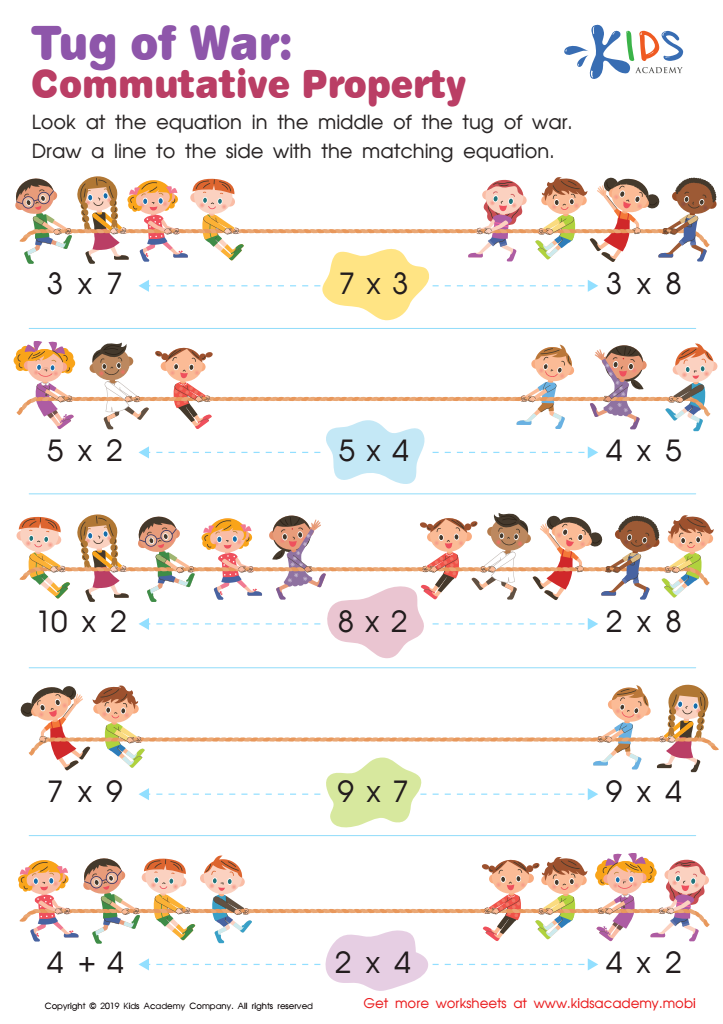
Tug of War: Commutative Property Worksheet
Tug of war is a great game to teach your child simple math. Explain the commutative property--it states that the product remains the same regardless of the order of factors. Use the equations in the middle of the worksheet and have your child draw a line to the corresponding equation. It's a fun and easy way to learn math.
Tug of War: Commutative Property Worksheet
Worksheet
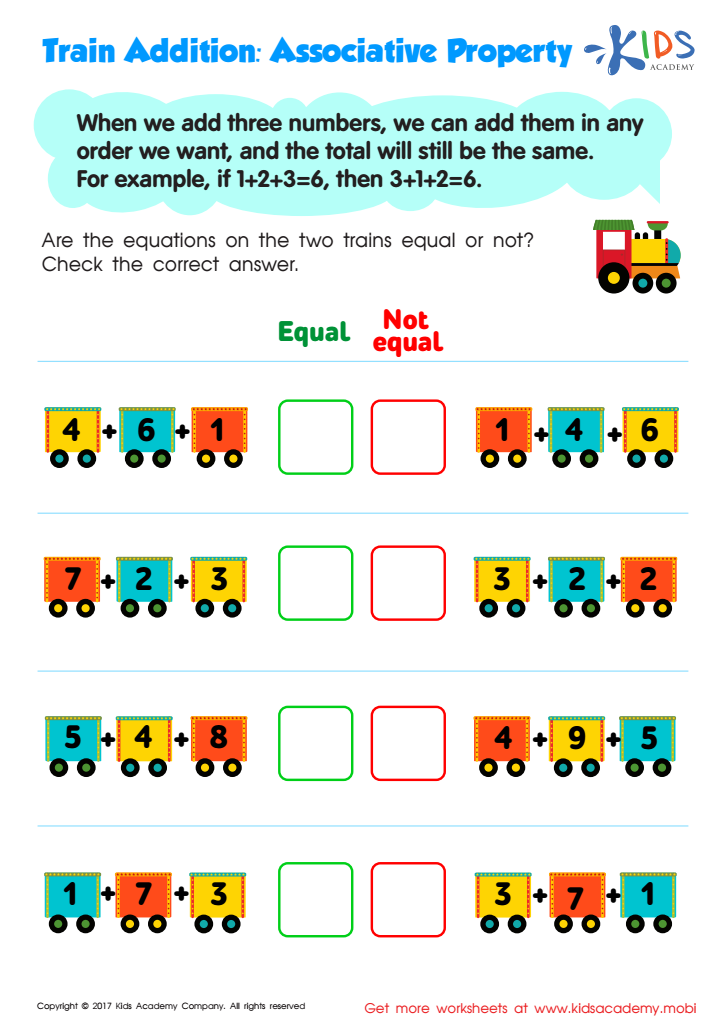
Train Addition: Associative Property Worksheet
The associative property of addition lets us add numbers in any order. Total will remain the same. Help kids practice this pre-algebra skill with a train-themed worksheet. It will help them understand if the equations are equal using this property.
Train Addition: Associative Property Worksheet
Worksheet
Join Kids Academy for Free
Who is primarily going to use this learning content?







Practicing addition for children aged 5 to 8 is critical for several reasons. First and foremost, it lays the foundation for all future mathematics. At this stage, students begin to develop essential number sense, which helps them understand relationships between numbers, patterns, and the concept of quantity. Mastering basic addition skills fosters confidence in young learners, allowing them to engage more freely with math tasks without fear of failure.
Additionally, practicing addition encourages cognitive development. Counting and calculating strengthen a child’s critical thinking, problem-solving abilities, and analytical skills, which are necessary in various subjects beyond math. Regular practice through engaging activities—such as games, songs, or visual aids—can make learning fun and interactive, keeping children motivated.
Furthermore, proficiency in addition aids in daily life skills. Whether it’s handling money, measuring ingredients in cooking, or sharing items, foundational math skills are essential. Lastly, for parents and teachers, nurturing these skills provides insight into a child’s learning style and areas needing support, allowing for targeted assistance. In essence, prioritizing addition practice is not just about arithmetic—it fosters a love for learning and equips children with lifelong skills.








